The art of the home
Lighting a conservatory: the room where artificial light comes second
Published on ·3 min read
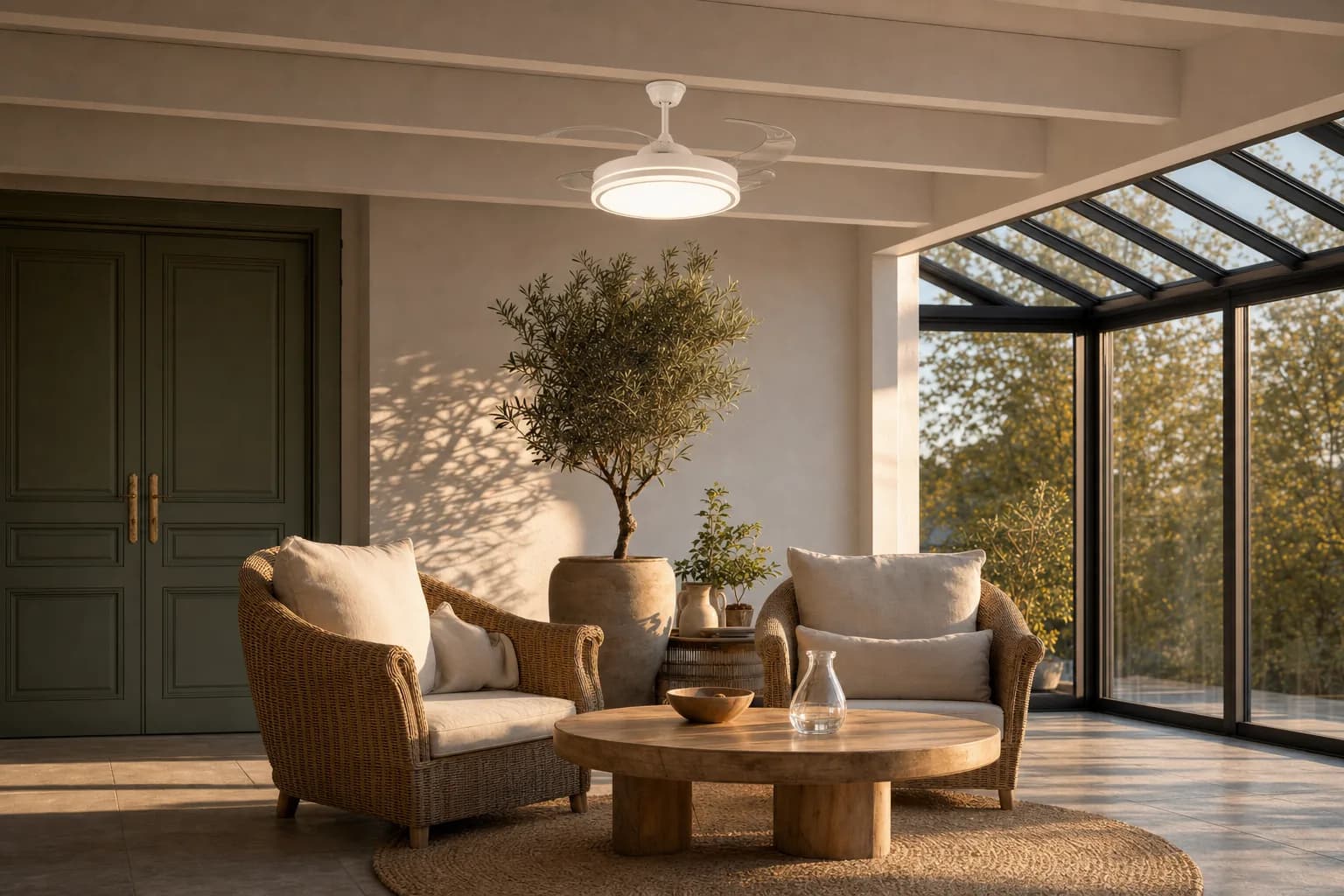
A conservatory is a room apart: bathed in daylight during the day to the point of making any lighting pointless, then completely dark from dusk, without the walls that bounce light back elsewhere in the house.
Those three particularities change what you should look for overhead.
From broad daylight to complete darkness
No other room knows such a gap. At midday, a conservatory receives more light than it needs. At eight in the evening it receives none, and the panes bounce nothing back. The transition is abrupt and happens every day.
That is what makes dimming more useful here than anywhere else: you rarely switch on at full power, but you need capacity on winter evenings. A fixed luminaire will always be too strong or too weak.
More lumens than elsewhere, at equal area
In a conventional room, a large share of the light bounces off the walls and ceiling before reaching the eyes. In a conservatory the walls are glass: light passes through and is lost outside.
Count roughly twenty per cent more than the usual benchmark, that is 120 to 180 lumens per square metre. And favour a luminaire that also lights upward, so the little opaque surface available, the ceiling, does some work.
- ·120 to 180 lumens per square metre, against 100 to 150 elsewhere
- ·Dimming indispensable, the day-night gap being at its maximum
- ·Opal diffuser, so it is not seen in the panes
- ·Plan for summer heat as much as for winter light
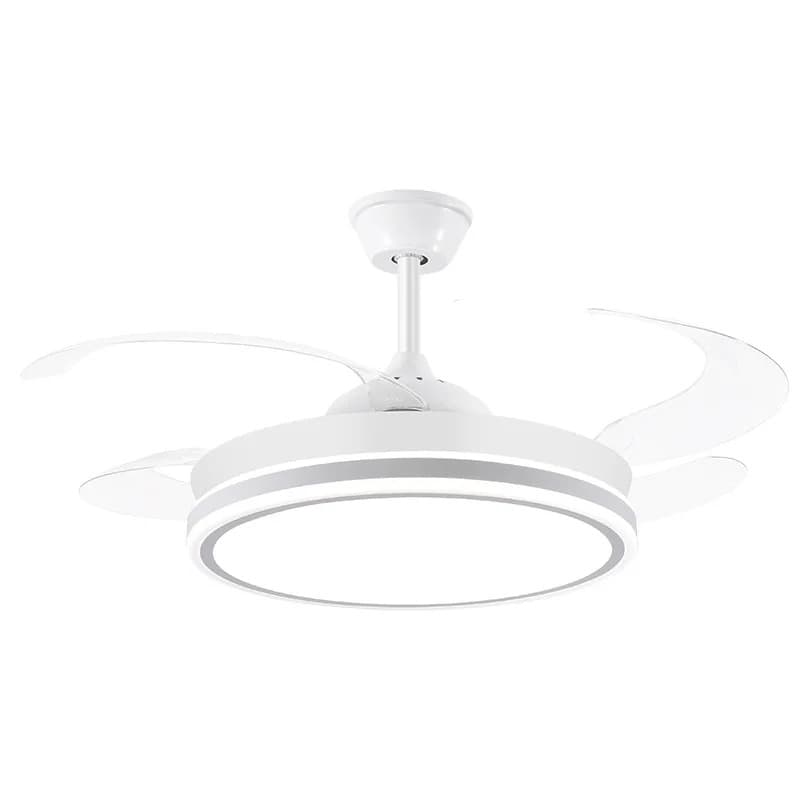
The Boréal 107
Retractable blades · Ø 107 cm · LED ceiling light & silent fan
- ✓Retractable blades: invisible when off, nobody guesses it's a fan
- ✓Sleep with windows closed, 30 dB, quieter than a whisper
- ✓Integrated LED 2700K → 6000K, dimmable: replaces your ceiling light
At night, the panes become mirrors
As soon as night falls, every glazed surface reflects the image of the room, and first of all that of the luminaire. A bare source, or one behind a clear diffuser, is duplicated in every panel, which is as unpleasant as direct glare.
An opal diffuser solves that: it spreads the light across the whole surface of the luminaire, and its reflection in the glass becomes a soft patch instead of a bright point. It is the criterion most specific to this room.
Heat, the other subject
A conservatory is the most exposed room in a house: glazed roof and walls, often south-facing, and very little thermal mass. It can run ten degrees above the rest of the home on a summer afternoon, which makes it unusable exactly when it should be enjoyed.
The ceiling is often the only free location there, the walls being glass and the floor occupied. That makes this fixing point doubly useful: a model that lights and moves air renders two services where no other equipment finds room.
In a conservatory, count twenty per cent more lumens than elsewhere, insist on dimming and an opal diffuser so the luminaire is not duplicated in the panes. And remember that the ceiling is the only free surface there: it may as well serve in summer too, when the room becomes too hot to use.
Frequently asked questions
How many lumens for a conservatory?+
120 to 180 lumens per square metre, roughly twenty per cent more than a conventional room. Glazed walls do not bounce light back, it is lost outside instead.
Why can you see the luminaire in the glass at night?+
Because a pane becomes a mirror as soon as it is darker outside than in. An opal diffuser turns that reflection into a soft patch rather than a bright point.
How do you cool a conservatory in summer?+
External shading is the most powerful lever, because it stops radiation before the glass. Air movement comes next, and the ceiling is often the only free location to provide it.
The SEY Maison Circle
Every month, an exceptional piece. Never reissued.
The Drops principle: one high-end furniture piece per month, in a numbered edition. Once it's gone, it never comes back. Circle members are notified 48 h early, access each drop 24 h before everyone else, and receive our guides before publication.
Discover the Drops →