Interior design
CRI: the number that explains why your colours change at night
Published on ·3 min read
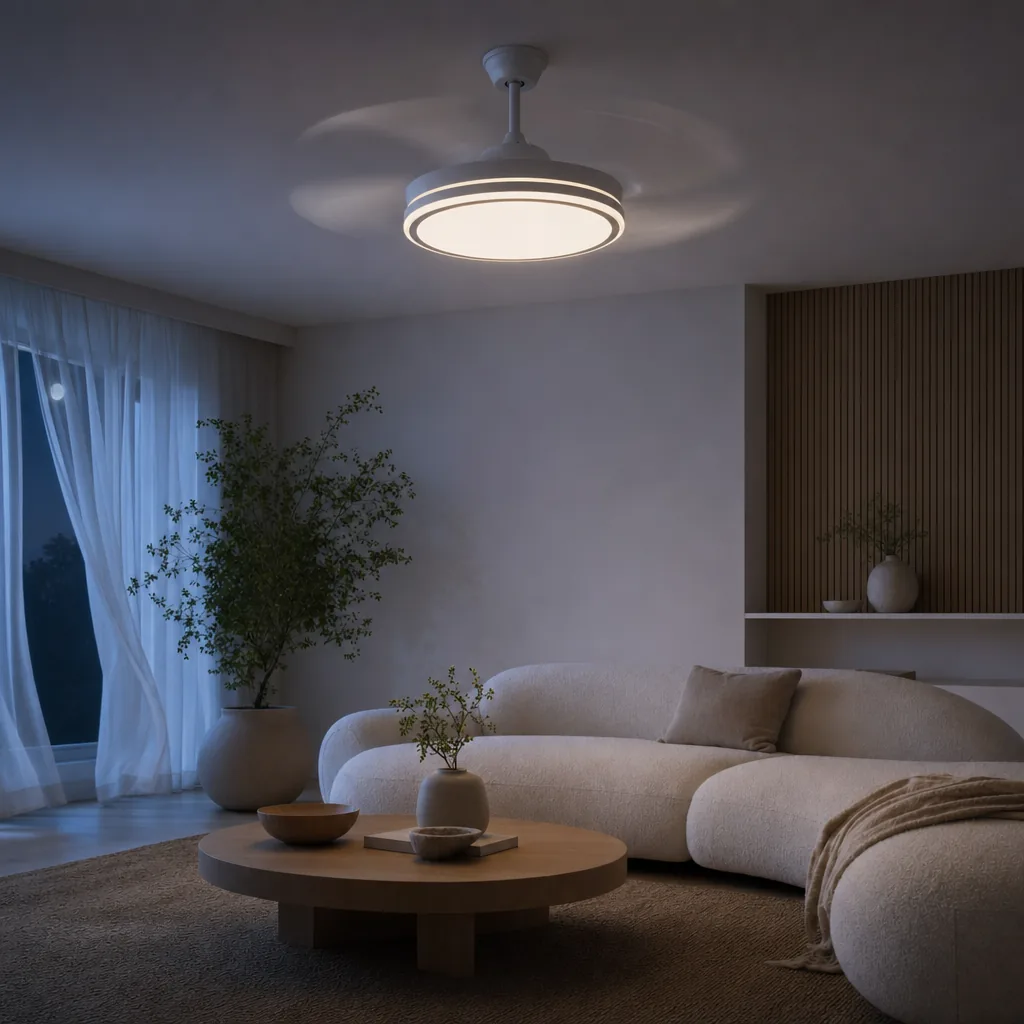
You chose a sofa in a shop, a wall colour on a swatch, a floor from a sample. Back home in the evening, nothing looks quite the same shade. The paint gets blamed, or the salesperson, or tired eyes. The culprit is almost always the light on the ceiling.
What is being measured there is the colour rendering index, the CRI. It is the most useful figure on a lighting spec sheet, and the one most often missing.
What CRI measures, and what it does not
A light source does not emit all wavelengths equally. If red is missing from its spectrum, a red object has nothing to send back and looks dull. CRI scores that faithfulness from 0 to 100, taking daylight as the reference at 100.
It says nothing about the quantity of light, measured in lumens, nor about its tint, measured in kelvins. A light can be warm and false, cold and faithful. The three figures are read together, and CRI is the one that decides whether colours are true.
- ·CRI below 80: flat reds, greyed wood, dull complexions
- ·CRI of 80 to 90: acceptable, the gap still shows on textiles
- ·CRI above 90: colours are the ones seen in daylight
- ·CRI is independent of kelvins: check both separately
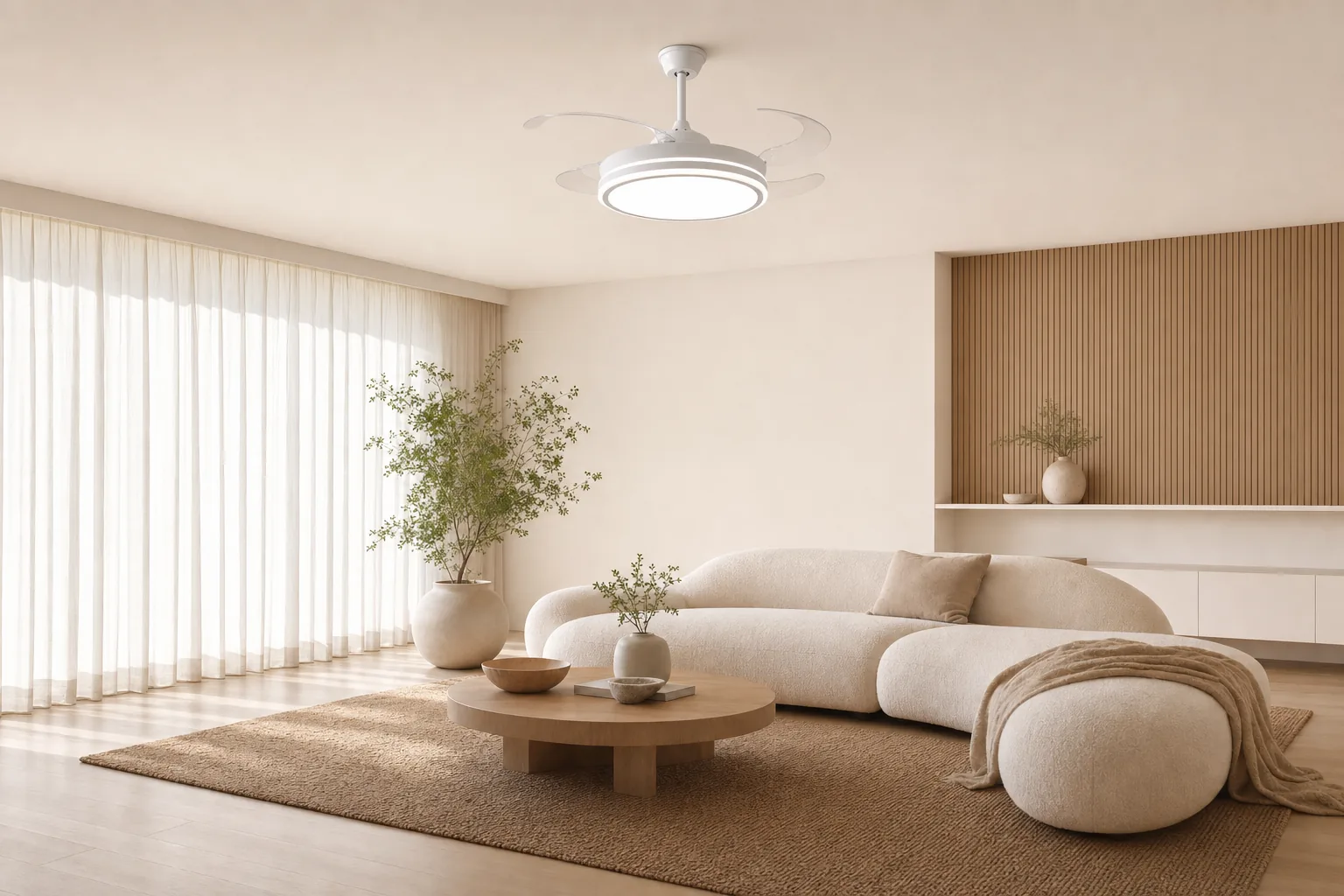
The Boréal 107
Retractable blades · Ø 107 cm · LED ceiling light & silent fan
- ✓Retractable blades: invisible when off, nobody guesses it's a fan
- ✓Sleep with windows closed, 30 dB, quieter than a whisper
- ✓Integrated LED 2700K → 6000K, dimmable: replaces your ceiling light
Why so few manufacturers show it
Raising CRI costs more. It takes a fuller spectrum, so better LEDs, with a slightly lower light output for the same power. A manufacturer aiming at a low price prefers to advertise lumens and stay quiet about rendering.
In practice, the absence of the figure is an answer in itself. When a sheet gives power, kelvins and service life but skips CRI, it is unlikely to be flattering. The Boréal 107 states 97, which puts it at the level of demanding retail lighting.
Where it shows most
A living room with wood, leather or coloured textiles is where a low CRI is noticed immediately: materials lose their depth and look flat. A kitchen comes next, because you judge the cooking of a piece of meat or the freshness of a vegetable by eye.
Then a bathroom, where you look at yourself. Under a CRI of 75, a complexion looks grey and make-up chosen in the evening bears no resemblance to anything outdoors the next day. It is the same problem as a badly lit fitting room.
CRI is the only figure that tells you whether your lighting shows your home as it is. Look for 90 at minimum, and treat its absence from a spec sheet as a bad sign. A ceiling light stays up for ten years: it may as well do justice to what it lights for all that time.
Frequently asked questions
What is a good CRI?+
Above 90 for a living space, where you judge materials and colours. Between 80 and 90 remains acceptable in a hallway or garage. Below 80, shades are visibly distorted.
Does CRI change with colour temperature?+
No, they are independent measurements. A 2700K light can have a CRI of 70 or of 97; overall tint and colour faithfulness cannot be deduced from one another.
How do I find the CRI of a bulb I already own?+
It is sometimes printed on the base or the packaging, often noted as Ra followed by a number. If it cannot be found, it is usually because it is not flattering: manufacturers gladly display a good figure.
Does a high CRI consume more?+
Slightly, at equal brightness, because a fuller spectrum is a little less efficient in lumens per watt. The gap is a few watts, nothing next to the difference in rendering.
The SEY Maison Circle
Every month, an exceptional piece. Never reissued.
The Drops principle: one high-end furniture piece per month, in a numbered edition. Once it's gone, it never comes back. Circle members are notified 48 h early, access each drop 24 h before everyone else, and receive our guides before publication.
Discover the Drops →