Ceiling fan on a stretch ceiling: is it possible?
Published on ·8 min read

You have a stretch ceiling, or you are about to have one installed, and you want a ceiling fan in the centre of the room. The membrane is perfectly smooth, stretched from wall to wall, and it is hard to see how a rotating appliance could hang from it. The question comes up often, and it has a clear answer.
Yes, it is possible, and it is done routinely for light fittings. But the fan never hangs from the membrane: it hangs from the original ceiling, through it. Everything depends on the reinforcement installed behind, and on when it is installed. This article separates the new stretch ceiling from the existing one, lists the points to have confirmed by the fitter, and says which kind of model keeps the constraints down.
What a stretch ceiling is, and why it carries nothing
A stretch ceiling is a membrane, in PVC or polyester, stretched over a frame of profiles fixed at the top of the walls. Between the membrane and the original ceiling there is a void of a few centimetres. The membrane is held only at its edges: in the middle of the room it rests on nothing.
It is made to be beautiful and flat, not to carry loads. A screw driven into the membrane tears it, a hanging weight deforms it. Everything fitted under a stretch ceiling, from a simple spotlight to a chandelier, is therefore fixed to the original ceiling by an intermediate part, and the membrane is only pierced cleanly at that spot.
For a fan the principle is the same, with one more requirement: the intermediate part must be rigid, because the unit rotates and vibrates slightly. A compact model weighs 4 to 6 kg, a large 132 cm model 8 to 10 kg.
The solution: a reinforcement plate fixed to the original ceiling
The reinforcement is a plate, in wood or another rigid material, fixed to the original ceiling by adjustable rods or brackets. It is lowered until its underside sits exactly at the level of the future membrane. The fan bracket is screwed into this plate, through the membrane.
On the membrane side, the fitter glues a reinforcement ring around the position, then cuts the membrane inside the ring. The ring stops the cut from running. The cable passes through this opening, so do the bracket screws, and the fan's canopy covers the whole thing.
Two conditions for the assembly to hold. The plate must be anchored in something solid, a concrete slab or a joist, not in old crumbling plaster. And it must be wide enough to take the whole fan bracket, with its screw points. Those are the two pieces of information to give the fitter.
- ·Rigid plate anchored in the slab or joists of the original ceiling
- ·Underside of the plate exactly level with the membrane
- ·Reinforcement ring glued to the membrane before cutting
- ·Fan bracket screwed into the plate, never into the membrane
New stretch ceiling: everything is decided before the membrane goes up
If the stretch ceiling is not yet installed, you are in the simple case. The fitter installs the reinforcement plates before stretching the membrane: it is their usual work for every light fitting. They only need to know, before installation day, that this one is a fan and not a ceiling light.
Give them the exact position, the weight of the unit, the dimensions of the bracket and the spacing of its screws, which you can take from the unit or its manual. Tell them too that the unit rotates: they will choose the plate and its anchoring accordingly. Ideally, have the fan on site the day the membrane is fitted.
Use the opportunity to have the electrical supply checked. The cable has to reach the plate before the membrane closes the ceiling. With a remote-controlled fan, a simple supply is enough, with no extra control wire to a switch.
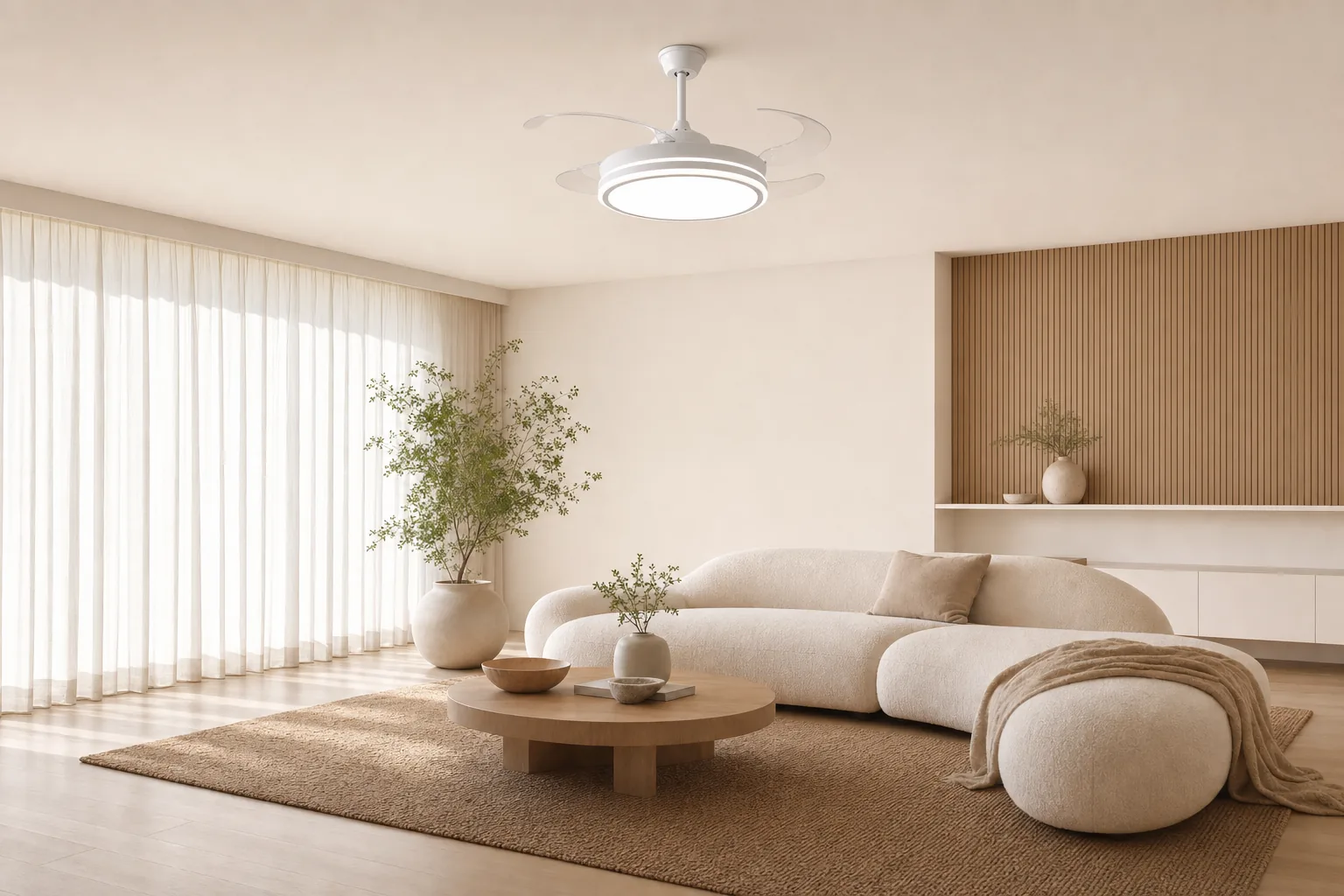
The Boréal 107
Retractable blades · Ø 107 cm · LED ceiling light & silent fan
- ✓Retractable blades: invisible when off, nobody guesses it's a fan
- ✓Sleep with windows closed, 30 dB, quieter than a whisper
- ✓Integrated LED 2700K → 6000K, dimmable: replaces your ceiling light
Stretch ceiling already in place: bring a fitter back
If the membrane is already up, a reinforcement cannot be slipped behind it without opening it. Two situations arise. If there is already a light fitting in the centre, there is already a plate: what remains is to find out whether it is strong and wide enough for a fan, which is checked by taking the light down, with the power off at the breaker.
If there is nothing, or if the existing plate is too light, the membrane has to be unhooked at least in part to reach the original ceiling. Depending on the type of membrane and the fixing system, this is possible or not, and the membrane re-tensions more or less well: only a stretch ceiling fitter can say, after seeing yours.
This is not a job to attempt yourself. A membrane unhooked badly gets marked or torn, and a damaged membrane cannot be patched like plasterboard. Ask the original fitter for a quotation if you know who it was: they know which system they installed.
Heat, vibration, airflow: the points to have confirmed
Three questions are for the fitter, because they depend on the membrane. The first is heat: PVC membranes are sensitive to hot sources placed close to them, which is why they are paired with lighting that gives off little heat. LED lighting built into the fan goes in the right direction, but have the compatibility confirmed.
The second is contact. No moving part may touch the membrane, and the canopy must rest on the reinforcement ring without pulling on the membrane. If the unit vibrates against the membrane, the noise spreads across its surface. A bracket tightened firmly on a rigid plate settles the matter.
The third is airflow. A stretched membrane can move with air movements in the room. Ask the fitter how yours behaves when air is being circulated, particularly in winter mode, when the fan pushes air towards the ceiling. The answer depends on the type of membrane and on how the void is ventilated.
Height: measure under the membrane
A stretch ceiling costs a few centimetres of height, sometimes more when it hides an uneven old ceiling. The safety rule is therefore checked under the membrane: at least 2.10 m between the floor and the bottom of the blades, with the unit assembled.
Under a common height, around 2.40 m to 2.50 m, that calls for a compact model mounted close to the ceiling. A model hanging from a 30 to 40 cm downrod brings the blades too low. Measure at the exact position, subtract the total height of the unit, and check that 2.10 m remains.
Check the distance to the walls as well, about 50 cm between the blade tips and the nearest wall, and the room left by the other elements set into the membrane: spotlights, ventilation grilles, access hatch.
Which model under a stretch ceiling
Under a membrane, the right model is the one that asks the least of the reinforcement and needs the fewest openings. Less weight means a simpler plate. Integrated lighting means one cut in the membrane instead of two, since the fan replaces the ceiling light.
The Boréal 107 follows that logic. It is a round ceiling light with four retractable blades, 107 cm in diameter with the blades extended, from the family of compact models. Its integrated dimmable LED offers three colour temperatures, from 2700 K to 6000 K: it lights the room and moves the air from a single point. Its copper motor is rated at 30 to 34 dB, with six speeds and a remote control included.
Switched off, blades folded, it reads as a light fitting, which suits the smooth surface of a stretch ceiling. Its winter mode is activated from the remote. A 107 cm diameter suits rooms up to about 15 m². One practical tip: have the plate approved by the fitter before installing the unit, because the 14-day right of withdrawal applies to a product that has not been installed.
A ceiling fan under a stretch ceiling is possible, on one condition that is not open to discussion: it is fixed to the original ceiling through a rigid reinforcement plate, and the membrane carries nothing. On a new ceiling, tell the fitter before installation and give them the weight and dimensions of the bracket. On an existing ceiling, bring them back: only they know whether the membrane can be opened and re-tensioned. Have heat, contact and the membrane's behaviour under airflow confirmed, check 2.10 m under the blades, and switch the power off at the breaker before any work on the light point. To keep constraints down, a compact model with integrated lighting such as the Boréal 107, with its 2-year warranty, needs only one reinforced point for both air and light.
Frequently asked questions
Can you install a ceiling fan on a stretch ceiling?+
Yes, if it is fixed to the original ceiling through a reinforcement plate placed behind the membrane. The membrane itself carries no load: it is only cut inside a reinforcement ring to let the fixing and the cable through.
Does the stretch ceiling have to be taken down to fit a fan?+
If no plate strong enough exists at the chosen position, the membrane has to be unhooked at least in part to install one. Depending on the membrane and its fixing system, that is possible or not. Only a stretch ceiling fitter can confirm it.
Can a fan damage the membrane of a stretch ceiling?+
Not if it is fixed to a rigid plate and no part touches the membrane. Have the fitter confirm that the lighting is compatible with the membrane and how it behaves when air is circulated, two points that depend on the type of membrane.
How much height do you need under a stretch ceiling for a fan?+
The rule is at least 2.10 m between the floor and the bottom of the blades, measured under the membrane. Under a common ceiling height, that leads to a compact model mounted close to the ceiling instead of one hanging from a downrod.
The SEY Maison Circle
Every month, an exceptional piece. Never reissued.
The Drops principle: one high-end furniture piece per month, in a numbered edition. Once it's gone, it never comes back. Circle members are notified 48 h early, access each drop 24 h before everyone else, and receive our guides before publication.
Discover the Drops →