Ceiling fan on a suspended ceiling: the fixing that holds
Published on ·9 min read
Your room has a suspended ceiling: tiles resting on a metal grid, or plasterboard hung from hangers, with a void above. You want to put a ceiling fan there, and you suspect that a few screws in a fibre tile will not be enough. You are right.
The rule fits in one sentence: a suspended ceiling dresses the room, it does not carry loads. The fan is fixed to the original structure, above the void, and the suspended ceiling simply lets the fixing pass through. This article explains how to identify what is above, which fixing holds over time, how to check the height, and which model suits a lowered ceiling.
Why a suspended ceiling carries nothing
A suspended ceiling is a second ceiling, hung below the first on hangers. The frame, made of thin metal profiles, is designed to carry the tiles or boards, a little insulation and light fittings. It is not designed for a concentrated load of several kilos that rotates.
And a fan is not a light fitting. A compact model weighs 4 to 6 kg, a large 132 cm model 8 to 10 kg, and above all it vibrates slightly in use, thousands of times an hour. A fixing that holds at rest can loosen over time if it is set in a material that flexes. A hung frame flexes: that is its nature.
This case must be told apart from a plasterboard ceiling screwed under joists, or under rails that are themselves fixed to the structure: there, you can aim for the joist or the rail. As soon as there is a void and hangers, you go all the way up.
Looking above: the void and the original structure
Before buying anything, you need to know two things: the height of the void between the suspended ceiling and the original ceiling, and what that original ceiling is made of. With tiles it is simple: lift one and look, torch in hand. With plasterboard, go through an access hatch, or through the opening of a recessed light, with the power off at the breaker.
Above, you will find one of three cases. A solid concrete slab: the most favourable, taking metal anchors suited to concrete. Timber joists: you screw into them after pilot drilling. A beam-and-block floor with hollow blocks: the anchor must go into a beam or use fixings made for hollow materials, and this is the case where professional advice is most useful.
Measure the height of the void at the planned spot, and note what is already there: electrical conduits, ventilation ducts, pipes. The fixing point must fall in a clear area.
- ·Height of the void between the suspended ceiling and the original ceiling
- ·Type of original ceiling: solid concrete, timber joists, beam and hollow block
- ·Obstacles in the void: conduits, ducts, pipes
- ·An electrical supply nearby
The fixing that holds: anchor, threaded rod, plate
The principle is always the same. At the top, an anchor in the structure: metal anchors in concrete, coach screws in timber. In between, one or more threaded rods crossing the void. At the bottom, level with the suspended ceiling, a rigid plate to which the fan bracket is screwed. The suspended ceiling is simply cut where the fixing passes, and the fan's canopy covers the cut.
Two details make the difference. The first is rigidity: a single long rod can sway. The deeper the void, the more you need an assembly that does not move, with several rods set apart or a rigid support. The second is tightening: the nuts on a threaded rod exposed to vibration must be locked with lock nuts, otherwise they work loose.
The plate must neither rest on the suspended ceiling's frame nor pull it upwards: it sits flush, nothing more. Once the unit is fitted, run it at full speed for a minute, then retighten everything after a week of use.
- ·Anchor in the structure: metal anchors in concrete, coach screws in timber
- ·Threaded rods locked with lock nuts
- ·A rigid assembly that does not sway, even with a deep void
- ·Plate level with the suspended ceiling, independent of its frame
The Horizon 132
Ultra-flat · Ø 132 cm · Made for low ceilings
- ✓Flush-mount profile: ideal under 2.40 m ceilings
- ✓Large 132 cm diameter, covers up to 30 m²
- ✓Reversible blades, light or dark wood finish
€309€389
Tiles or plasterboard: what changes
With a tiled suspended ceiling, often in a 60 × 60 cm format, the job is at its most accessible: remove the tiles around the chosen point, work in the void at arm's length, then put the tiles back. The tile crossed by the fixing is cut in its centre; it can also be replaced by a rigid panel of the same size, which looks neater around the canopy.
One point to watch with lightweight tiles: the airflow from the fan can make them rattle if they simply rest on the grid. If that happens after installation, hold-down clips keep them still.
With plasterboard, access is harder, since nothing comes apart. Either an access hatch exists nearby, or the ceiling has to be opened, the fixing installed, then the ceiling closed and refinished. That is why, on a plasterboard suspended ceiling, the job usually goes to an equipped professional.
Height: the trap of the lowered ceiling
A suspended ceiling has almost always cost the room some height. Yet the safety rule does not move: at least 2.10 m between the floor and the bottom of the blades. The calculation is a subtraction: height under the suspended ceiling, minus the total height of the unit, equals height under the blades.
With a downrod model, which hangs 30 to 40 cm down, a suspended ceiling at 2.40 m leaves 2.00 to 2.10 m under the blades: too tight, or too low. A low profile is needed. A unit with a total height of 25 cm leaves 2.15 m under a suspended ceiling at 2.40 m, and reaches the 2.10 m limit under a suspended ceiling at 2.35 m. Below 2.35 m, this format no longer fits.
Measure at the exact spot, from the finished floor to the underside of the suspended ceiling, and check the distance to the walls as well: about 50 cm between the blade tips and the nearest wall.
Electricity in the ceiling void
The void of a suspended ceiling often already contains a supply: the one for the spotlights or light panels. The fan can be connected to it if the lighting circuit is in good condition, but the connection must be made in a closed, accessible junction box, not with terminal blocks left loose above the tiles. Beware of low-voltage spotlights: connect to the 230 V supply, before their transformer, never after it.
The cable must not lie loose on the tiles or rub against the metal frame: it runs in conduit and is secured. Before any work, switch the power off at the breaker and check with a tester that the circuit is dead. The wall switch is not enough.
A remote-controlled fan simplifies the wiring: it only needs its supply, with no extra control wire to pull through the void. If a new line has to be created, or if the state of the installation leaves you in doubt, bring in an electrician. On an existing point, fitting generally costs between 80 and 150 €, as a guide only; a fixing that has to be taken up into the structure takes longer and is priced by quotation.
Which model under a suspended ceiling: the Horizon 132
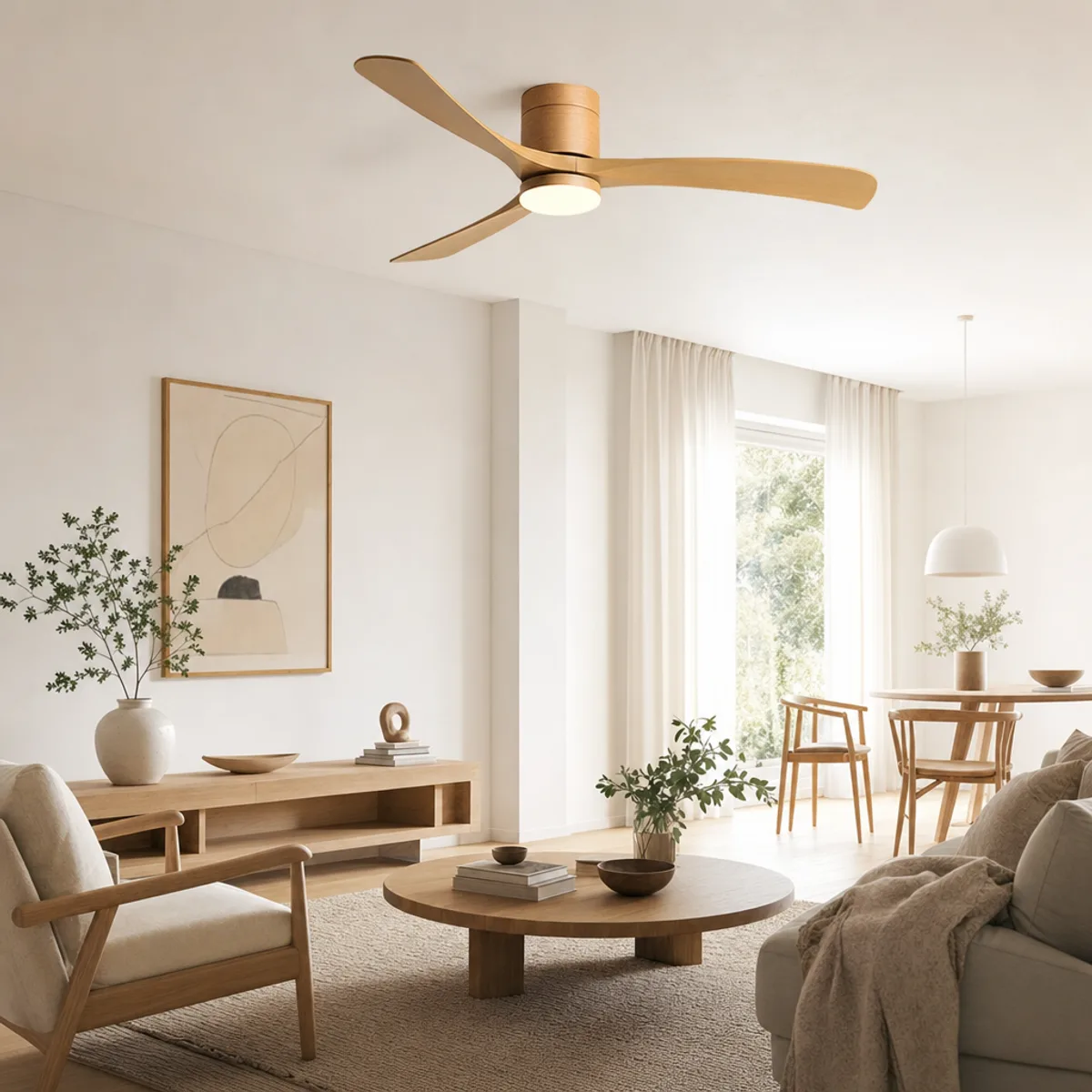
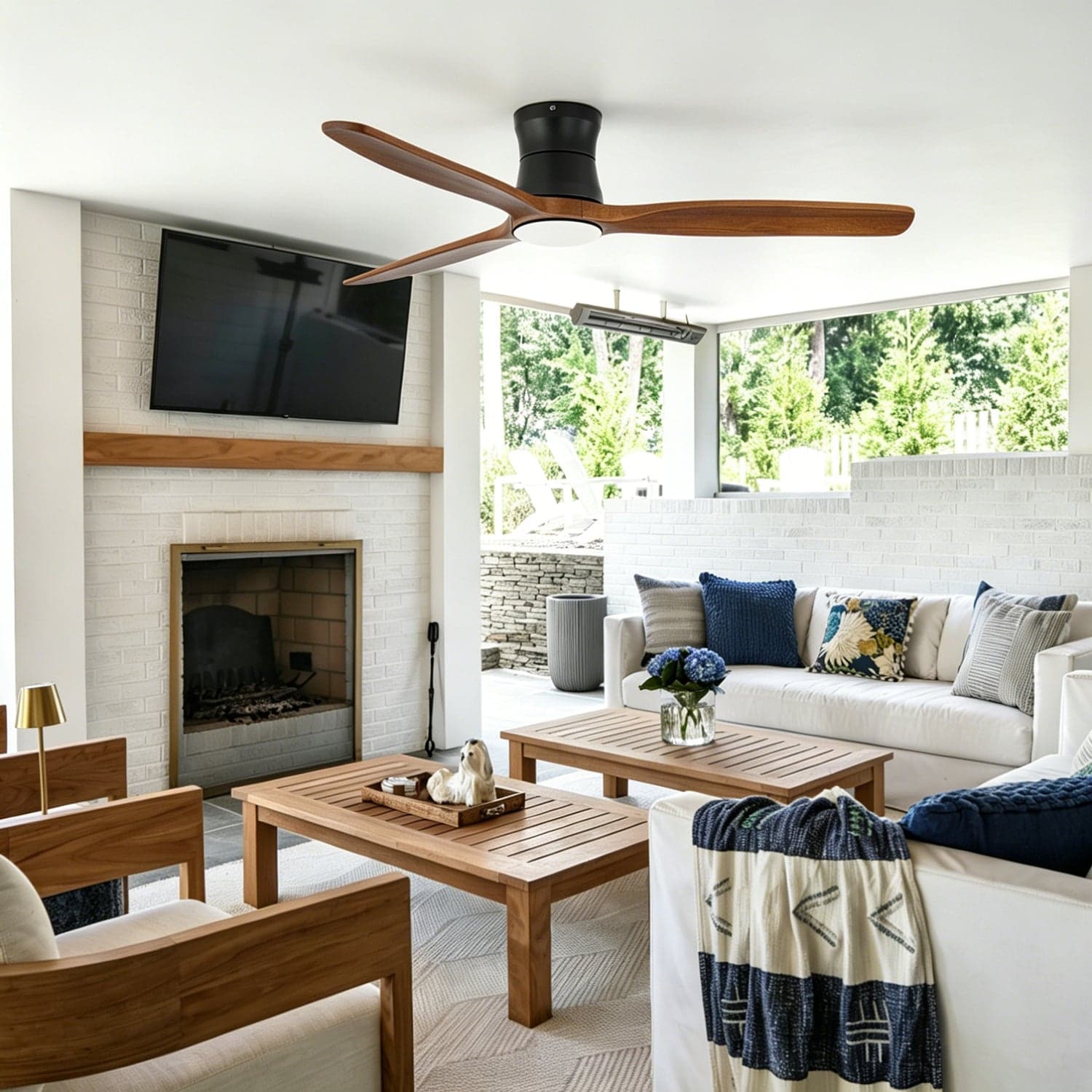
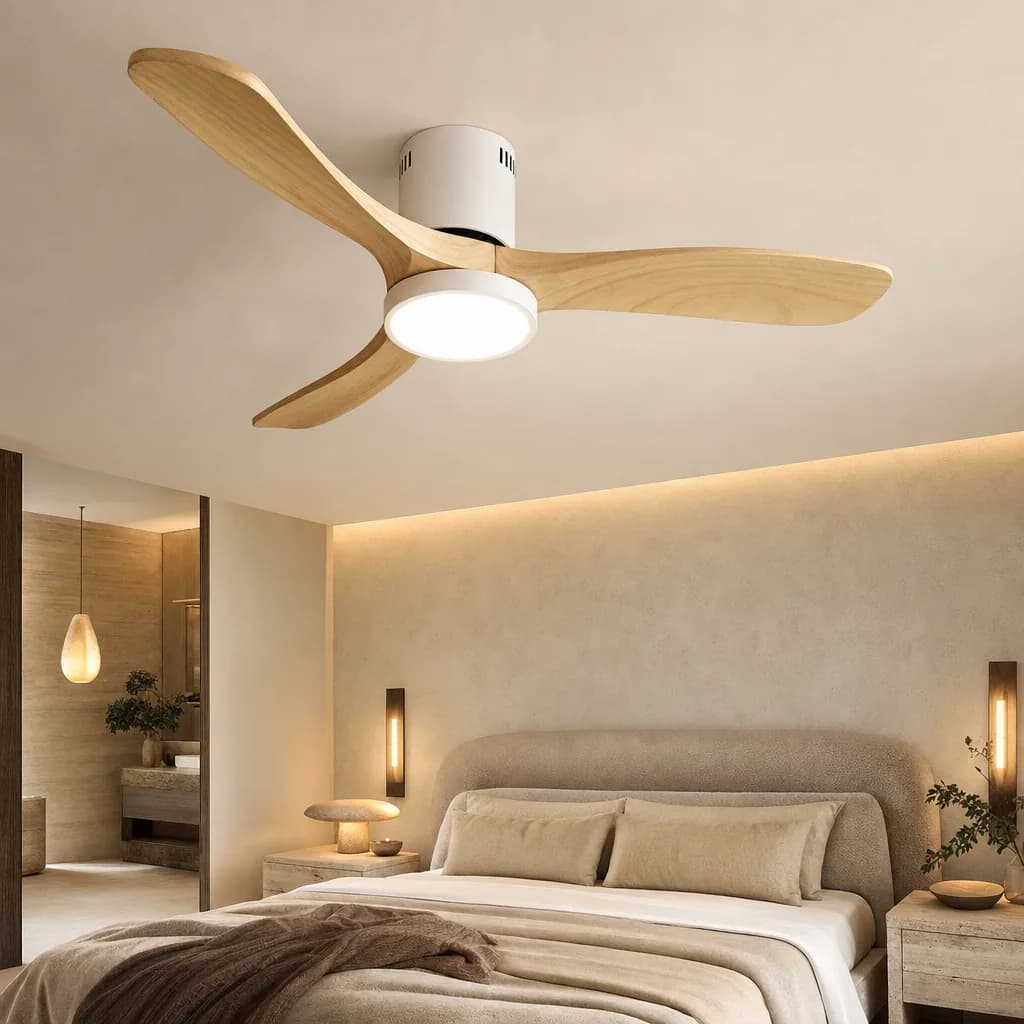
Under a lowered ceiling, the criterion that rules out the most models is total height. The Horizon 132 is designed for this case: 25 cm between ceiling and blades, a flush profile, and a 132 cm diameter that covers up to 30 m². Its product sheet describes it as ideal under 2.40 m ceilings.
Its reversible DC motor is rated at 33 dB maximum, with six speeds controlled by remote. Its blades are reversible, one side light wood, the other dark wood: you keep the side that goes with the tiles or the paint of the suspended ceiling.
Large 132 cm models generally weigh 8 to 10 kg: one more reason to ask nothing of the frame. The Horizon's product sheet does not mention integrated lighting, which is rarely a problem under a suspended ceiling, since it usually has its own spotlights or light panels.
On a suspended ceiling, the fixing that holds is the one that ignores it: an anchor in the original slab or joists, threaded rods locked with lock nuts, a rigid plate level with the suspended ceiling, and a suspended ceiling that only dresses the room. Check the height first, 2.10 m between floor and blades, because a lowered ceiling leaves little margin. Switch the power off at the breaker before opening the void, and hand the job to a professional if you are not equipped to work in the structure. With its 25 cm total height, its 132 cm diameter for rooms up to 30 m², its reversible DC motor and its 2-year warranty, the Horizon 132 is the model to choose as soon as the suspended ceiling sits at 2.35 m or higher.
Frequently asked questions
Can you fix a ceiling fan to a tiled suspended ceiling?+
Not to the tiles or their grid, which are not designed for a rotating load. The fixing has to pass through the suspended ceiling and anchor into the original slab or joists, using threaded rods and a plate. The tile it passes through is simply cut.
How much height do you need under a suspended ceiling to fit a fan?+
You need 2.10 m between the floor and the bottom of the blades. With a low-profile model 25 cm high in total, the suspended ceiling must therefore be at 2.35 m or more. A downrod model needs more.
Do you need a professional to fit a fan under a suspended ceiling?+
This is the case where one is most useful. You have to anchor into the structure, adjust threaded rods and sometimes open and close a plasterboard ceiling. If you are not equipped for that work, ask for a quotation.
Can the fan be connected to the supply for the ceiling spotlights?+
It is possible if the lighting circuit is in good condition, with a 230 V connection in a closed, accessible junction box, before any transformer. Switch the power off at the breaker before working. If in doubt about the circuit, ask an electrician.
The SEY Maison Circle
Every month, an exceptional piece. Never reissued.
The Drops principle: one high-end furniture piece per month, in a numbered edition. Once it's gone, it never comes back. Circle members are notified 48 h early, access each drop 24 h before everyone else, and receive our guides before publication.
Discover the Drops →