Ceiling fan: how many decibels for a quiet night's sleep
Published on ·7 min read
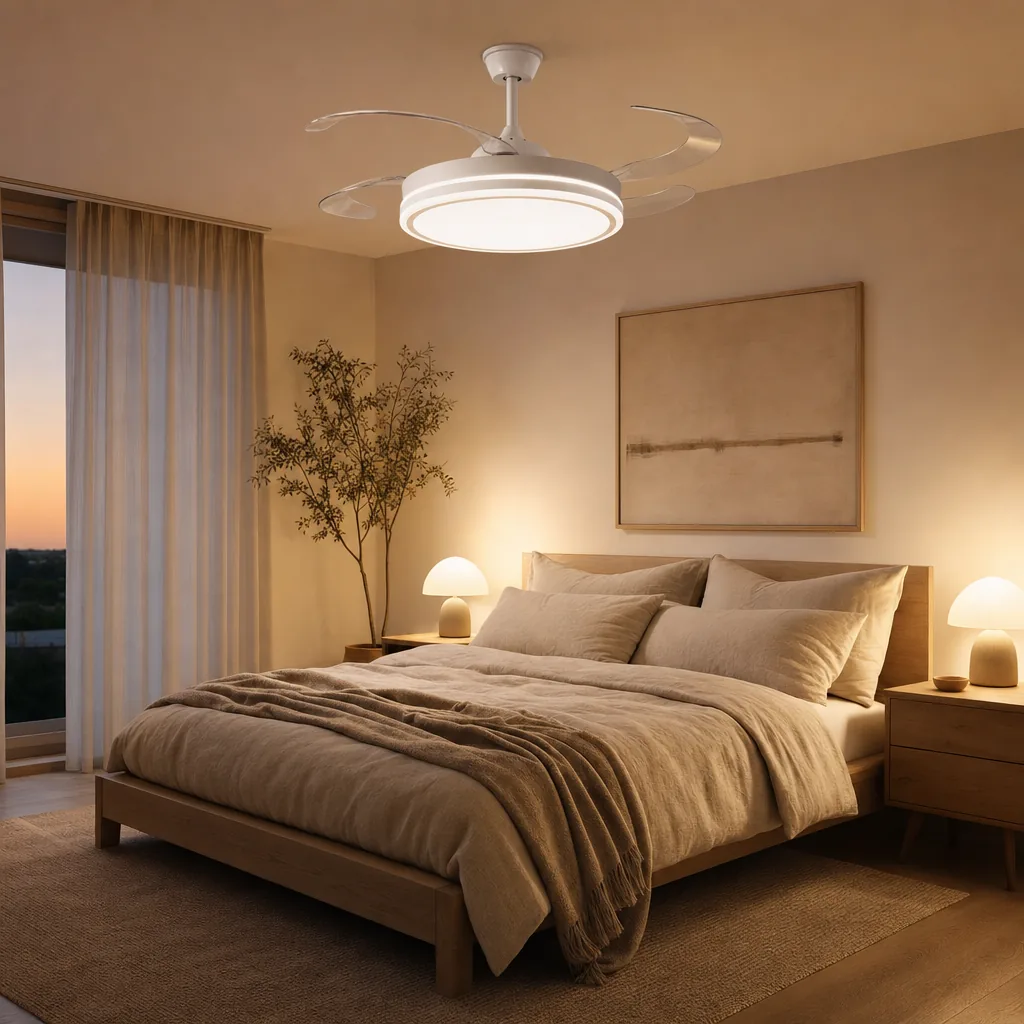
You sleep badly as soon as it gets hot, and you hesitate to run an appliance all night above the bed. The question is fair and it has an answer in figures: there is a noise level below which a ceiling fan is forgotten, and another above which it gets in the way of sleep.
The short answer: under 35 dB at the speed you will use at night, and around 30 dB if your bedroom is very quiet. The full answer means knowing what those figures are worth in a real bedroom, why a gap of three decibels matters, and how to read the one printed on a product sheet. That is the purpose of this article.
The figure to remember: under 35 dB, around 30 in a quiet bedroom
Two benchmarks come up throughout this journal. 30 dB is a whisper at one metre. 35 dB is the threshold at which noise starts to disturb sleep. The useful zone for a bedroom lies between the two, and our comparison of quiet models sets the bar at 33 dB at night speed.
Above 35 dB, everything depends on how you sleep: some people get used to it, light sleepers do not. At 45 dB the fan is clearly audible in a silent bedroom, whoever is sleeping there. So it is better to aim low: you can always go up a speed, you cannot go below the minimum of the appliance.
These figures apply to the speed you will really use while asleep, not to the top speed. A bedroom fan spends its nights on its first few steps. Those are the ones to judge.
- ·25 dB: almost inaudible in a quiet room
- ·30 dB: a whisper at one metre
- ·33 dB: recommended limit in a bedroom at night speed
- ·35 dB: threshold at which noise starts to disturb sleep
- ·40 dB: a quiet library
- ·45 dB: clearly audible in a silent bedroom
Why a three-decibel gap changes the night
The decibel is not a linear scale. Ten decibels more means ten times more sound energy, and the ear perceives it as roughly twice as loud. A fan at 40 dB therefore does not make a third more noise than a model at 30 dB: it seems twice as noisy.
The practical consequence is that small gaps count. A difference of three decibels is clearly audible. Between a fan at 31 dB and another at 34 dB, the gap looks negligible on paper. At two in the morning, with the windows closed, it is not. That is why product sheets should be compared to the nearest decibel, and at equal speed.
The gain is just as real in the other direction. Going down one or two steps saves several decibels, for a breeze that is still enough for a body at rest. At night, the lowest speed that suits you is always the right one.
The figure on the sheet: at what speed was it measured?
A fan does not have one noise level, it has one per speed. The slowest is almost silent, the fastest moves a lot of air and can be heard. When a sheet states a single, very low figure, it is nearly always the one for the minimum speed.
So look for a range. It gives the level at low speed, the night one, and the level at high speed, the one for a hot evening. The Boréal 107 is stated at 30 to 34 dB depending on speed: 30 dB at the bottom of the scale, 34 dB at the top. Both ends stay under the 35 dB threshold.
If the sheet gives only one figure, ask the seller before buying: at what speed, and at what distance. A precise answer already tells you something about how seriously the measurement was made.
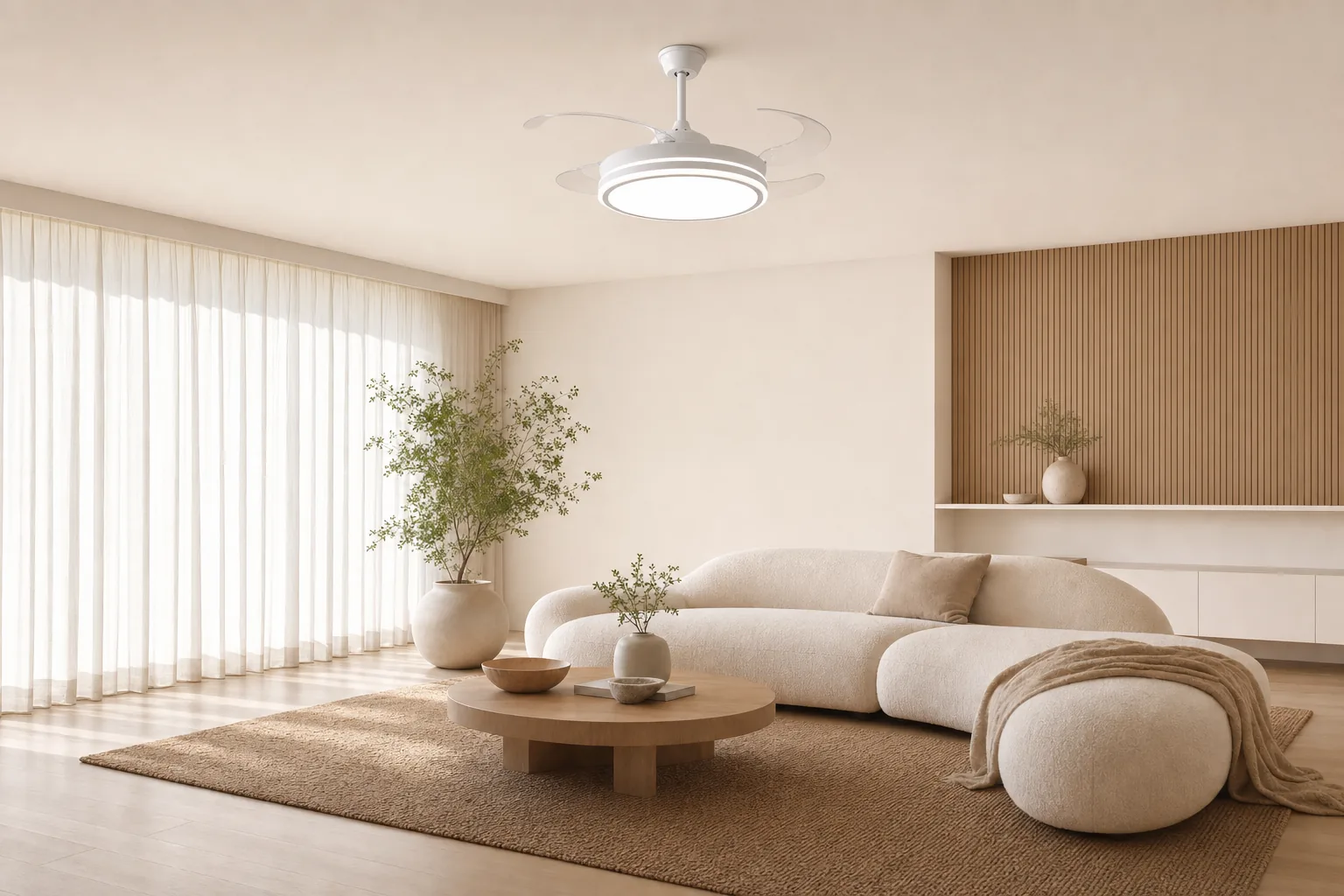
The Boréal 107
Retractable blades · Ø 107 cm · LED ceiling light & silent fan
- ✓Retractable blades: invisible when off, nobody guesses it's a fan
- ✓Sleep with windows closed, 30 dB, quieter than a whisper
- ✓Integrated LED 2700K → 6000K, dimmable: replaces your ceiling light
Distance and the room: your bedroom is not a laboratory
The noise level drops as you move away from the source: by about 6 dB each time the distance doubles. A figure taken one metre from the motor and a figure taken at three metres therefore do not describe the same appliance. Yet your pillow sits at a very specific distance from the blades, most often between one and two metres.
The room matters too. A bedroom reverberates: the walls, ceiling and floor send the sound back. A fan measured at 28 dB(A) in an echo-free chamber can reach 33 to 35 dB(A) in a real room. Thick curtains, a rug and the bedding absorb part of that reverberation. A bare bedroom with a tiled floor leaves it intact.
The background noise of your bedroom is part of the sum
A bedroom is never at zero decibels. At night, the background noise of a quiet home falls to around 25 to 30 dB. The fan is only heard for what it adds to that background.
Decibels do not add up like lengths: two sources of 30 dB together do not make 60 dB, but 33 dB. A fan at 30 dB in a bedroom whose background is already at 30 dB therefore brings the total to about 33 dB, a level that stays under the threshold. The same fan in a very silent country bedroom will be heard more, because nothing else accompanies it.
In town, the opposite happens. The steady breath of the fan partly covers the irregular noises from the street, and lets you sleep with the windows closed.
The type of noise matters as much as the level
Two noises of the same level are not slept through in the same way. A continuous breath, that of air moved by broad blades turning slowly, becomes background noise: you stop hearing it within minutes. A click, a motor hum or a blade whistle catches the attention, even at 28 dB.
The decibel says nothing about that difference. Before the first night, run the fan at low speed with the door closed and listen from the bed. If a sharp, regular noise comes on top of the breath, it most often comes from a screw that needs tightening or an unsuitable wall dimmer, and it can be corrected. Switch the power off at the circuit breaker before doing anything to the appliance, and call an electrician if in doubt.
Which model for a bedroom
For a bedroom up to 20 m², the Boréal 107 holds both ends: 30 to 34 dB depending on speed, so under 35 dB across its whole range. Its motor is copper, its six speeds are set from the remote without leaving the bed, and its dimmable LED can be set to 2700K for the end of the evening.
Switched off, its four blades retract and only a round ceiling light remains above the bed. In winter, reverse rotation brings the warm air at the ceiling back down. It carries a 2-year warranty, with EU support.
For a larger bedroom, move up to a 132 cm model. For the same airflow, a large diameter turns more slowly, 120 to 150 revolutions per minute against 180 to 200 for a 107 cm fan, and the noise of the air falls accordingly. Just check that its sheet does state less than 35 dB at low speed.
To sleep peacefully under a ceiling fan, remember two figures: 35 dB, the threshold not to exceed, and 33 dB, the limit we recommend in a bedroom at night speed. Check that the sheet gives a range, that the lower end is the one you will use at night, and remember that a gap of three decibels can be heard. The Boréal 107, stated at 30 to 34 dB, stays under the threshold at all its speeds: it is the model we recommend for a bedroom up to 20 m².
Frequently asked questions
What is the maximum number of decibels for a ceiling fan in a bedroom?+
Stay under 35 dB at the speed used at night, the threshold at which noise starts to disturb sleep. We recommend 33 dB at most, and around 30 dB in a very quiet bedroom.
Is 30 dB really quiet?+
30 dB is a whisper at one metre. In a bedroom whose background noise is already between 25 and 30 dB at night, a breath of air at that level blends into the background after a few minutes.
Why does my fan seem louder than the stated figure?+
The figure on the sheet often refers to the slowest speed, and it may have been measured further away than your pillow or in an echo-free room. A real bedroom reverberates: a fan measured at 28 dB(A) in a laboratory can reach 33 to 35 dB(A) at home.
Is the Boréal 107 quiet enough to sleep under?+
Its sheet states 30 to 34 dB depending on speed, which is under 35 dB across its whole range. The low speed, the one for the night, sits at 30 dB, the level of a whisper.
The SEY Maison Circle
Every month, an exceptional piece. Never reissued.
The Drops principle: one high-end furniture piece per month, in a numbered edition. Once it's gone, it never comes back. Circle members are notified 48 h early, access each drop 24 h before everyone else, and receive our guides before publication.
Discover the Drops →