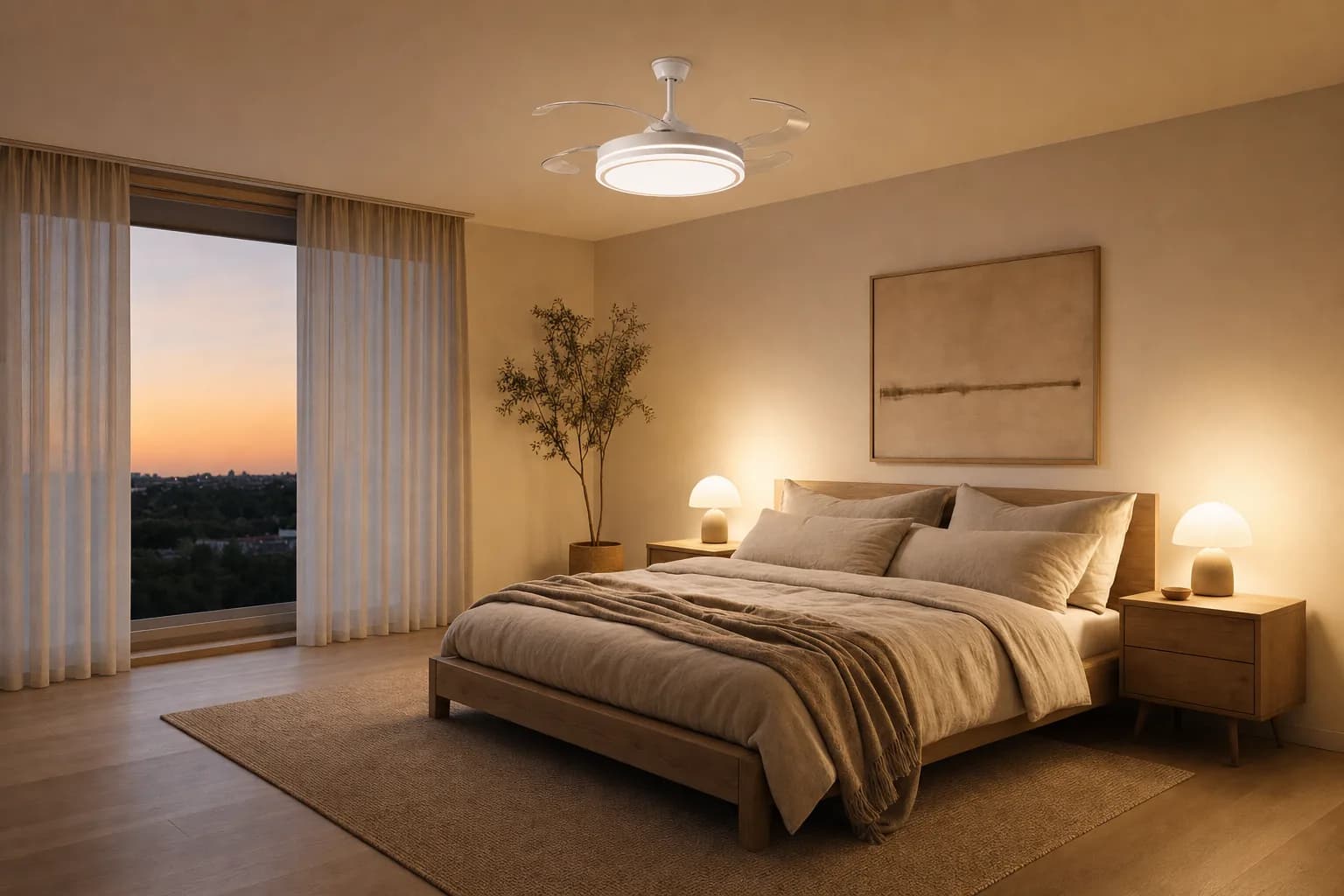
Silence & sleep
Ceiling fan in a flat: can the neighbours hear it? Noise, vibration, co-ownership
Published on ·4 min read

In a flat every noise counts twice: your own and the one you impose. Before fitting a ceiling fan the question comes quickly: can the upstairs neighbour hear it? And do you have to ask the co-owners?
The answers are reassuring, with one condition this article details: a fan's noise does not cross a floor, but its vibrations can if it is badly fitted. Here is what the neighbour perceives, what the rules say, and the fixing that settles everything.
What the upstairs neighbour really perceives
A quality ceiling fan produces 30 to 34 dB at one metre, whisper level. A 20 cm concrete slab attenuates airborne noise by 50 to 60 dB: what reaches the floor above is below the audible threshold, even at night in a quiet building. The airflow of the blades does not travel through the structure at all.
What can cross is structure-borne noise: a vibration passed mechanically to the ceiling, then the slab, then the floor above. It comes from unbalanced blades, a loose bracket, or a low-grade motor that vibrates. A well-built, well-fixed unit produces none. So it is the fitting, not the fan, that decides.
The fixing that stops vibrations
Three rules so that no vibration travels up. First: fix the bracket into the load-bearing structure, concrete slab or joist, never into a plasterboard sheet alone or a loose hook. Second: tighten, run at full speed for a minute, and re-tighten after a week of use. Third: check balance, a fan that visibly wobbles at high speed must be balanced with the supplied kit or returned.
The Boréal 107 comes with a bracket that screws straight onto the existing fixing point, a factory-balanced copper motor and symmetrical light ABS blades. Fitted on a connection box or into a slab, it transmits nothing: the upstairs neighbour will only learn it exists if you tell them.
- ·Bracket screwed into the slab, the joist or a connection box's fixing points
- ·Full-speed test for a minute, re-tighten after a week
- ·Balanced blades: no visible wobble of the body at high speed
- ·Speed 1 or 2 at night: the motor turns slowly, under no strain
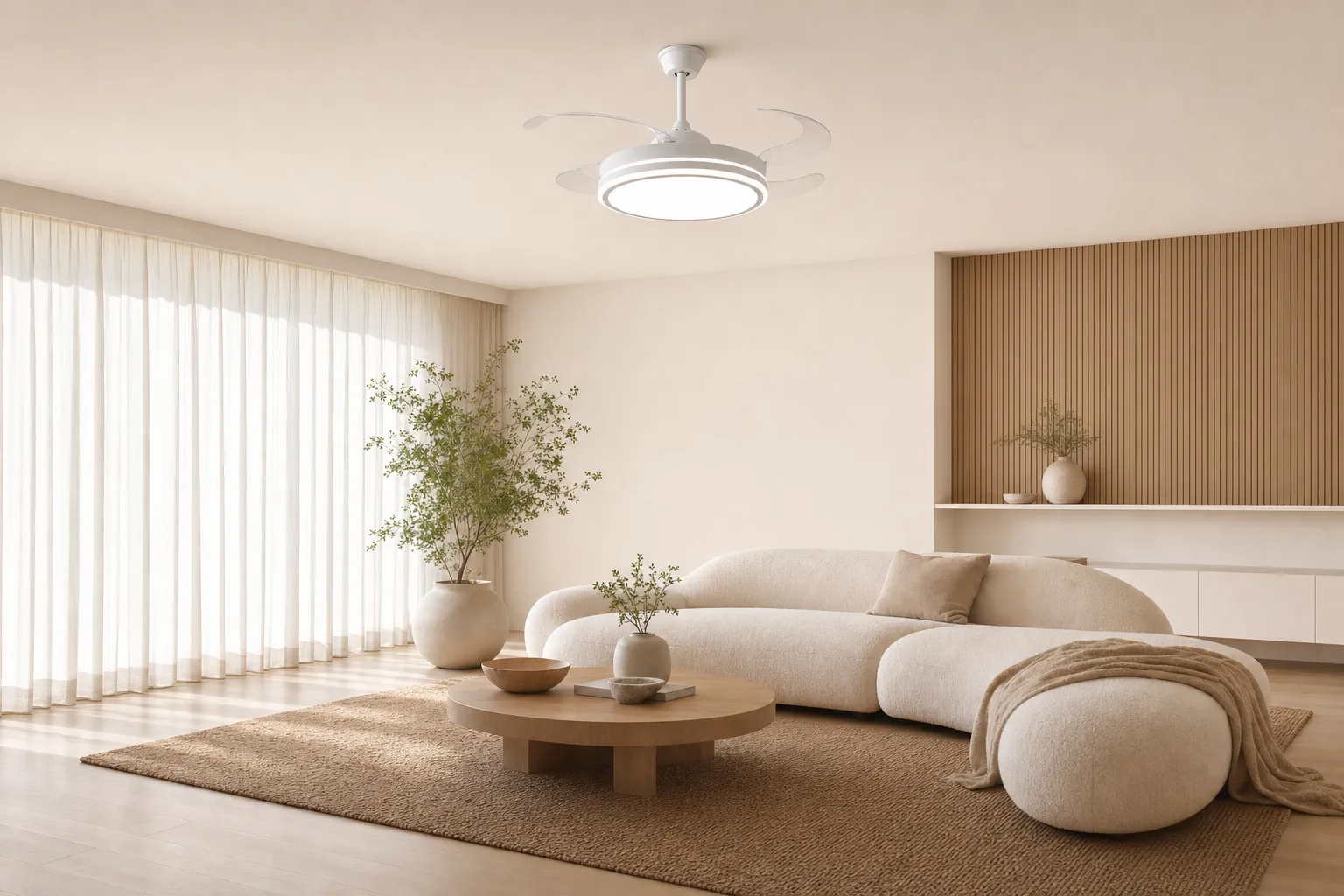
The Boréal 107
Retractable blades · Ø 107 cm · LED ceiling light & silent fan
- ✓Retractable blades: invisible when off, nobody guesses it's a fan
- ✓Sleep with windows closed, 30 dB, quieter than a whisper
- ✓Integrated LED 2700K → 6000K, dimmable: replaces your ceiling light
Do you need the co-owners' permission?
No, in the general case. Replacing a ceiling light with a ceiling fan is an interior fitting that touches neither common parts, nor the facade, nor the building's structure: it uses the existing light point of the private lot. The co-ownership rules need not be consulted, the general meeting need not vote.
The only obligation is towards neighbours: not to create abnormal disturbance. A 30 dB unit well fixed creates none. By comparison, a portable air conditioner puts its 50 to 60 dB and its vibrating unit directly on the floor, in contact with the slab: that is what brings the neighbour down, not the ceiling fan.
The right unit for a flat
For a flat the brief is precise: compact for 2.5 m ceilings, quiet at low speed, light for the fixing, reversible for winter, with LED to replace the ceiling light without new wiring. And discreet, because in 60 m² every object counts.
The Boréal 107 ticks those boxes: 15 cm deep, 30 dB at speed 1, about 5 kg, winter mode from the remote, dimmable LED in three temperatures. In a 1970s flat as in a period apartment, it fits in thirty minutes in place of the ceiling light, and exists for nobody but you.
In a shared building, a well-fixed ceiling fan transmits nothing to the neighbour: 30 dB inaudible through a slab, no vibration if the bracket is anchored in the structure and the blades balanced. No permission to ask, no disturbance to fear. The Boréal 107, compact, light and quiet, is made for the flat.
Frequently asked questions
Does a ceiling fan make noise for the upstairs neighbour?+
No, if well fixed. Its 30 to 34 dB are inaudible through a slab, and the airflow does not travel through the structure. Only the vibrations of a badly fixed or unbalanced unit cross: fixing into the slab or joist and balancing the blades remove them.
Do you need co-ownership approval to install a ceiling fan?+
No. Replacing a ceiling light with a ceiling fan is an interior fitting of the private lot, with no effect on common parts, facade or structure. No permission or meeting vote is needed.
How to avoid ceiling fan vibrations in a flat?+
Fix the bracket into the load-bearing structure, concrete or joist, or onto a connection box's fixing points, tighten, test at full speed, re-tighten after a week, and check the body does not wobble. A factory-balanced unit like the Boréal 107 does not vibrate.
The SEY Maison Circle
Every month, an exceptional piece. Never reissued.
The Drops principle: one high-end furniture piece per month, in a numbered edition. Once it's gone, it never comes back. Circle members are notified 48 h early, access each drop 24 h before everyone else, and receive our guides before publication.
Discover the Drops →