Silence & sleep
Ceiling fan and sleep: what studies say about the ideal bedroom temperature
Published on ·4 min read
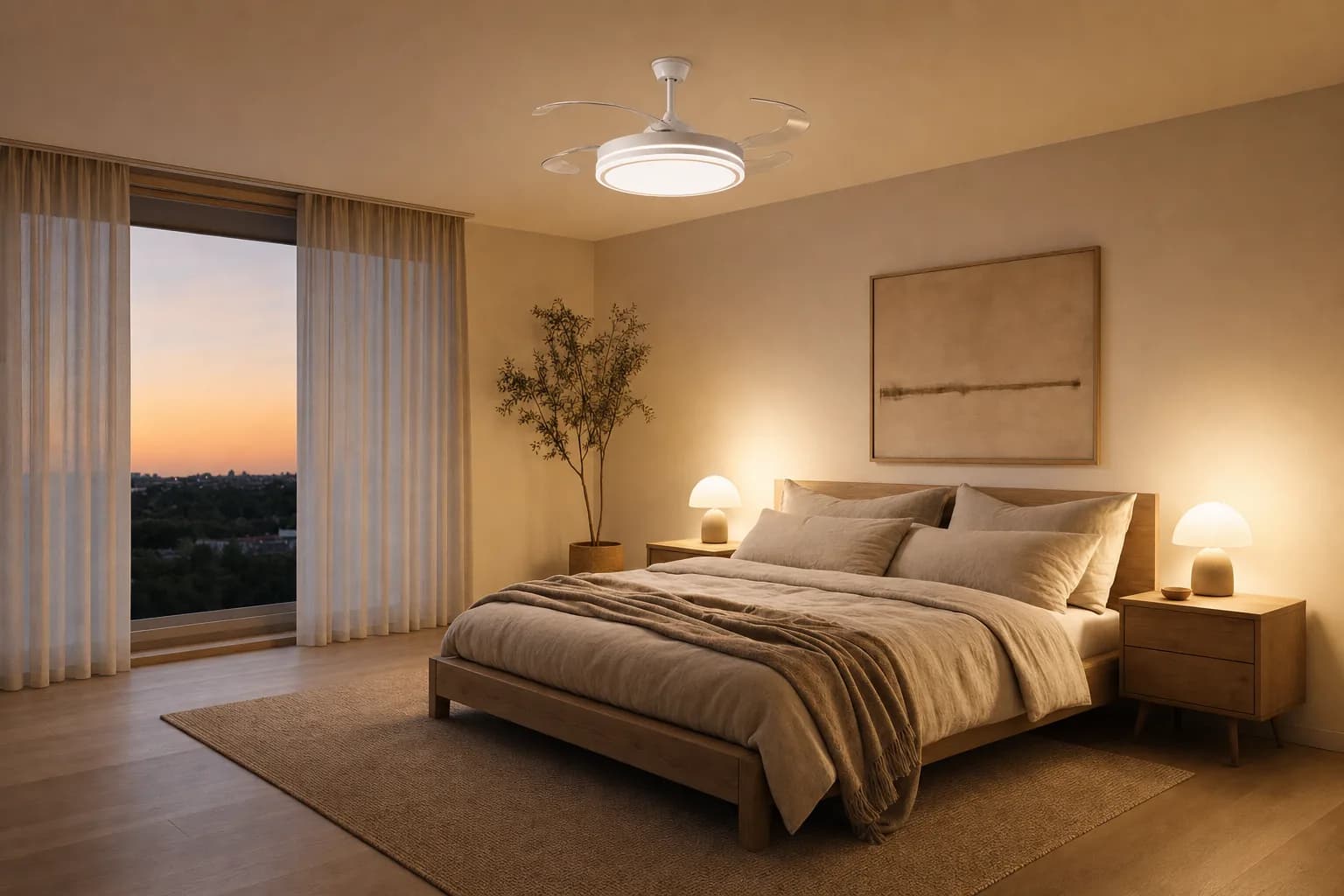
Bedroom temperature is one of the best documented sleep factors. The body needs to lower its core temperature by about 1 °C to fall asleep, and does so more easily in a cool room. Recommendations converge: between 16 and 19 °C, with tolerance up to about 22 °C.
In summer most bedrooms exceed 24 °C at night, sometimes 28 °C. This article explains what that does to sleep, how a ceiling fan helps get back into the right window without air conditioning, and how to set it for a whole night.
What happens when the bedroom exceeds 24 °C
Studies on sleep in warm environments show two effects. First, time to fall asleep lengthens: the body struggles to shed its heat, and the sleep signal arrives later. Then the night's structure changes: less deep sleep, more micro-awakenings, especially in the second half of the night when heat stored in the walls remains.
These effects are measurable from 24 to 25 °C and worsen markedly beyond 27 °C. What you feel the next day, the sense of having slept badly despite eight hours in bed, matches that loss of deep sleep. A warm bedroom does not necessarily shorten the night, it degrades it.
How a fan acts on felt temperature
A ceiling fan does not cool the air. It does something else, more useful for sleep: it moves air over the skin, which speeds up evaporation of sweat and heat exchange. At 0.5 m/s of air, felt temperature drops 2 to 4 °C. A 26 °C bedroom feels like 22 to 23 °C, within the acceptable window.
That is exactly the mechanism the body needs to fall asleep: shedding internal heat. A ceiling fan does it over the whole bed surface, evenly, without the localised cold jet of a pedestal fan aimed at the face. In the morning you do not wake with a stiff neck or a dry throat.
- ·Air at 0.3 m/s (speed 1): feels 1 to 2 °C cooler
- ·Air at 0.5 m/s (speed 2): feels 2 to 3 °C cooler
- ·Air at 0.8 m/s (speed 3): feels 3 to 4 °C cooler, more for falling asleep than for the whole night
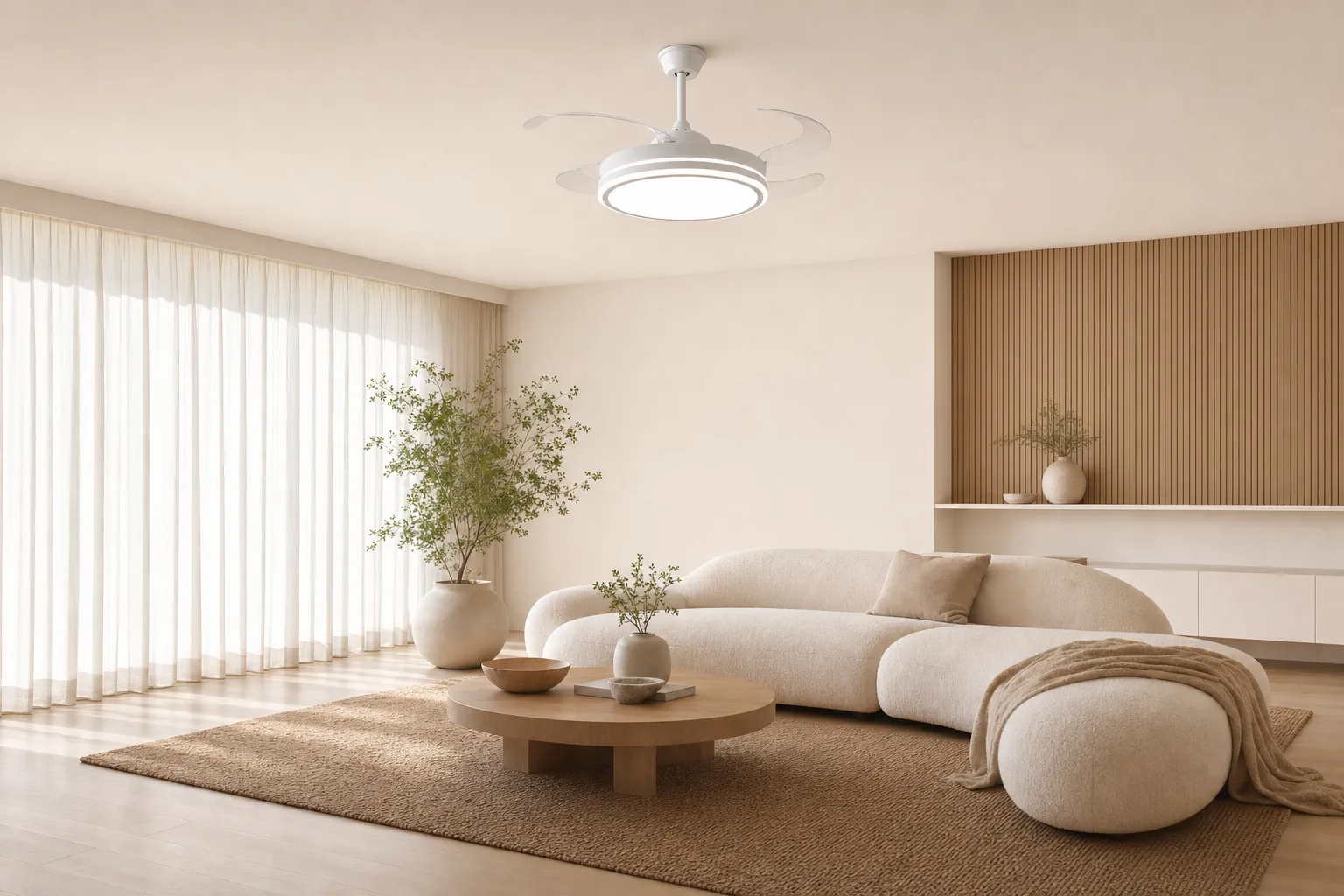
The Boréal 107
Retractable blades · Ø 107 cm · LED ceiling light & silent fan
- ✓Retractable blades: invisible when off, nobody guesses it's a fan
- ✓Sleep with windows closed, 30 dB, quieter than a whisper
- ✓Integrated LED 2700K → 6000K, dimmable: replaces your ceiling light
Noise, the other sleep factor
Lowering felt temperature is useless if the device doing it wakes you. Work on night-time noise places the sleep disturbance threshold around 35 dB in the bedroom: above it, micro-awakenings increase even if you do not remember them. A pedestal fan runs at 45 to 55 dB; an indoor air conditioner at 35 to 45 dB.
The Boréal 107 runs at 30 to 34 dB, under that threshold. Its copper motor turns slowly, and the wide blades move air without whistling. The remaining sound is a steady, continuous breath, the kind the brain files as background and stops hearing. Many sleep better with it than in total silence, because it masks street noise.
The setting for a whole night
Speed 2 to fall asleep, then speed 1 for the night: the most common setting, done from the remote without getting up. If the bedroom drops clearly late in the night, the timer at 2 to 4 hours switches off around 2 or 3 a.m., when the body has finished cooling and the room has freshened.
In winter the same device serves differently: in reverse mode, on speed 1, it brings ceiling heat back to the bed and removes the cold-ceiling feeling, with no draught. The bedroom stays in the 16 to 19 °C window with the heating a notch lower. One device, two seasons, the same calm night.
Sleep needs a cool, quiet bedroom. A ceiling fan brings the felt temperature from 26 °C to 22 °C at 30 dB, under the sleep disturbance threshold, without air conditioning or a localised draught. The Boréal 107 is set from the remote, switches off on the timer and serves in winter too.
Frequently asked questions
What is the ideal temperature for sleeping?+
Recommendations converge between 16 and 19 °C, with tolerance up to about 22 °C. Above 24 °C, falling asleep takes longer and deep sleep decreases measurably.
Does a ceiling fan cool the bedroom?+
It does not lower the air temperature, but lowers the felt temperature by 2 to 4 °C by speeding up evaporation on the skin. A 26 °C bedroom feels like 22 to 23 °C.
Is it bad to sleep with a ceiling fan?+
No, provided it is quiet and the air is not a cold jet aimed at the face. A ceiling fan at 30 dB on speed 1 spreads gentle air movement over the whole bed, with no stiff neck or dry throat on waking.
The SEY Maison Circle
Every month, an exceptional piece. Never reissued.
The Drops principle: one high-end furniture piece per month, in a numbered edition. Once it's gone, it never comes back. Circle members are notified 48 h early, access each drop 24 h before everyone else, and receive our guides before publication.
Discover the Drops →