Silence & sleep
Sleeping in the city in summer: windows closed against noise, cool with a ceiling fan
Published on ·4 min read

It is the dilemma of every urban summer: window open, the night air comes in, and with it the scooters, the terraces, the 5 am deliveries. Window closed, silence returns and the bedroom climbs to 27 or 28°C.
The choice is a false one. What you seek from an open window is not so much outdoor air as moving air, and moving air can be produced indoors, windows shut, at below-whisper volume. Here is how that third way works.
What does street noise actually do to your sleep?
You think you get used to noise; the brain never fully does. Every sound peak, a two-wheeler, a car door, can trigger a micro-awakening of a few seconds that you never remember but that fragments deep and REM sleep. Morning comes, recovery does not.
It is not average decibels that wake you, it is sudden variation. That is precisely why a soft, steady sound, like a fan's constant breath, protects sleep: it slightly raises the background level and smooths out the peaks.
The third way: windows closed, air in motion
With windows shut, double glazing removes around twenty decibels: a 65 dB street becomes a distant 40-45 dB backdrop. The heat remains, and that is where circulation comes in: a ceiling fan lowers perceived temperature by 3 to 4°C. At an actual 27°C, you sleep at a felt 23-24°C in a quiet room again.
The appliance's own noise is the keystone. A DC motor on night speed runs at 28-32 dB, around the roughly 30 dB recommended for bedrooms, and it is a continuous sound that acts as white noise, masking what remains of the street. A portable AC, by contrast, hums at 60-65 dB in start-stop cycles and needs its exhaust duct in a partly open window, letting the noise back in.
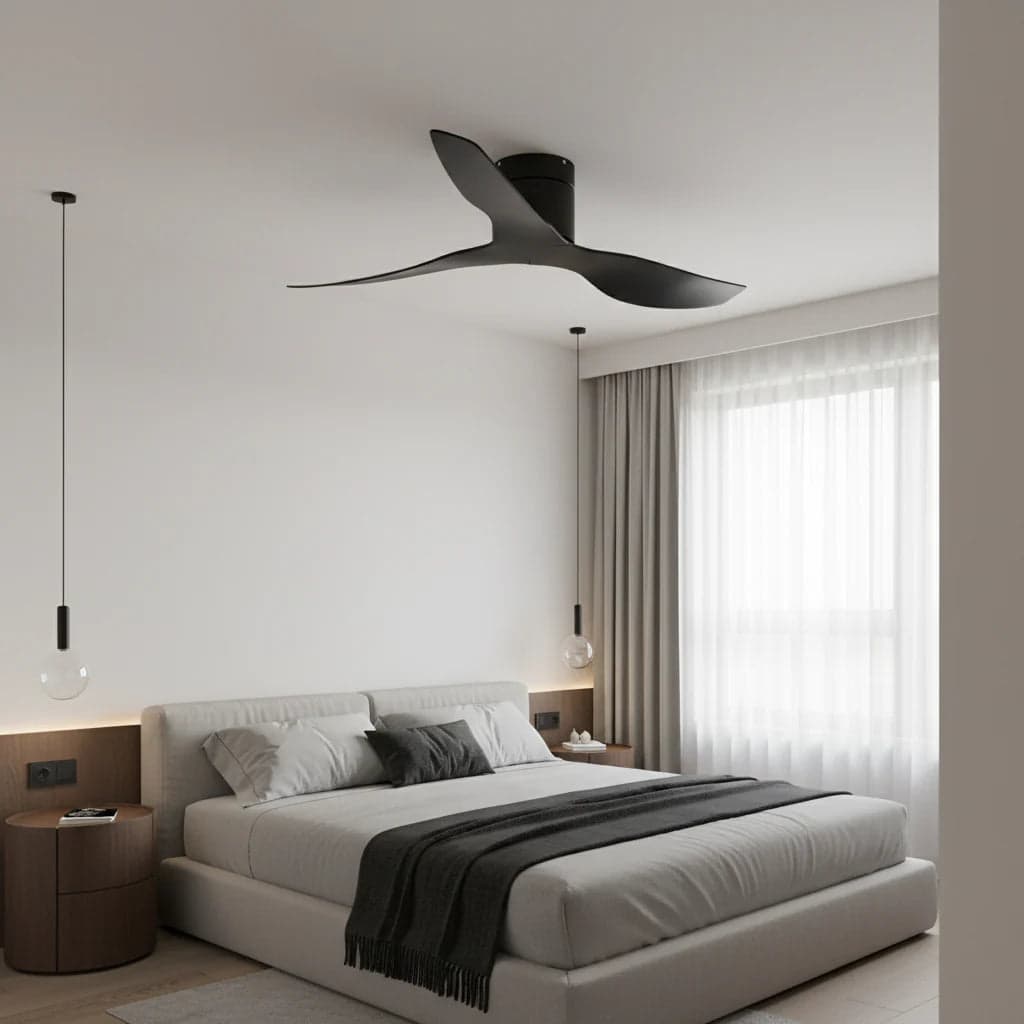
The Minuit 132
Ultra-flat all black · Ø 132 cm
- ✓Silent DC motor, 6 reversible speeds
- ✓Remote control included
- ✓30-minute installation, illustrated manual
€309€389
How to optimise an urban bedroom for hot nights
The ceiling fan is the centrepiece, but a street-facing bedroom benefits from being prepared like a recording studio: everything that reduces incoming heat or residual noise improves the night.
- ·Shutters or blinds closed from morning on the sunny side: heat blocked outside never needs evacuating
- ·Flash airing between 4 and 6 am, when the street is quietest and the air coolest, then close everything
- ·Check window seals: a tired seal lets in warm air and an extra 3 to 5 dB
- ·Heavy textiles (curtains, rugs) absorb sound reflections in the room
- ·Fan on night speed (1 or 2 of 6): 28-32 dB, soft vertical flow, nothing blowing on your face
Which model for a street-facing bedroom or attic studio?
In an urban bedroom, often compact and sometimes sloped, two criteria dominate: absolute motor silence and minimal vertical bulk. That is exactly the brief of the Minuit 132: an ultra-flat profile that presses close to the ceiling of bedrooms and attic studios where every centimetre counts, a silent reversible DC motor and six speeds by remote.
Its all-black finish has a particular virtue at night: lights off, it ceases to exist for the eye. Only the breath remains, discreet and continuous, while the street carries on behind the double glazing. In winter its reversible mode redistributes the warm air trapped under the ceiling.
The noise-or-heat dilemma requires sacrificing neither silence nor coolness: decouple the two. Windows closed against the street, ceiling fan for perceived temperature, and the urban bedroom becomes a place to sleep again. For a street-facing room or attic studio we recommend the Minuit 132, ultra-flat, all black, silent on night speed, and covered by a 2-year warranty.
Frequently asked questions
Can a ceiling fan really mask street noise?+
It does not erase noise, it makes it less salient: its steady 28-32 dB breath slightly raises the background level, so street peaks, already cut by the closed window, stand out less. It is the white-noise principle without an extra device.
Why not a portable AC in a street-facing bedroom?+
Because it combines the two flaws you are fleeing: a 60-65 dB compressor with waking start-stop cycles, and an exhaust duct that forces the window to stay partly open, letting the street noise back in.
Is a fan enough if the bedroom hits 29-30°C?+
Wind-chill removes 3 to 4 perceived degrees: at an actual 29-30°C you fall back to a felt 25-27°C, still warm. Combine it with daytime solar protection and the 4-6 am flash airing to lower the actual starting temperature.
The SEY Maison Circle
Every month, an exceptional piece. Never reissued.
The Drops principle: one high-end furniture piece per month, in a numbered edition. Once it's gone, it never comes back. Circle members are notified 48 h early, access each drop 24 h before everyone else, and receive our guides before publication.
Discover the Drops →