Silence & sleep
30 dB for a ceiling fan: what the figure really means, and how to compare it
Published on ·4 min read
Every fan spec sheet shows a noise level in decibels, and almost all announce between 25 and 40 dB. The figure is rarely false, but almost always incomplete: measured at what speed, at what distance, in what room? Without those details, 30 dB from one manufacturer and 30 dB from another can describe two very different units.
This article explains what 30, 35, 40 and 50 dB represent in real life, why the scale fools intuition, how to read a noise measurement, and why the nature of the noise matters more than its level for sleeping.
The decibel scale fools intuition
The decibel is not a linear scale. Going from 30 to 40 dB is not a third more noise: it is ten times more sound energy, perceived by the ear as about twice as loud. Going from 30 to 33 dB is already a clearly audible difference. And two sources at 30 dB together do not make 60 dB, but 33 dB.
Concretely, on the fan scale: 25 dB is almost inaudible in a quiet room, 30 dB a whisper at one metre, 35 dB the threshold from which sleep studies measure micro-awakenings, 40 dB a library, 45 dB a recent fridge, 50 dB a normal conversation. A pedestal fan runs at 45 to 55 dB; a tower at 40 to 50; a decent ceiling fan at 30 to 40 depending on speed.
- ·25 dB: almost inaudible in a quiet room
- ·30 dB: whisper at one metre
- ·35 dB: sleep disturbance threshold
- ·40 dB: library
- ·50 dB: normal conversation
At what speed, at what distance
A noise measurement only makes sense with two parameters. Speed: a fan showing 28 dB on speed 1 can climb to 45 dB on speed 3; if the sheet gives only one figure, it is almost always minimum speed. Distance: the level drops 6 dB each time distance doubles; 30 dB measured a metre from the motor become 24 dB at two metres. A measurement at one metre and one at the centre of the room do not compare.
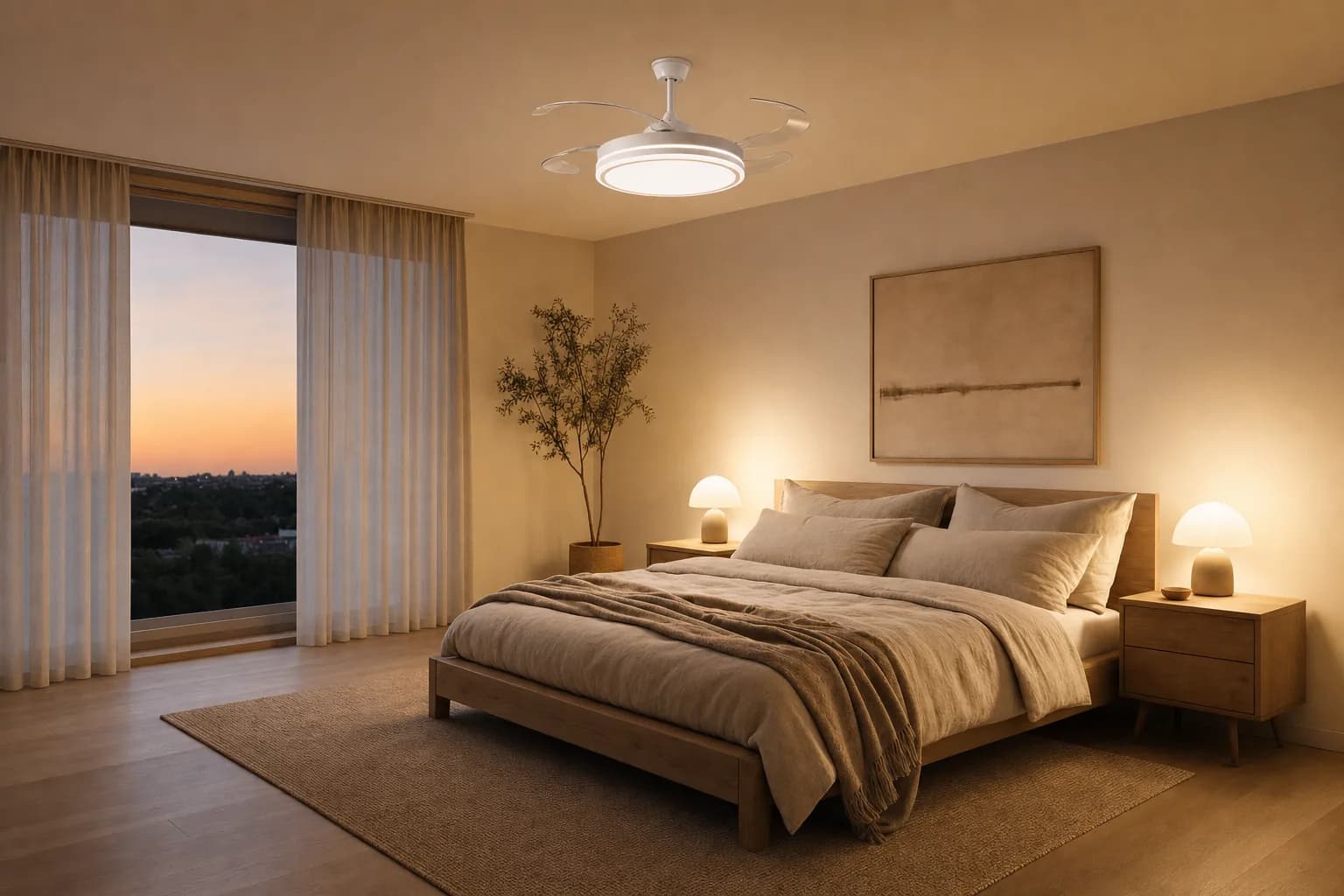
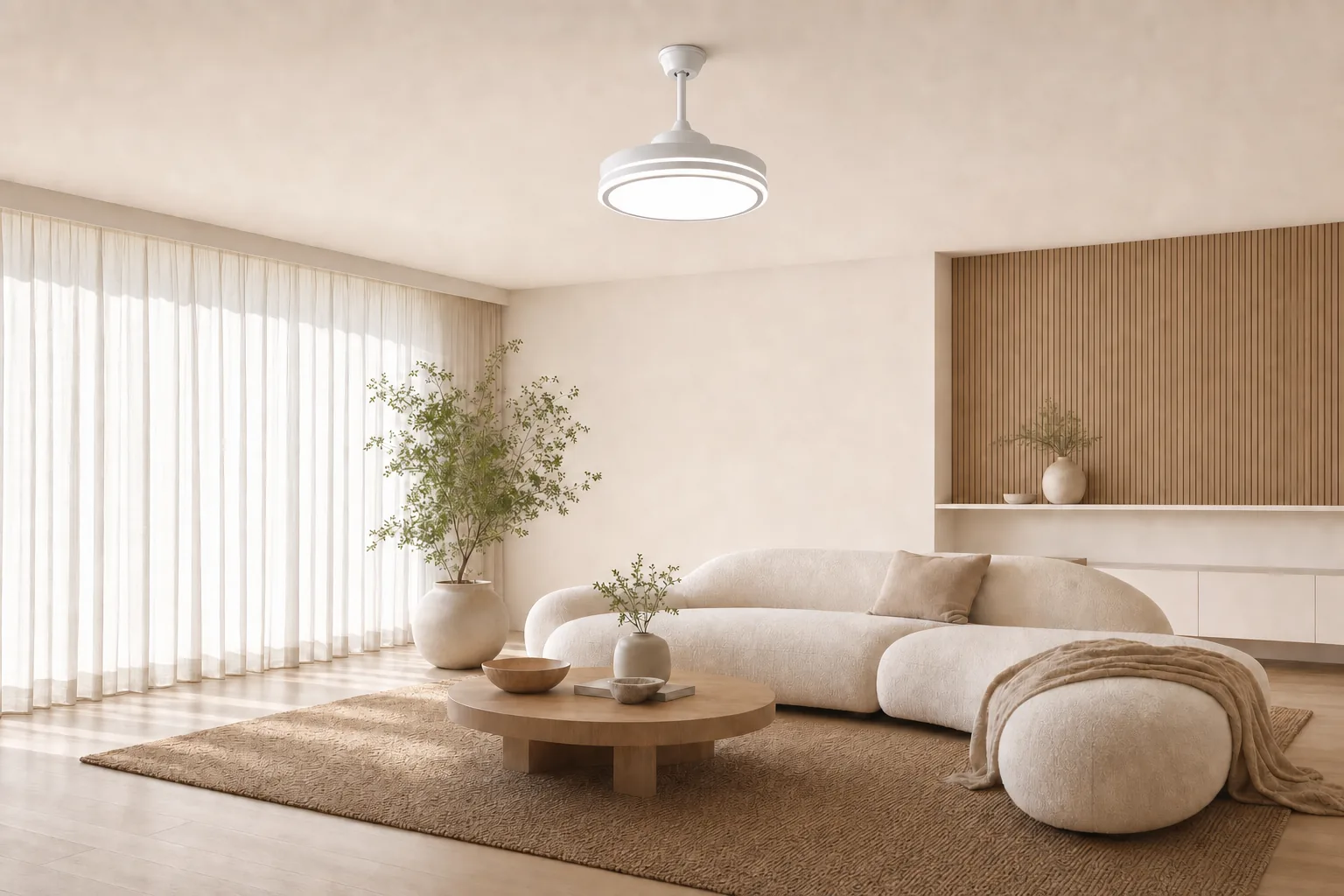
The Boréal 107 is rated at 30 to 34 dB: 30 dB on speed 1, 34 dB on speed 3. Those are the two bounds of real use, the night on speed 1, an evening on speed 3. An honest sheet gives that range; a sheet giving one low figure gives the best case. The question to ask any seller holds in six words: at what speed, at what distance.
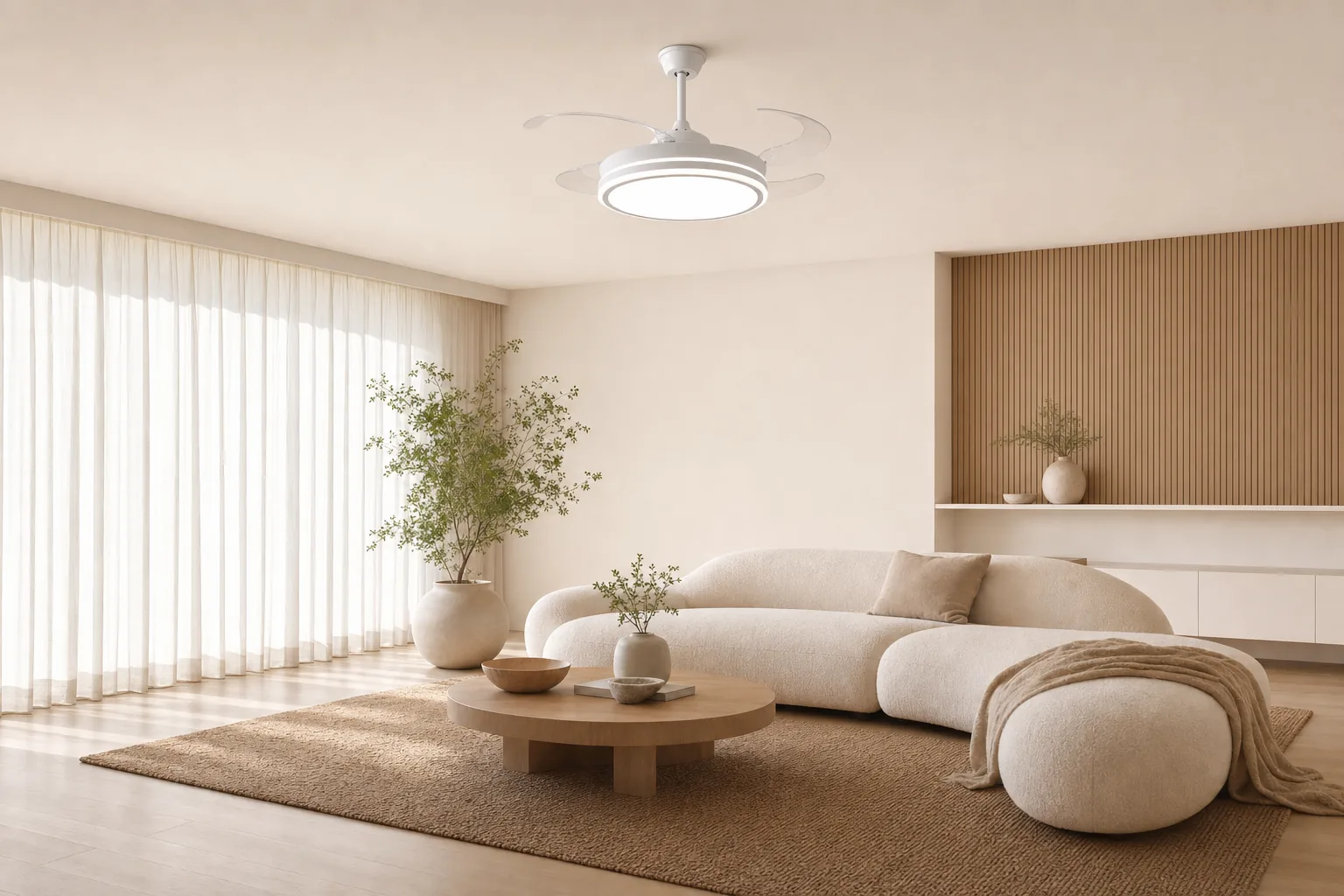
The Boréal 107
Retractable blades · Ø 107 cm · LED ceiling light & silent fan
- ✓Retractable blades: invisible when off, nobody guesses it's a fan
- ✓Sleep with windows closed, 30 dB, quieter than a whisper
- ✓Integrated LED 2700K → 6000K, dimmable: replaces your ceiling light
The type of noise counts more than the level
Two noises of the same level are not lived the same way. A continuous, steady breath, that of air moved by wide blades at low speed, files as background noise: the brain stops hearing it within minutes, and it even masks street noise. That is the sound of a well-designed ceiling fan, and it is why many sleep better with one.
A rattle, a motor hum, a whistle from a badly profiled blade, or a vibration that changes with speed are noises with character: even at 28 dB they catch attention and prevent falling asleep. A well-balanced copper motor at a few hundred rpm does not hum; wide, balanced blades do not whistle. The dB level says nothing of that, only listening does, or user reviews after several weeks.
Three questions before believing a sheet
First question: does the figure match minimum speed or a range? A single low figure describes the best case. Second question: at what distance is it measured? Under the unit is the most demanding measurement; at three metres, everything is quiet. Third question: what type of motor and blades? A low-speed motor and wide blades are the guarantee of a breath rather than a hum.
The Boréal 107 answers all three: 30 to 34 dB depending on speed, copper motor and wide retractable blades. The remaining sound is a breath that conversation covers on speed 3 and that you forget on speed 1. For a bedroom, that is what separates a unit you switch off at midnight from one that runs until morning.
30 dB is a whisper, and 35 dB the threshold of disturbed sleep; 10 dB more sounds twice as loud. A figure is only worth something with its speed and distance, and a steady breath sleeps better than a quieter rattle. The Boréal 107: 30 to 34 dB depending on speed, copper motor, a breath you stop hearing.
Frequently asked questions
Is 30 dB loud or not?+
It is a whisper at one metre, under the 35 dB threshold from which noise starts disturbing sleep. By comparison, a pedestal fan runs at 45 to 55 dB and a conversation at 50 dB.
Why can two fans rated at 30 dB sound so different?+
Because the measurement depends on speed and distance, rarely specified, and because the type of noise counts: a steady breath is forgotten, a hum or rattle of the same level catches attention.
What noise level to sleep with a ceiling fan?+
Under 35 dB at night speed, with a continuous breath-type noise. The Boréal 107 runs at 30 dB on speed 1, with a copper motor that does not hum.
The SEY Maison Circle
Every month, an exceptional piece. Never reissued.
The Drops principle: one high-end furniture piece per month, in a numbered edition. Once it's gone, it never comes back. Circle members are notified 48 h early, access each drop 24 h before everyone else, and receive our guides before publication.
Discover the Drops →