The art of the home
Replacing a chandelier with a ceiling light: three surprises when you take it down
Published on ·3 min read
Taking down a chandelier is the first step of many light renovations. It is also the moment when three things appear, none of which was in the photograph of the new luminaire.
Better to know them before ordering, because two of them are settled at the moment of purchase.
Weight and mounting
A brass or crystal chandelier commonly weighs five to fifteen kilos. The mounting installed to hold it is therefore often robust, sometimes a plate screwed into a joist. That is good news: it will take any ceiling light, and even a rotating appliance.
The opposite also happens, especially in older homes where the chandelier hung from a hook set into plaster. In that case the hook must go and give way to a fixing that reaches a structural element, and that is to be checked before ordering a heavy model.
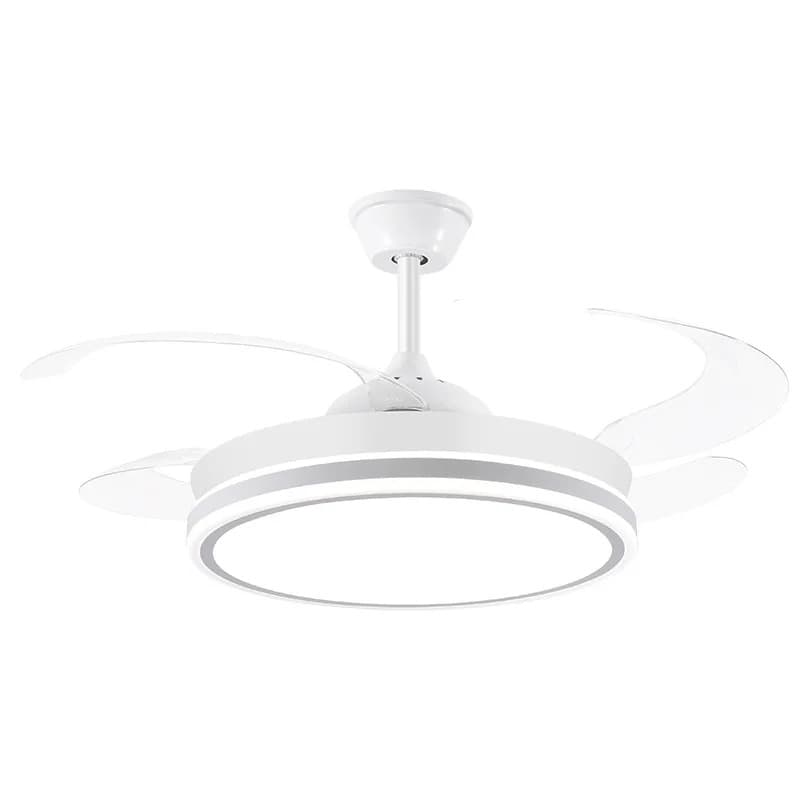
The Boréal 107
Retractable blades · Ø 107 cm · LED ceiling light & silent fan
- ✓Retractable blades: invisible when off, nobody guesses it's a fan
- ✓Sleep with windows closed, 30 dB, quieter than a whisper
- ✓Integrated LED 2700K → 6000K, dimmable: replaces your ceiling light
The mark on the ceiling
A chandelier ceiling rose is often fifteen to twenty-five centimetres across, and it has protected the ceiling for years. Once removed, it leaves a cleaner disc of paint, sometimes an old hole from a previous model, and plaster cracks.
If the new ceiling light is narrower, that mark will stay visible. Two options: choose a model whose base covers at least the old footprint, or plan to repaint the ceiling. It is a point decided beforehand, not once the box is open.
- ·Measure the footprint of the old rose before ordering
- ·Choose a base at least as wide, or plan the repaint
- ·Check the type of fixing: plate or hook set in plaster
- ·Check that an earth conductor is present
Light, often reduced
A chandelier with six 400-lumen bulbs produces 2,400 lumens. Many ceiling lights sold as replacements top out at 1,500. The room then looks darker after the change, and the model or the LED gets blamed.
Redo the calculation before buying: count 100 to 150 lumens per square metre in a living space, and check that the new model reaches at least what the old one produced. It is also a chance to gain comfort, with dimming and adjustable temperature that a bulb chandelier never offered.
Before ordering, measure the footprint of the rose, look at how the chandelier is held, and add up the lumens of its bulbs. Those three checks take ten minutes and avoid the two most common disappointments: a visible paint mark and a room that has become darker.
Frequently asked questions
Can a ceiling light replace a chandelier?+
Yes, the connection is identical, on the same three conductors. Just check that the base of the new luminaire covers the footprint left by the rose, otherwise the mark will stay visible.
How do I know how many lumens my chandelier produced?+
Add up the lumens of its bulbs, printed on the base or the packaging. A 5 W LED bulb gives around 400 to 500 lumens, a 40 W halogen around 400 as well.
Will a chandelier mounting hold a ceiling fan?+
Often yes, since a chandelier weighs more than a fan. Check however that it is a plate fixed into a structural element and not a simple hook set into plaster.
The SEY Maison Circle
Every month, an exceptional piece. Never reissued.
The Drops principle: one high-end furniture piece per month, in a numbered edition. Once it's gone, it never comes back. Circle members are notified 48 h early, access each drop 24 h before everyone else, and receive our guides before publication.
Discover the Drops →