Interior design
Round white ceiling light: the best-selling shape, and what separates the models
Published on ·3 min read
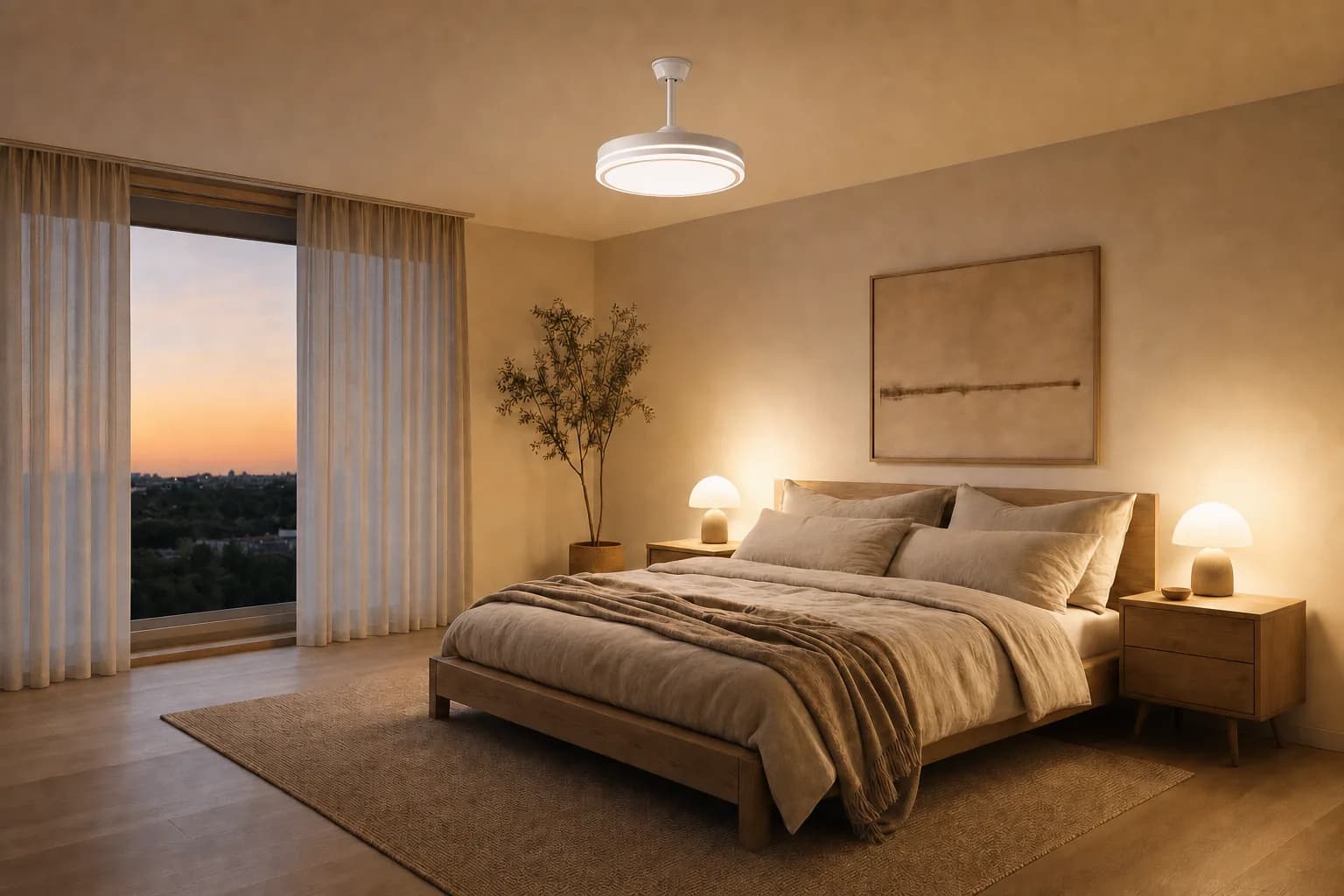
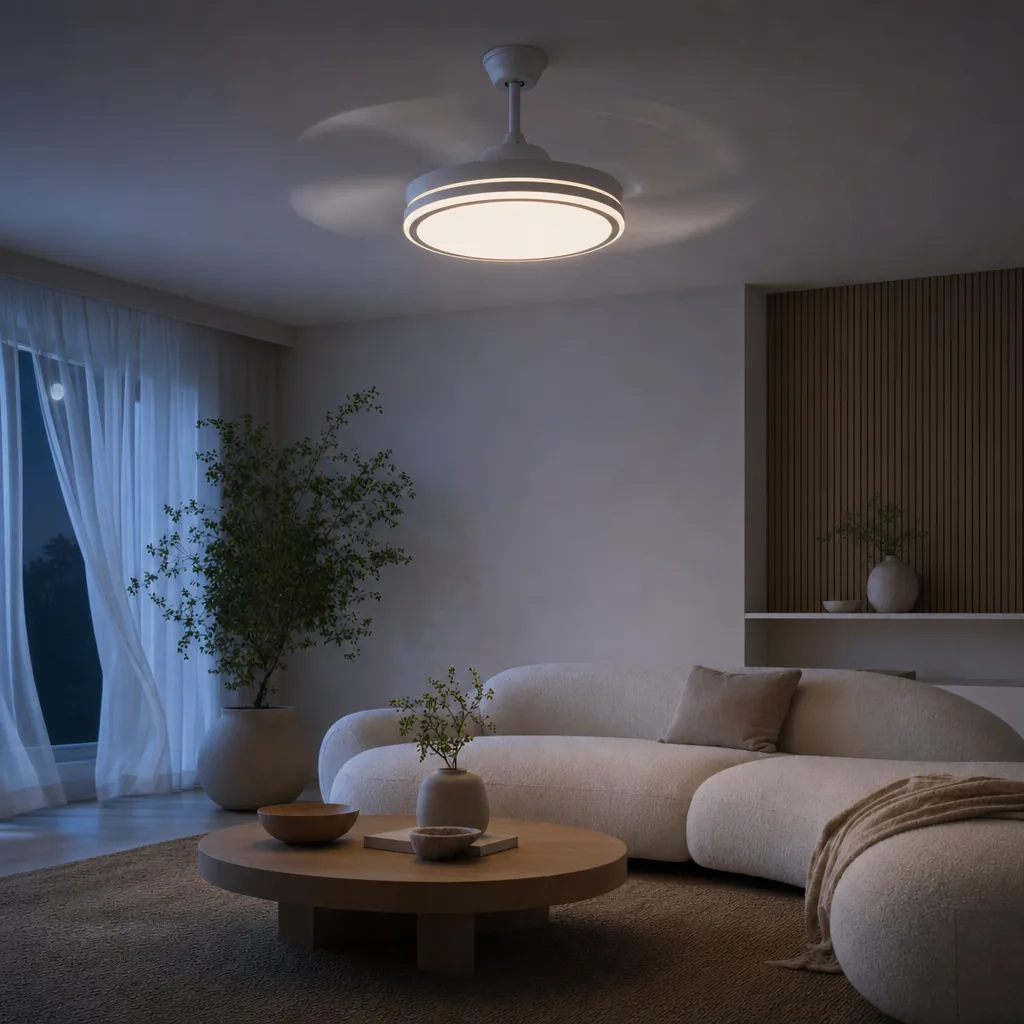
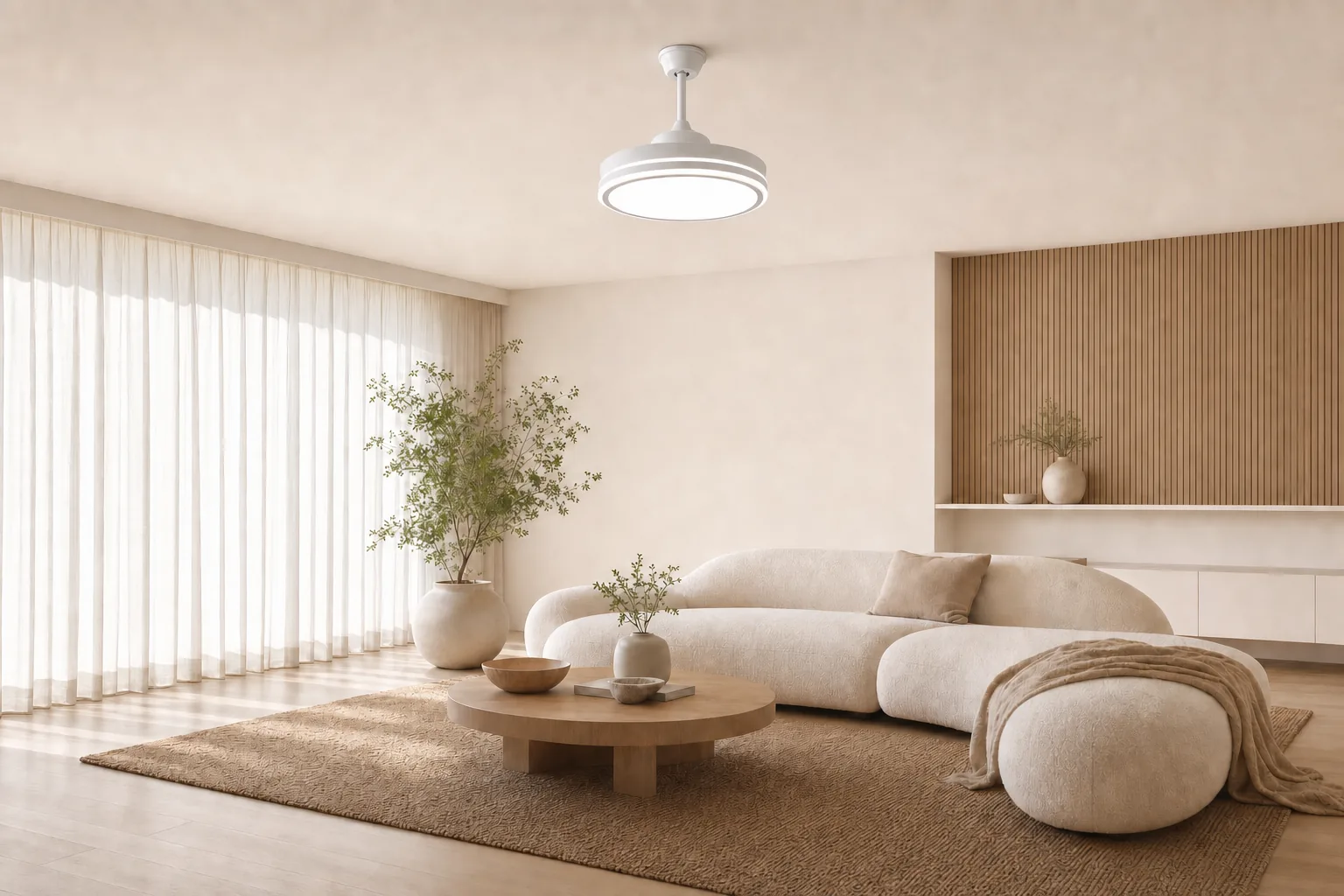
The round white ceiling light is the best-selling shape, and for good reasons: it goes with everything, does not date, and blends into a white ceiling to the point of disappearing. It is also the category where models look most alike in photographs and differ most in use.
Here is what really separates them once they are up.
Why round and white works everywhere
A disc has no orientation. Unlike an elongated or edged shape, it has no good or bad angle from the sofa, and needs aligning with neither walls nor furniture. That is what makes it compatible with rooms whose layout changes.
White on white takes the logic further: the object blends into the only large plain surface in the room. The ceiling becomes a continuous plane again, and attention goes to the walls, the materials and the people, which is usually the point.
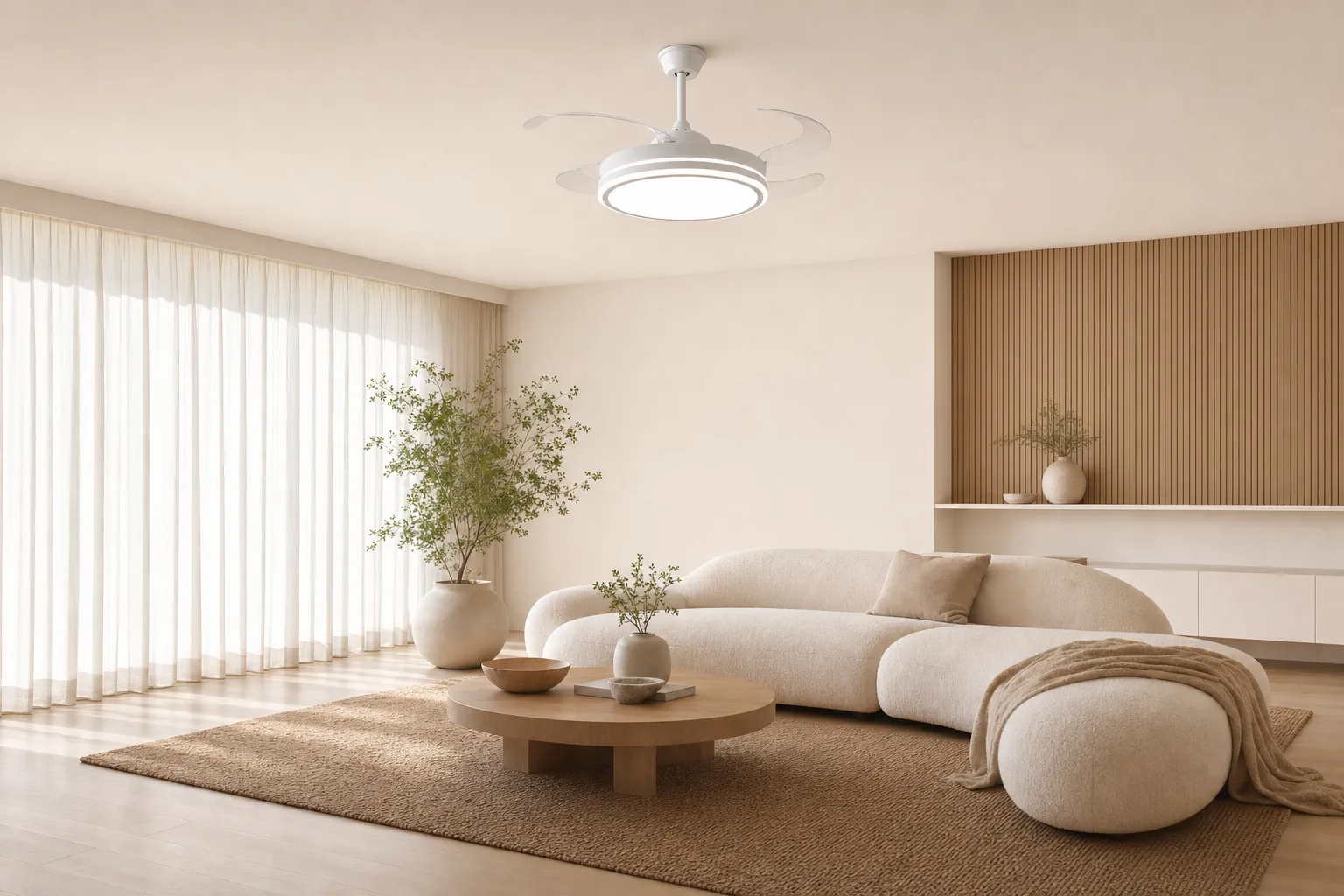
The Boréal 107
Retractable blades · Ø 107 cm · LED ceiling light & silent fan
- ✓Retractable blades: invisible when off, nobody guesses it's a fan
- ✓Sleep with windows closed, 30 dB, quieter than a whisper
- ✓Integrated LED 2700K → 6000K, dimmable: replaces your ceiling light
The three figures that separate two models
The first is quantity: between two 60 cm discs, one may give 1,200 lumens and the other 2,400. In a living space that factor of two changes everything, and it shows in no photograph.
The second is colour temperature, and above all whether it is adjustable or fixed. A disc locked at 4000K will always feel slightly cold in a living room in the evening.
The third is CRI, colour rendering. It decides whether your floor stays warm or pulls grey once night falls, and it is missing from most spec sheets.
- ·Lumens: from 1,200 to 2,400 for the same 60 cm diameter
- ·Kelvins: fixed or adjustable, the difference is lived every evening
- ·CRI: above 90 so colours stay true
- ·Depth: the flatter the disc, the less it announces itself
Depth, the forgotten criterion
At equal diameter, two discs can be 5 cm or 15 cm deep. The first looks stuck to the ceiling, the second forms a volume that casts its shadow on the surface around it and is noticed from the doorway.
It also determines compatibility with a low ceiling. Under 2.50 m, the depth of the luminaire enters directly into the clear-passage calculation, and every centimetre counts.
Round and white is a safe choice, and that is precisely why you should compare something other than shape. Look at lumens, adjustable temperature and CRI: those are the three values that make a plain disc light better than a designer one, and they fit on one line of a spec sheet.
Frequently asked questions
Does a white ceiling light suit every room?+
Yes, it is the most neutral shape and the only one that needs aligning with nothing. On a white ceiling it blends in almost entirely, leaving attention to the rest of the room.
How do you compare two round ceiling lights identical in a photo?+
By three figures: lumens, colour temperature and whether it adjusts, and CRI. Two discs of the same diameter can light twice as differently and render colours in very different ways.
What depth for a round ceiling light?+
As flat as possible if you want it forgotten, and necessarily under 15 cm if your ceiling is at 2.50 m or less, since depth enters the clear-passage calculation.
The SEY Maison Circle
Every month, an exceptional piece. Never reissued.
The Drops principle: one high-end furniture piece per month, in a numbered edition. Once it's gone, it never comes back. Circle members are notified 48 h early, access each drop 24 h before everyone else, and receive our guides before publication.
Discover the Drops →