Comparisons & guides
Ceiling light for a large open-plan room: why one is never enough beyond 30 m²
Published on ·2 min read
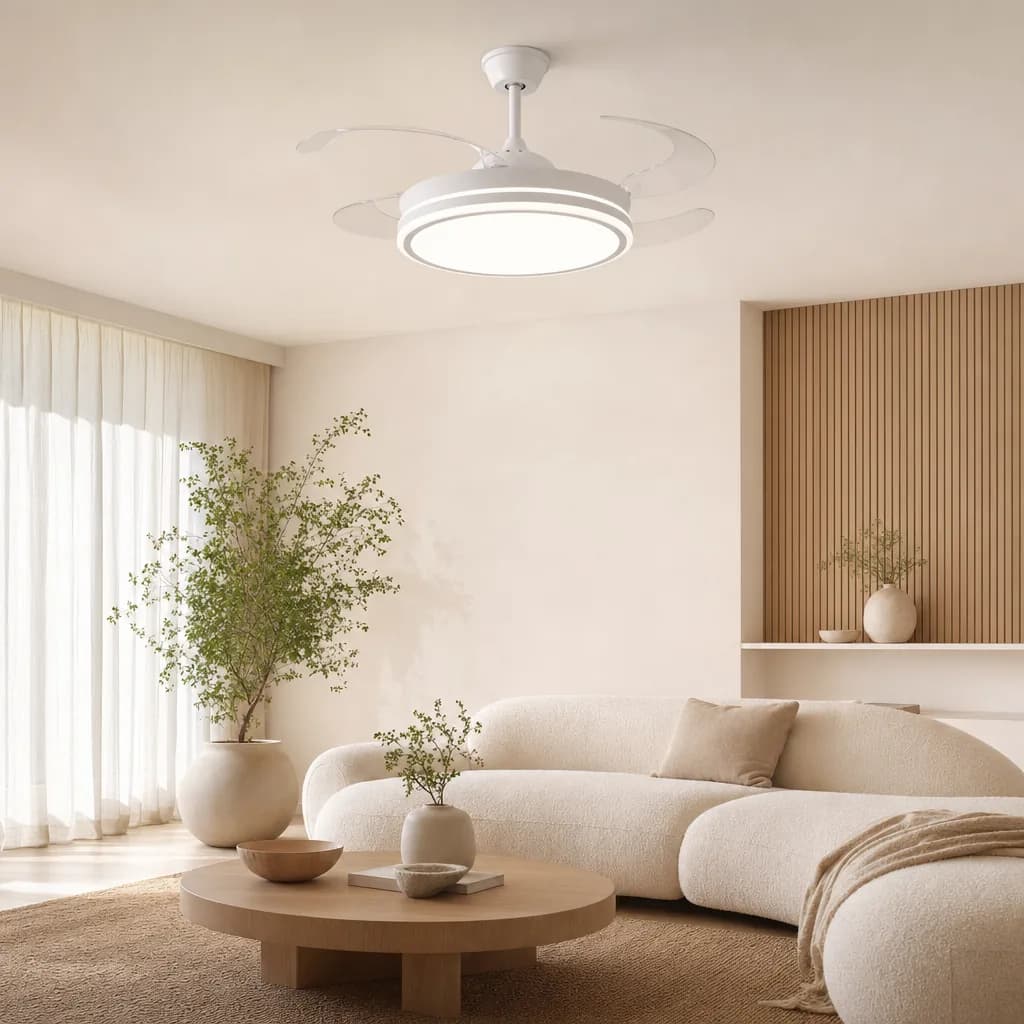
Open-plan living spaces have a well-known lighting flaw: they often end up lit like a lobby, uniformly and without relief. The cause is almost always the same, a single luminaire placed at the geometric centre.
Here is how to reason by zones rather than by surface.
The geometric centre is the centre of nothing
In an open-plan room of 35 m², the central point usually sits in a walkway: between the sofa and the table, where nobody stops. The luminaire there lights the floor, and the zones where life happens get grazing light.
The right approach is to identify the two or three zones of use, the seating corner, the table, perhaps the island, and place a source above each. The room then stops being a volume and becomes a succession of places again.
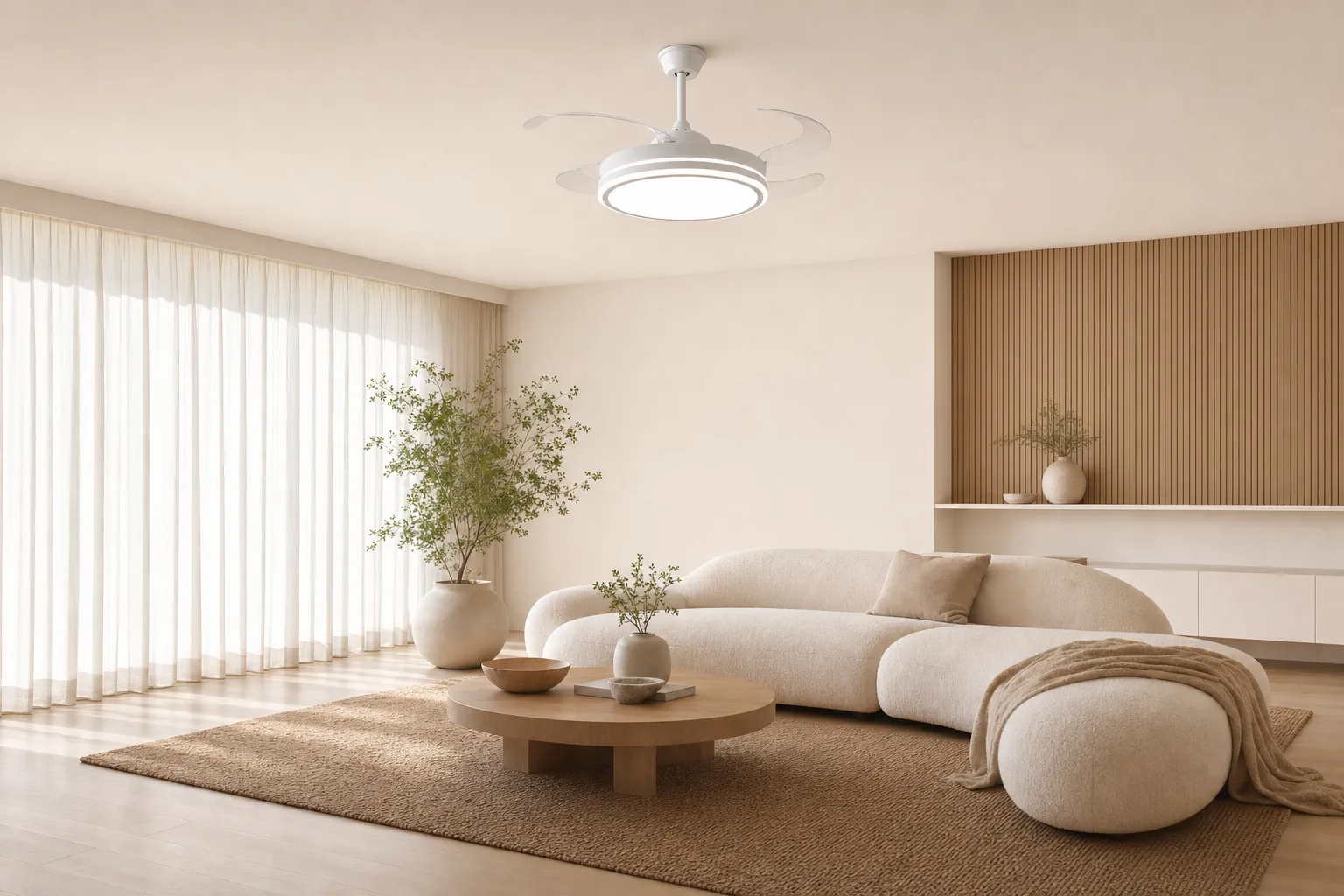
The Boréal 107
Retractable blades · Ø 107 cm · LED ceiling light & silent fan
- ✓Retractable blades: invisible when off, nobody guesses it's a fan
- ✓Sleep with windows closed, 30 dB, quieter than a whisper
- ✓Integrated LED 2700K → 6000K, dimmable: replaces your ceiling light
Two sources rather than one very large
A 140 cm luminaire lights a large surface, but from a single point: cast shadows stay strong and the uniformity feels like a waiting room. Two 90 cm luminaires, three to four metres apart, cover the same surface with half the contrast.
They also turn more slowly if they are bladed appliances, which makes them quieter. The rule holds for light as for airflow: two moderate sources beat one strong one.
- ·35 m²: 3,500 to 5,250 lumens in total
- ·Two 90 cm luminaires rather than one at 140 cm
- ·Three to four metres between the two points
- ·One luminaire per zone of use, not at the geometric centre
The fixing point, the real constraint
The practical obstacle is that an open-plan room rarely has two ceiling feeds. Where there is only one, two options exist: run a second supply, which means building work, or complete with plug-in low sources, which asks nothing.
In the second case, the existing light point is worth exploiting well: a generous diameter, adjustable in intensity and temperature, covering the main zone, and two or three lamps for the rest. It is less perfect than a dedicated installation, and far cheaper.
Beyond 30 m², stop looking for the luminaire that will cover everything: it does not exist, and what comes close lights like a lobby. Reason by zones, two moderate sources rather than one strong, and fill in with low lamps if the ceiling offers only one point.
Frequently asked questions
How many luminaires for a 35 m² room?+
Two at the ceiling if the installation allows, three to four metres apart and placed above the zones of use. With one light point, complete with two or three plug-in low lamps.
Can one very large ceiling light cover 35 m²?+
In quantity yes, in comfort no. Light comes from a single point, shadows stay hard and the uniformity feels like a lobby. Two moderate sources do better.
How many lumens for 35 m²?+
3,500 to 5,250 lumens in total, spread between the ceiling and low sources. The ceiling carries half to two thirds, as in a smaller room.
The SEY Maison Circle
Every month, an exceptional piece. Never reissued.
The Drops principle: one high-end furniture piece per month, in a numbered edition. Once it's gone, it never comes back. Circle members are notified 48 h early, access each drop 24 h before everyone else, and receive our guides before publication.
Discover the Drops →