The art of the home
Hallway and entrance ceiling light: the one room where nothing else works
Published on ·2 min read
The entrance and the hallway are the rooms you light last and switch on most often. They combine three constraints which, together, leave only one possible answer.
Here are those constraints, and what they impose in practice.
Three constraints that decide everything
The first is passage. You move through a hallway, often carrying things, sometimes two abreast. Nothing should come below 2 m from the floor, which rules out pendants whatever the ceiling height.
The second is width. A hallway is one metre to one metre twenty: a bulky luminaire immediately becomes obtrusive, visually and physically. The ratio between the luminaire diameter and the hallway width matters more than its floor area.
The third is the switching rhythm. A hallway is switched on twenty times a day for a few seconds. A luminaire slow to reach full output is more annoying there than a luminaire with low output.
- ·Nothing below 2 m from the floor, no exceptions
- ·A diameter under half the hallway width
- ·Instant start, no gradual ramp-up
- ·80 to 120 lumens per square metre is enough
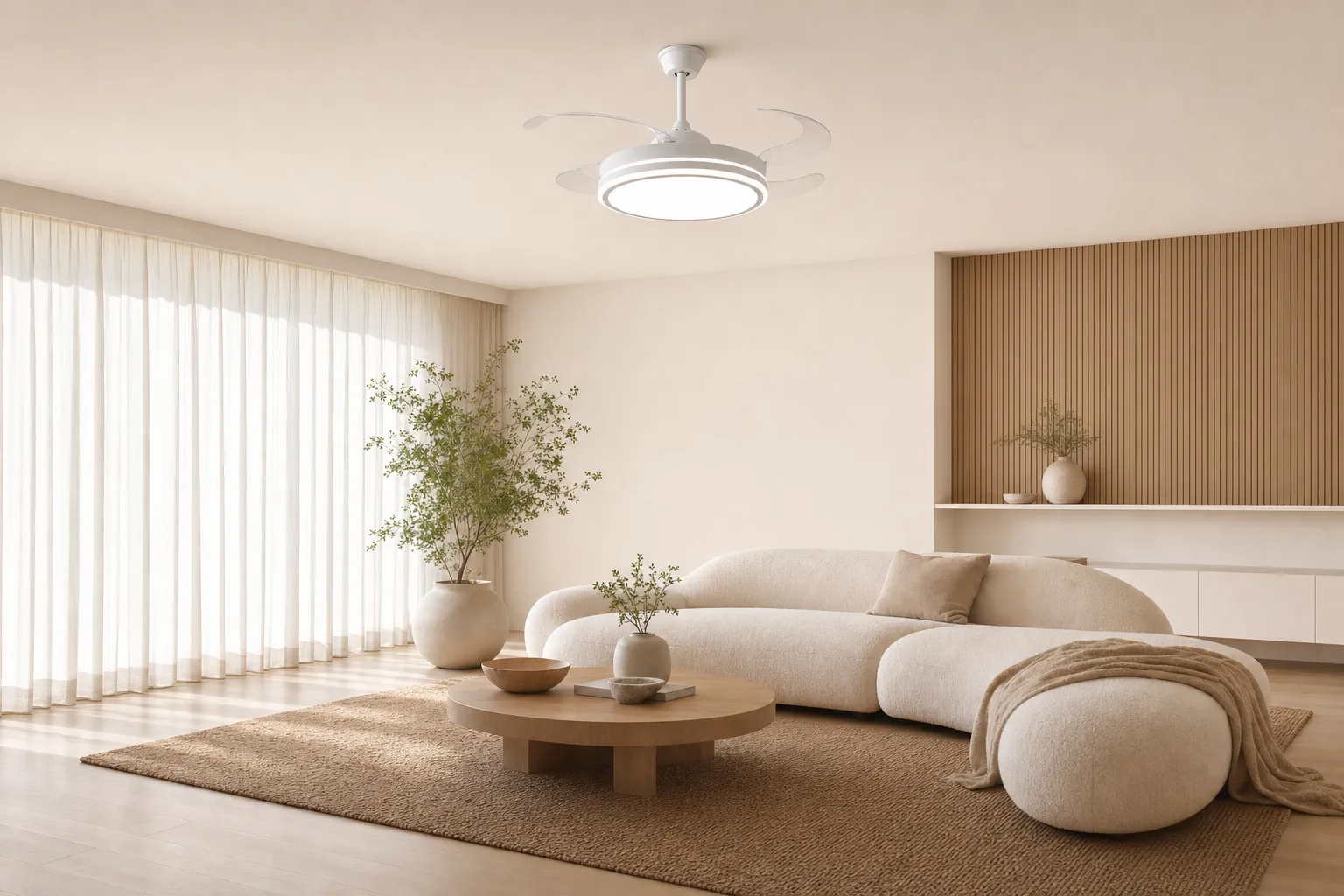
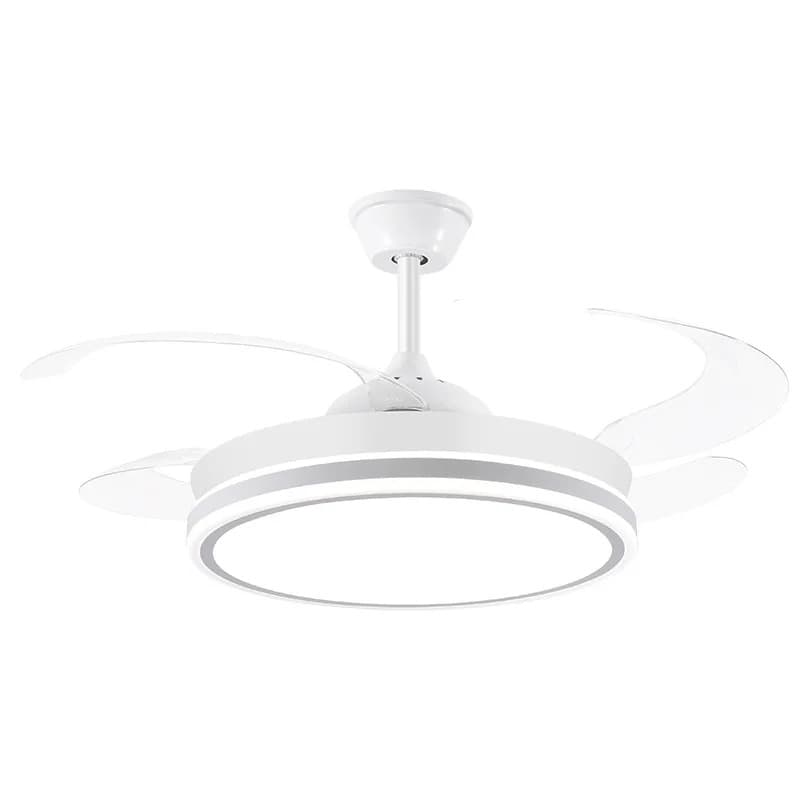
The Boréal 107
Retractable blades · Ø 107 cm · LED ceiling light & silent fan
- ✓Retractable blades: invisible when off, nobody guesses it's a fan
- ✓Sleep with windows closed, 30 dB, quieter than a whisper
- ✓Integrated LED 2700K → 6000K, dimmable: replaces your ceiling light
Temperature, so it does not feel like a hospital
A narrow space lit in cold white immediately takes on an institutional air. It is the combination of a small surface, close walls and light at 5000K or above that produces the effect, not the output.
A light around 3000K corrects that at no cost. It stays clear enough to find your keys and read a label, and warm enough for the hallway to belong to the home rather than to a block of flats.
The case of a long hallway
Beyond four metres, a single central luminaire leaves the ends dark and creates a tunnel effect. Two evenly spaced sources do better, even if each is less powerful.
When the ceiling offers only one point, a wall light or a lamp on a piece of furniture at the far end corrects the essential: it breaks the perspective and makes the end visible, which is enough to remove the tunnel feeling.
In an entrance or hallway, a ceiling light is not a default choice, it is the only luminaire compatible with passage. Stay under half the hallway width in diameter, count 80 to 120 lumens per square metre, choose 3000K over cold white, and add a second source if the hallway exceeds four metres.
Frequently asked questions
What lighting for a hallway?+
A flat ceiling light, 80 to 120 lumens per square metre, around 3000K. Nothing should come below 2 m from the floor, which rules out pendants even under a high ceiling.
What size ceiling light for a narrow hallway?+
A diameter under half the hallway width, so around 40 to 50 cm for a one-metre hallway. Beyond that, the luminaire becomes visually obtrusive.
Is a motion sensor useful in a hallway?+
It helps when you pass through with your hands full, and it prevents leaving the light on. Check that the luminaire starts instantly: a slow model makes the sensor pointless.
The SEY Maison Circle
Every month, an exceptional piece. Never reissued.
The Drops principle: one high-end furniture piece per month, in a numbered edition. Once it's gone, it never comes back. Circle members are notified 48 h early, access each drop 24 h before everyone else, and receive our guides before publication.
Discover the Drops →