Energy & ecology
How much does a ceiling light cost per year? The calculation in three lines
Published on ·3 min read

The question comes up with every purchase, and it deserves a figure rather than an impression. The calculation fits in three lines, and its result often surprises by how modest it is.
Here is how to do it, and where the real stake of a luminaire now lies.
The calculation, in three lines
Multiply the power in watts by the number of hours used daily, then by 365, and divide by 1,000 to get kilowatt-hours. Finally multiply by the price of a kilowatt-hour.
For a 30 W LED ceiling light on five hours a day: 30 times 5 times 365 divided by 1,000 gives around 55 kWh a year. At the French regulated tariff of roughly €0.15 per kilowatt-hour, that is close to €8 a year.
- ·30 W LED ceiling light, 5 h a day: around 55 kWh, close to €8 a year
- ·15 W LED ceiling light, 5 h a day: around 27 kWh, about €4 a year
- ·200 W halogen equivalent: around 365 kWh, about €55 a year
- ·A whole home in LED: a few per cent of the total bill

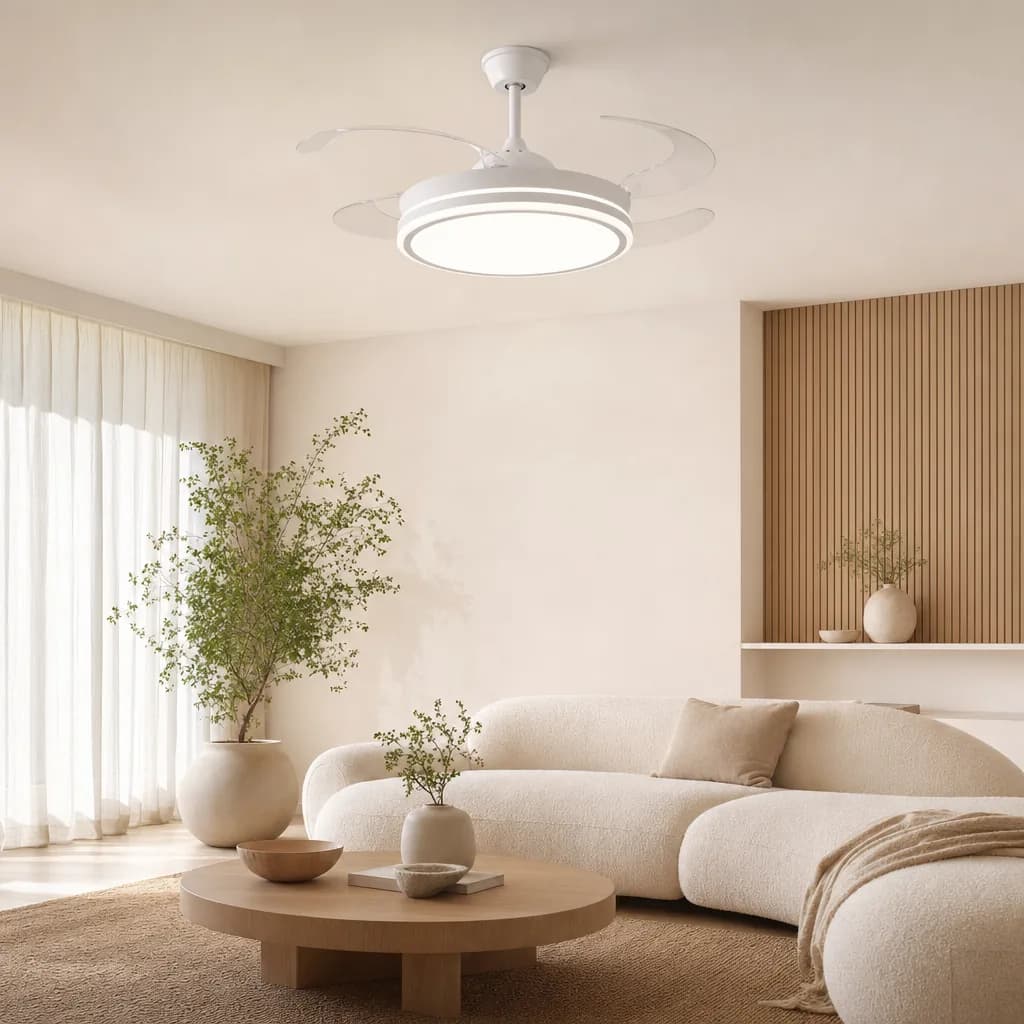
The Boréal 107
Retractable blades · Ø 107 cm · LED ceiling light & silent fan
- ✓Retractable blades: invisible when off, nobody guesses it's a fan
- ✓Sleep with windows closed, 30 dB, quieter than a whisper
- ✓Integrated LED 2700K → 6000K, dimmable: replaces your ceiling light
Why lighting stopped being an issue
Before LEDs, lighting accounted for a visible share of a household bill, because an incandescent bulb dissipated ninety per cent of its energy as heat. A home lit with halogen could exceed three hundred euros a year.
LEDs divided that consumption by five to ten for the same light. Lighting fell behind heating, hot water, refrigeration and the washing machine. Saving a few more watts on a luminaire no longer has a measurable effect on a bill.
Where the real stake now lies
The first is efficiency, measured in lumens per watt: two 20 W models can produce 1,400 or 2,200 lumens. That is where the difference plays out, not in a few watts of stated power.
The second is actual service life, that of the power unit rather than of the LED. A luminaire replaced after three years costs infinitely more than eight euros of annual electricity, in money as in waste. That is the ground on which a purchase is judged today.
An LED ceiling light costs a few euros a year, and that figure should no longer guide a purchase. Look instead at the lumens obtained per watt, and above all at how long the luminaire will last. It is premature replacement, not consumption, that now costs money.
Frequently asked questions
How much does an LED ceiling light use per year?+
Around 55 kWh for a 30 W model on five hours a day, close to €8 at the French regulated tariff. A 15 W model comes down to about €4 a year.
Should you switch off an LED ceiling light when leaving the room?+
Yes, but for wear rather than for the bill: repeated switching tires an LED less than a fluorescent tube, and the saving is real even if modest.
Does a more powerful ceiling light cost much more to run?+
No. Between 15 and 30 W, the annual gap is around four euros. Better to choose the output the room needs and add a dimmer than to undersize to save.
The SEY Maison Circle
Every month, an exceptional piece. Never reissued.
The Drops principle: one high-end furniture piece per month, in a numbered edition. Once it's gone, it never comes back. Circle members are notified 48 h early, access each drop 24 h before everyone else, and receive our guides before publication.
Discover the Drops →