
Silence & sleep
Neck pain at night: what actually puts your neck under tension
Published on ·6 min read
Waking up with a stiff neck is a very common complaint. The pain is there on the first movement, it gets in the way when you turn your head towards an oncoming car, then it fades within the hour. That pattern rarely looks like an injury. It looks like a position held for too long.
This article explains what the neck goes through during a night, which positions put it under tension, and what alignment markers to aim for. These are comfort and posture tips, not a diagnosis. Pain that lasts or keeps coming back calls for the advice of a health professional.
What the neck goes through in eight motionless hours
An adult head generally weighs 4 to 5 kg. During the day the neck muscles carry it and correct constantly: an uncomfortable position held for ten minutes ends up triggering a move, often without you thinking about it. At night that correction system runs at low speed. Muscles relax, and it is the ligaments, joint capsules and discs that absorb the position, sometimes for two or three hours in a row with no adjustment at all.
That is why a painful neck on waking usually tells a story about position rather than effort. Pain peaks on the first movement, then eases as circulation returns and the muscles get back to work. Many people notice it has almost gone by breakfast. That very specific profile, stiff on getting up then better afterwards, is a sign that the bedding and the sleeping position are worth a look.
The three positions that put the neck under tension
The first is side rotation. Face down, the head has to turn 80 to 90 degrees in order to breathe, and it stays there for hours. That is the neck's maximum range, held cold, with the muscles relaxed. The second is extension: a pillow that is too flat, or no pillow at all on your back, lets the head drop backwards and hollows the neck. The third is flexion: a pillow that is too thick on your back pushes the chin towards the sternum and stretches the whole back of the neck.
There is also a mixed position, the arm slid under the head or under the pillow. It lifts one shoulder, tilts the head to the opposite side and compresses the nerve pathway towards the arm. It is often the one behind waking up with pins and needles in the hand. None of these positions is dangerous in itself, they are simply held too long. The fix is rarely to force yourself: it is to make the good position more comfortable than the bad one.
- ·Face down: neck in near maximum rotation for several hours.
- ·On the back with a pillow that is too flat: head tipped back, neck hollowed.
- ·On the back with a pillow that is too thick: chin tucked in, back of the neck stretched.
- ·On the side with a pillow that is too low: head dropping towards the shoulder, tension on one side only.
- ·Arm under the head: shoulder lifted, sideways tilt, frequent pins and needles.
The alignment markers to aim for
The marker is easy to remember: the head should stay in line with the back, as if you were standing. On the side, that means filling the space between ear and shoulder, a space that often measures 10 to 12 cm on an average adult frame. On the back that space is much smaller, and 6 to 8 cm is usually enough. The nose stays in line with the sternum, the chin neither lifted nor tucked. A photo taken by someone else, from the side, shows the result in three seconds.
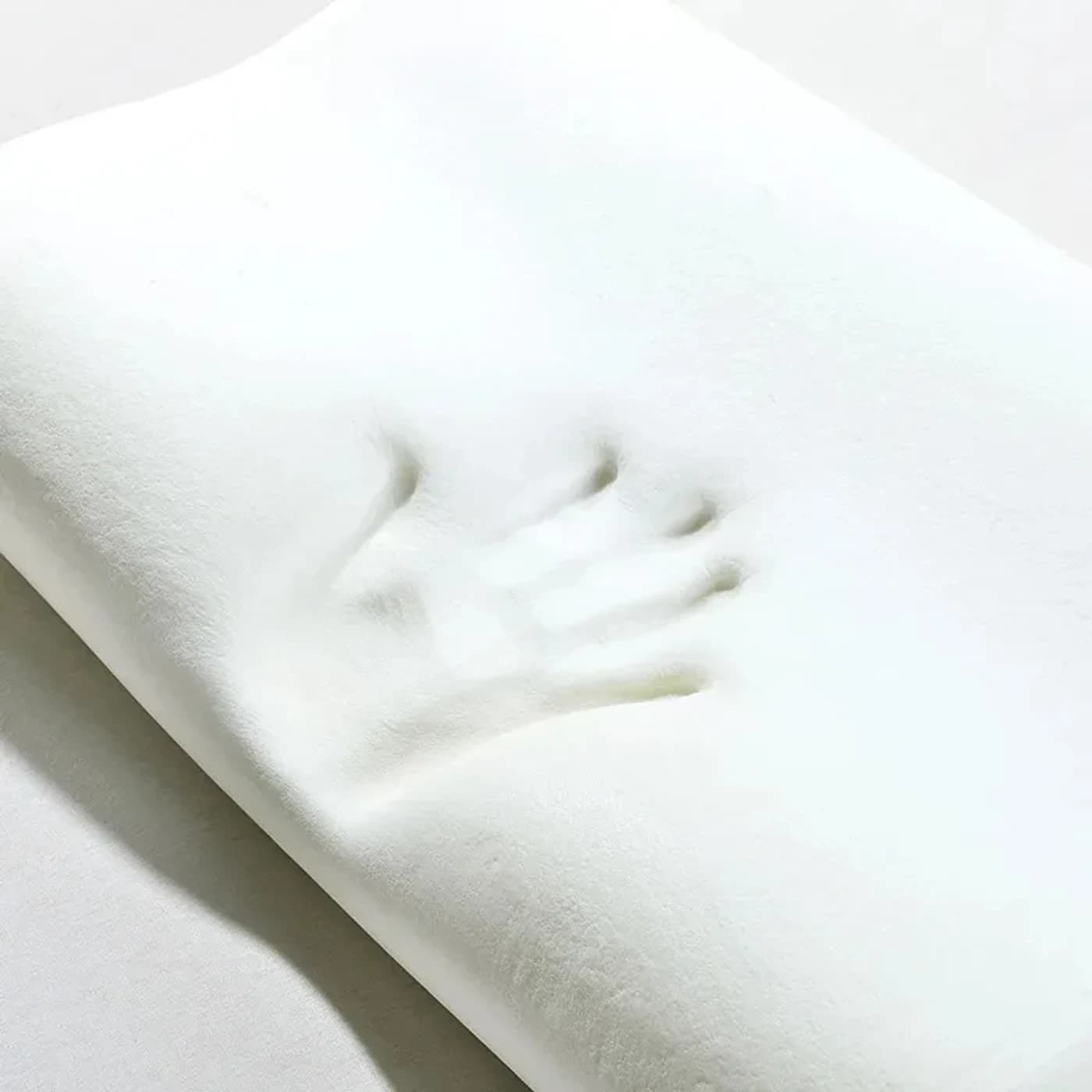
The practical problem is that many sleepers change position during the night and would need two heights. The Nuage 50 is built for that: a memory foam pillow in a 50 × 30 cm format, with two wave heights on the same product, 10 cm on one side and 7 cm on the other. You switch from one to the other by flipping it over, with nothing to buy twice. The high wave suits side sleeping, the low wave suits back sleeping. It comes on its own at 55 € or with its textured polyester and cotton cover at 65 €.
When the pillow is no longer the question
This has to be said plainly: nothing above replaces medical advice. Neck pain that lasts several weeks, travels down the arm, comes with persistent pins and needles, dizziness, unusual headaches, or wakes you at night calls for the advice of a health professional. A pillow is a comfort and posture item. It is neither a treatment nor a medical device, and presenting it otherwise would be dishonest.
When medical advice is reassuring, several comfort levers are worth checking before the pillow. Screen posture during the day, which tires the same muscles. The age of the mattress, because a mattress that sags too much shifts the whole body axis and no pillow can catch that up. The lifespan of the pillow itself, often two to three years before it flattens. And bedroom temperature, because a room that runs too warm multiplies position changes and awkward support.
A stiff neck on waking is usually a story of alignment held too long, not of effort. Aiming for the head in line with the back, with a pillow height matched to your sleeping position, settles many cases. If the pain lasts, returns or wakes you, talk to a health professional.
Frequently asked questions
Why does my neck hurt when I wake up but not during the day?+
Because the pain usually comes from the position held during the night, not from effort. With the muscles relaxed, the neck absorbs the same posture for hours without correcting it. Once you get up, circulation returns and the muscles go back to work, so the stiffness fades within the hour. If it lasts all day or comes back every week, see a health professional.
What pillow height is right for the neck?+
It depends on your sleeping position. On the side you need to fill the gap between shoulder and ear, often 10 to 12 cm. On the back, 6 to 8 cm is usually enough. The real marker is not an absolute figure but alignment: seen from the side, the head should stay in line with the back.
Is a memory foam pillow useful for the neck?+
Its interest is stability: slow rebound foam keeps the shape it is given and cradles the head instead of collapsing to one side at the first movement. Many people find that this limits side rotation. It is not a treatment, and it does not replace the advice of a health professional if pain persists.
The SEY Maison Circle
Every month, an exceptional piece. Never reissued.
The Drops principle: one high-end furniture piece per month, in a numbered edition. Once it's gone, it never comes back. Circle members are notified 48 h early, access each drop 24 h before everyone else, and receive our guides before publication.
Discover the Drops →