Ceiling fan blades: wood, ABS or metal, which material to choose?
Published on ·7 min read
Two ceiling fans of the same diameter, at roughly the same price. One has wooden blades, another ABS, a third metal. The product sheets do not explain what that changes, and the photos even less. Yet the material affects what you look at every day, the weight the ceiling carries, the upkeep and the way the fan ages.
It affects the air moved and the noise less than people think. This comparison reviews the materials, solid wood, veneer and wood effect, ABS, metal, with what each one brings and what it costs. It ends with a verdict by use, and with the model we recommend when you want real wood.
What the blade material changes, and what it does not
The airflow of a ceiling fan depends on four factors: diameter, blade pitch, ideally 12 to 15°, rotation speed and the motor. The material is not one of them. With identical shape, diameter and motor, a wooden blade and an ABS blade move the same amount of air.
As for noise, the motor decides: a DC motor runs between 28 and 34 dB, when an entry-level AC motor often exceeds 45 dB. On the blade side, what matters is balancing. Factory-balanced blades, whatever they are made of, remove imbalance and vibration at the source.
The material does change four very real things: appearance, weight, upkeep and how the fan holds up over time. Those are the four criteria to compare on.
Solid wood: an object you look at
A solid-wood blade is cut from a piece of wood. Its grain runs through the material: it continues on the edge, and each blade is different from the next. That is what sets a solid-wood fan apart from all the others: from close up and from afar, it is looked at like a piece of furniture.
Solid wood has two trade-offs. It is slightly heavier than ABS, which can call for a more powerful motor at the same diameter, and for a fixing that carries the whole without question. And it dislikes plenty of water and detergents: it is dusted dry.
In return, it ages well. On blades that turn for thousands of hours a year, real grain keeps its look, where a surface decoration can wear at the edges.
Veneer and wood effect: knowing how to read the product sheet
Between solid wood and plastic, there are veneered blades: a board core covered with a thin sheet of real wood. From the front, the look is that of wood. The limit shows on the edge, where the grain does not continue, and over time if the sheet is thin.
Then comes wood effect or wood finish. Those words mean a printed decorative film applied to ABS or metal. It is not wood, and there is nothing wrong with that if it is stated clearly: a good printed finish gives a blade that is light, regular and easy to clean. The problem starts when the photo suggests solid wood.
The reading rule is simple. If the sheet says solid wood, it is solid wood. If it says wood effect, wood finish or wood look, assume it is a decorative finish, and judge the model on the rest: motor, noise level, warranty.
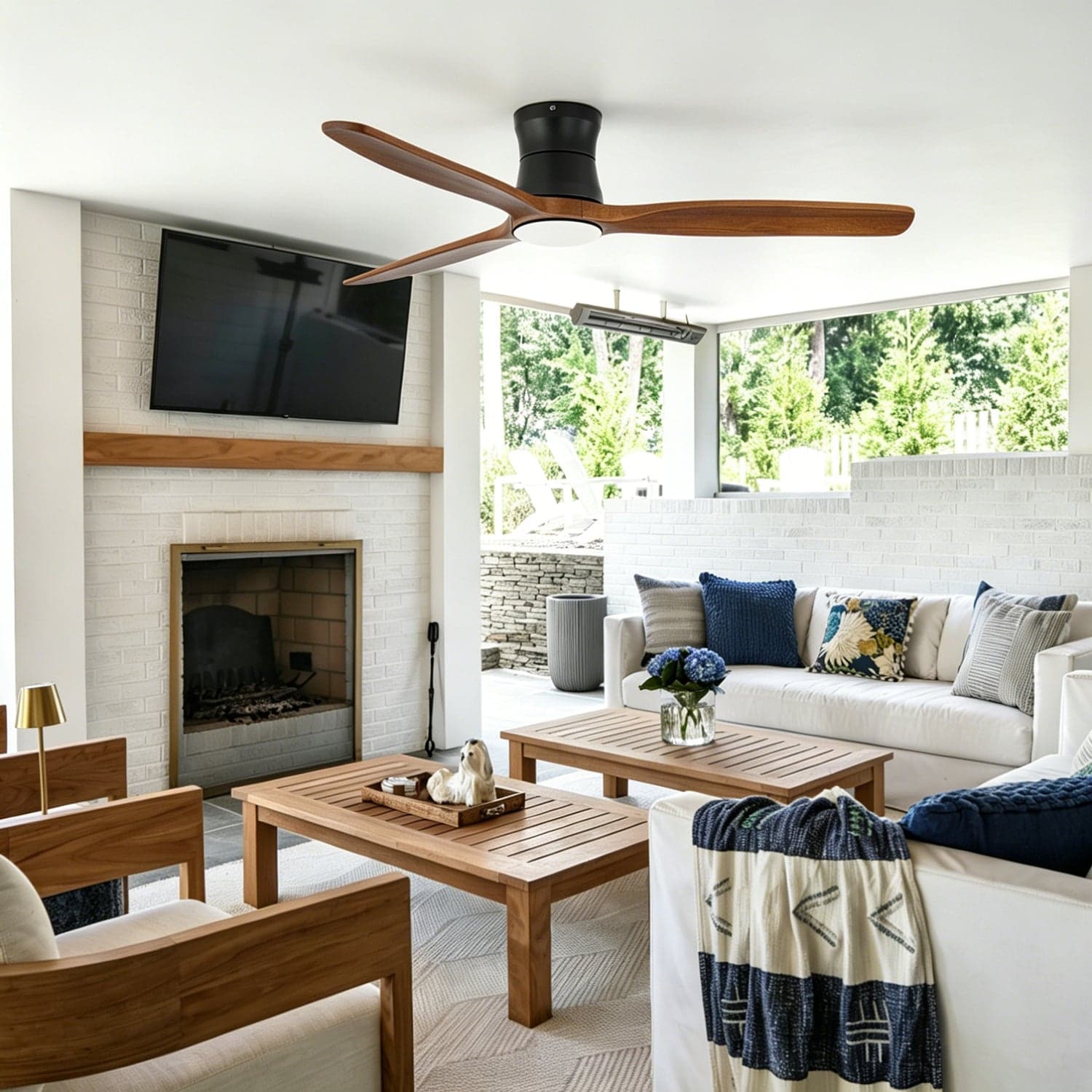
The Fjord 132
Solid wood · Ø 132 cm · Three Scandinavian blades
- ✓Oiled solid-wood blades, every unit is unique
- ✓Three-blade Scandinavian design: sculptural, never heavy
- ✓Ultra-silent DC motor, slow large-volume airflow
€419€429
ABS: light, precise, easy to live with
ABS is a rigid, moulded plastic. Moulding makes it possible to give the blade exactly the profile wanted, curve and thickness included, and to reproduce it identically from one blade to the next. That is an advantage for balancing.
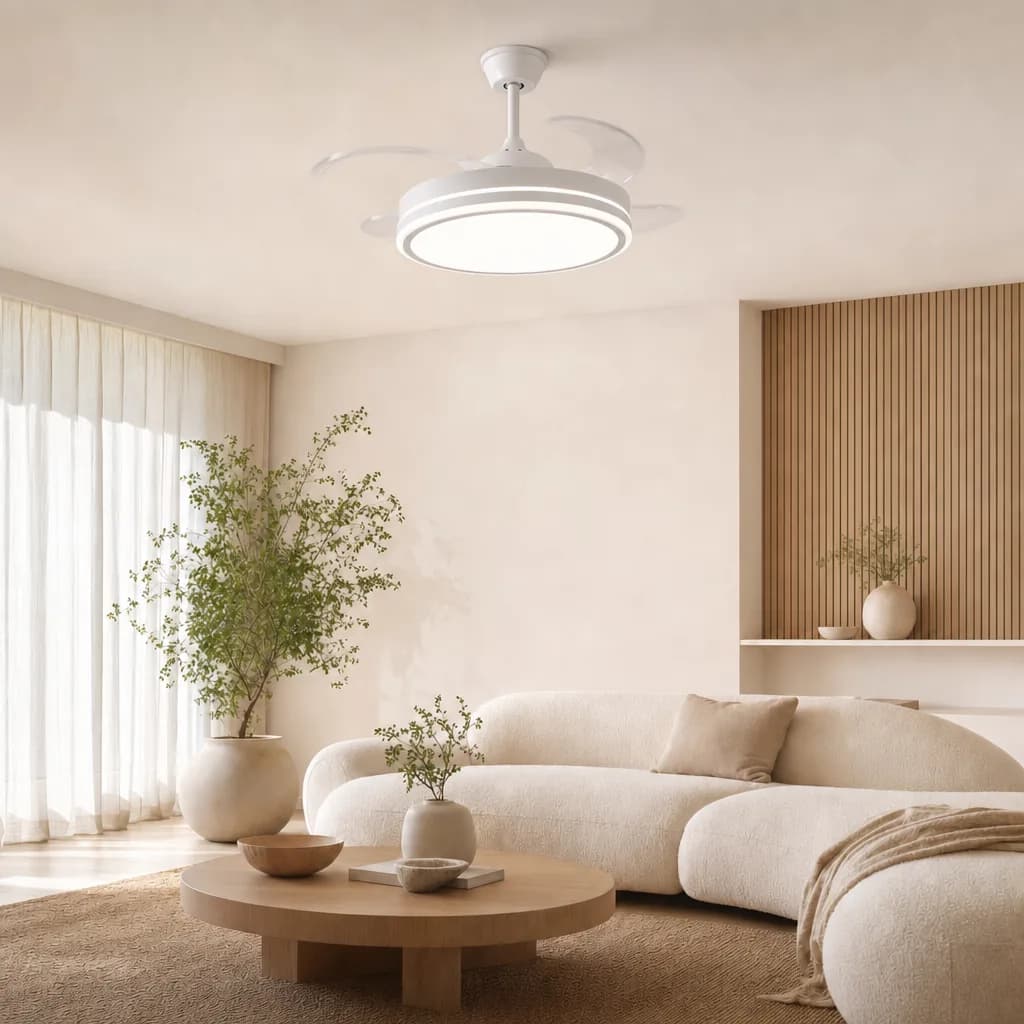
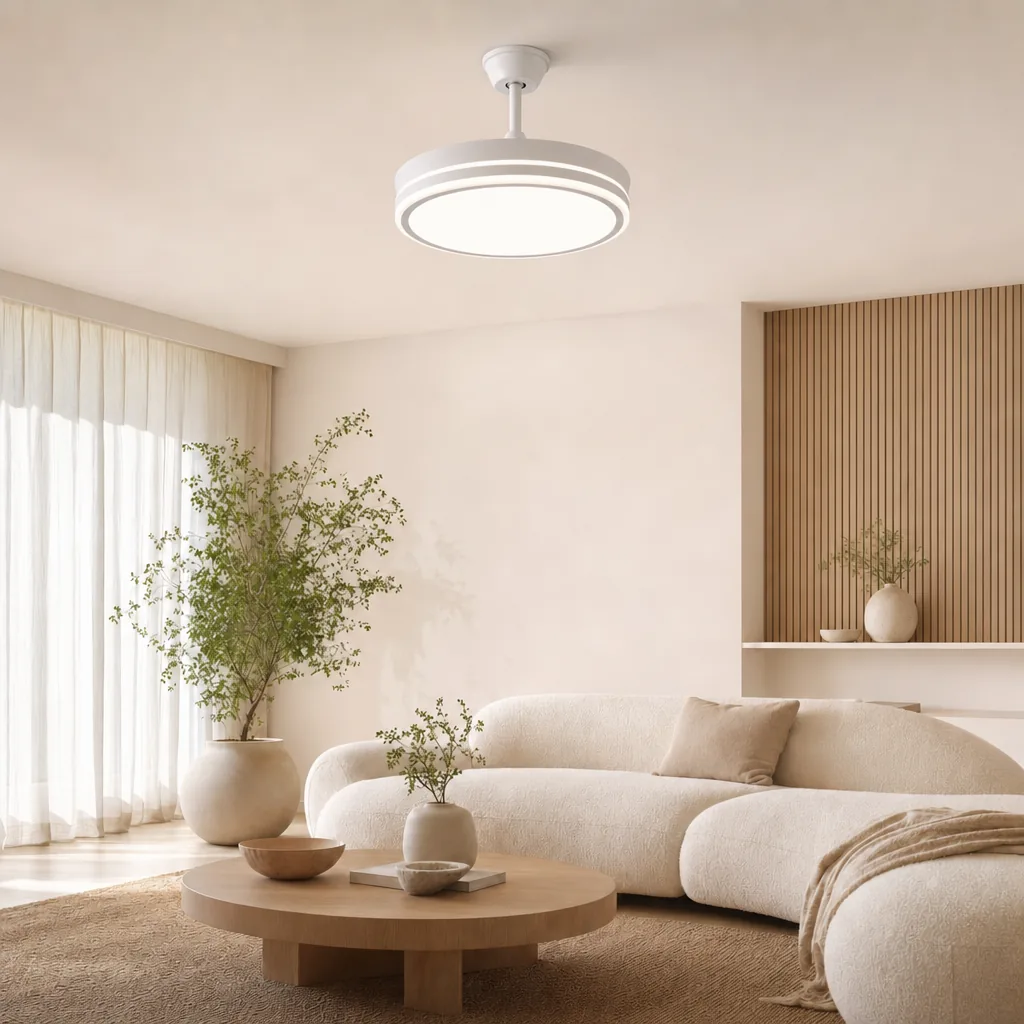
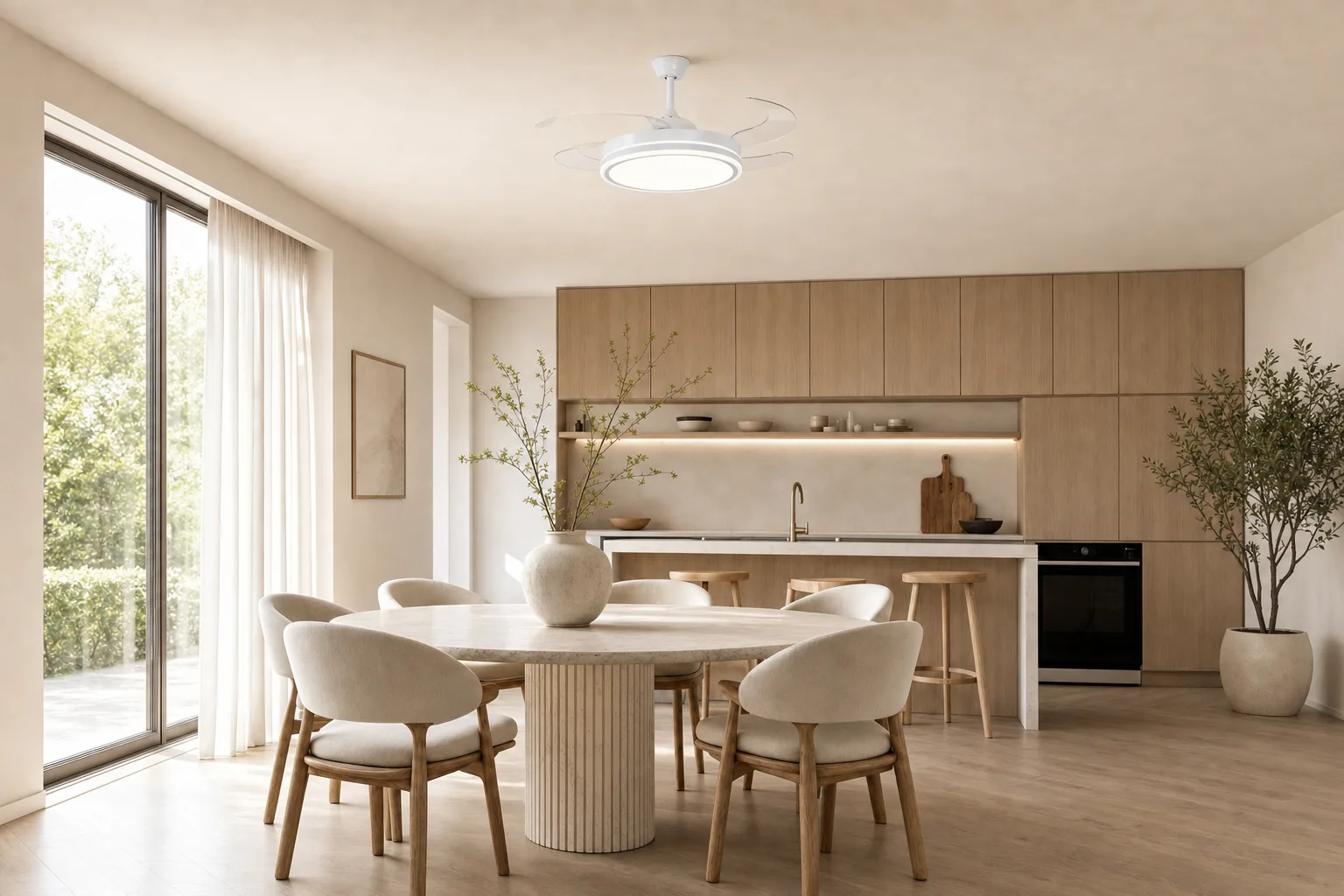
Its lightness counts too. It spares the motor and the fixing, and it is valuable on retractable-blade fans: a mechanism that opens and folds the blades must be stressed as little as possible. The Boréal 107, whose four blades fold away when it stops, has ABS blades.
Finally, ABS wipes clean in one pass, with no specific product. It is the easiest material to live with where blades get dirty, in a living space open to the kitchen for example. Its limit is aesthetic: up close, an ABS blade does not pass for wood, however well finished.
Metal: for large volumes and the industrial style
Metal blades are found mostly on industrial-style fans and on large workshop models. They are thin, rigid and do not fear knocks. Their flat, taut line is part of the style.
They have a reputation for being noisier than wood or ABS: thin sheet metal can resonate, and a thin edge cuts the air more sharply than a thick profile. On a well-designed fan the gap stays small. But in a bedroom, where the target is below 33 dB at night speed, it is not the material you choose first.
A thin metal edge also calls for strictness on height: at least 2.10 m between the floor and the bottom of the blades, as for any ceiling fan.
Upkeep and durability, material by material
Upkeep is the most practical criterion day to day. In every case, switch the fan off and wait for the blades to stop completely before touching them.
A word on moisture, because the question comes up about ABS and metal. A blade that does not fear water does not make a fan for a damp room: it is the motor and the electronics that count, and that is read in the appliance's protection rating. The product sheets for our models do not state one. They are installed in dry rooms, whatever their blades are made of.
- ·Solid wood: dry microfibre cloth every 2 to 4 weeks; twice a year, a barely damp cloth then an immediate dry wipe
- ·Veneer and printed finish: the same gentleness as for wood, without rubbing the edges
- ·ABS: one pass with a cloth, no specific product
- ·Metal: soft cloth, then a dry wipe so as not to leave marks
- ·All materials: check once a year that the blade screws are tight
Verdict: which material for which use, and our solid-wood choice
The choice depends on how the room is used and on how much the fan is in view.
If you want real wood, we recommend the Fjord 132. Its three blades are oiled solid wood, and every unit is unique. Their curve recalls fine joinery, and the fittings are invisible: nothing interrupts the line of the wood.
The weight of the wood is handled by a reversible DC motor, rated at 32 dB maximum, with six speeds on the remote. The Fjord measures 132 cm in diameter, the size for living rooms of 25 to 30 m². It is CE certified and carries a 2-year warranty.
- ·Living room, dining room, any room where the fan is on show: solid wood
- ·Retractable blades, discreet ceiling light, room open to the kitchen: ABS
- ·Large volume, workshop spirit, high ceiling: metal
- ·A taste for wood without solid wood: veneer or printed finish, knowingly
Blade material makes neither the airflow nor the silence of a ceiling fan: it makes its look, its weight, its upkeep and the way it ages. Solid wood for the object you look at, ABS for lightness and simplicity, metal for large volumes, and a careful reading of product sheets so as not to mistake a finish for wood. In a living room where the fan holds the centre of the ceiling, the Fjord 132, three oiled solid-wood blades and a DC motor at 32 dB maximum, is the model we recommend.
Frequently asked questions
Are wooden blades quieter than ABS blades?+
No, not in themselves. Noise level depends mainly on the motor and on how well the blades are balanced. A DC motor runs between 28 and 34 dB, whether the blades are wood or ABS.
How do you recognise real solid-wood blades?+
The product sheet must say solid wood. On the blade, the grain continues on the edge and differs from one blade to the next. Wood effect or wood finish means a printed decoration.
Are solid-wood blades too heavy for the ceiling?+
They are slightly heavier than ABS blades. Check the weight of the fan on its product sheet and fix it into a load-bearing support: concrete, beam, joist or reinforcement, never into plasterboard alone.
Why do retractable-blade fans have ABS blades?+
Because a mechanism that opens and folds the blades must be stressed as little as possible. ABS is light and can be moulded to the profile wanted, which suits that use.
The SEY Maison Circle
Every month, an exceptional piece. Never reissued.
The Drops principle: one high-end furniture piece per month, in a numbered edition. Once it's gone, it never comes back. Circle members are notified 48 h early, access each drop 24 h before everyone else, and receive our guides before publication.
Discover the Drops →