Ceiling fan airflow: how to read the figure
Published on ·8 min read
On a ceiling fan's product sheet, one figure always impresses: airflow. 6,000 m³/h here, 180 m³/min there, 5,500 CFM elsewhere. People conclude that the biggest figure points to the best fan. It is rarely that simple, and two sheets are not necessarily talking about the same thing.
This guide explains what airflow measures, how to move from one unit to another, why the figure is given at full speed, and what to look at instead to know what you will feel at home. It ends with a method for comparing two product sheets, and with the case of the Boréal 107.
What airflow measures
Airflow is the volume of air the blades set in motion over a given time. 6,000 m³/h means that 6,000 cubic metres of air pass through the circle of the blades in one hour. It is a measure of quantity, not of speed or coolness.
It should not be read as air renewal. A 30 m² living room under a 2.50 m ceiling holds 75 m³ of air. An airflow of 6,000 m³/h is eighty times that volume per hour, but it is the same air passing between the blades again and again. A ceiling fan stirs; it brings no air in and takes none out. To renew the air, you need a window or a ventilation system.
So the figure says one thing: the fan's ability to set a large volume in motion. That is useful for a large room, much less so for a bedroom.
m³/h, m³/min, CFM: moving from one unit to another
Three units appear on product sheets. The cubic metre per hour, m³/h, is the most common in Europe. The cubic metre per minute, m³/min, gives figures sixty times smaller for the same airflow. CFM, for cubic feet per minute, is the American unit.
Before any comparison, bring everything back to m³/h. The conversion is a single multiplication. A common trap: a model shown at 5,000 CFM looks less powerful than a model at 6,000 m³/h. Converted, the first moves about 8,500 m³/h. It is clearly ahead.
- ·From m³/min to m³/h: multiply by 60, so 6,000 m³/h for 100 m³/min
- ·From CFM to m³/h: multiply by about 1.7, so about 6,800 m³/h for 4,000 CFM
- ·From m³/h to CFM: divide by about 1.7
Why the figure is given at full speed
The airflow on a product sheet is measured at maximum speed. That makes sense from the manufacturer's point of view, since that is where the figure is largest. It is much less useful to you: full speed is used for a few minutes, to stir an overheated room when you come home. The rest of the time, a ceiling fan runs on speeds 1 to 3.
Yet airflow drops with speed, and not in the same way from one fan to another. Two models with the same maximum airflow can behave differently on speed 1: one keeps a broad, steady stir, the other moves almost nothing. The sheet rarely says so.
When a sheet gives the airflow at several speeds, that is a good sign, and the line to read is the one for low speeds.
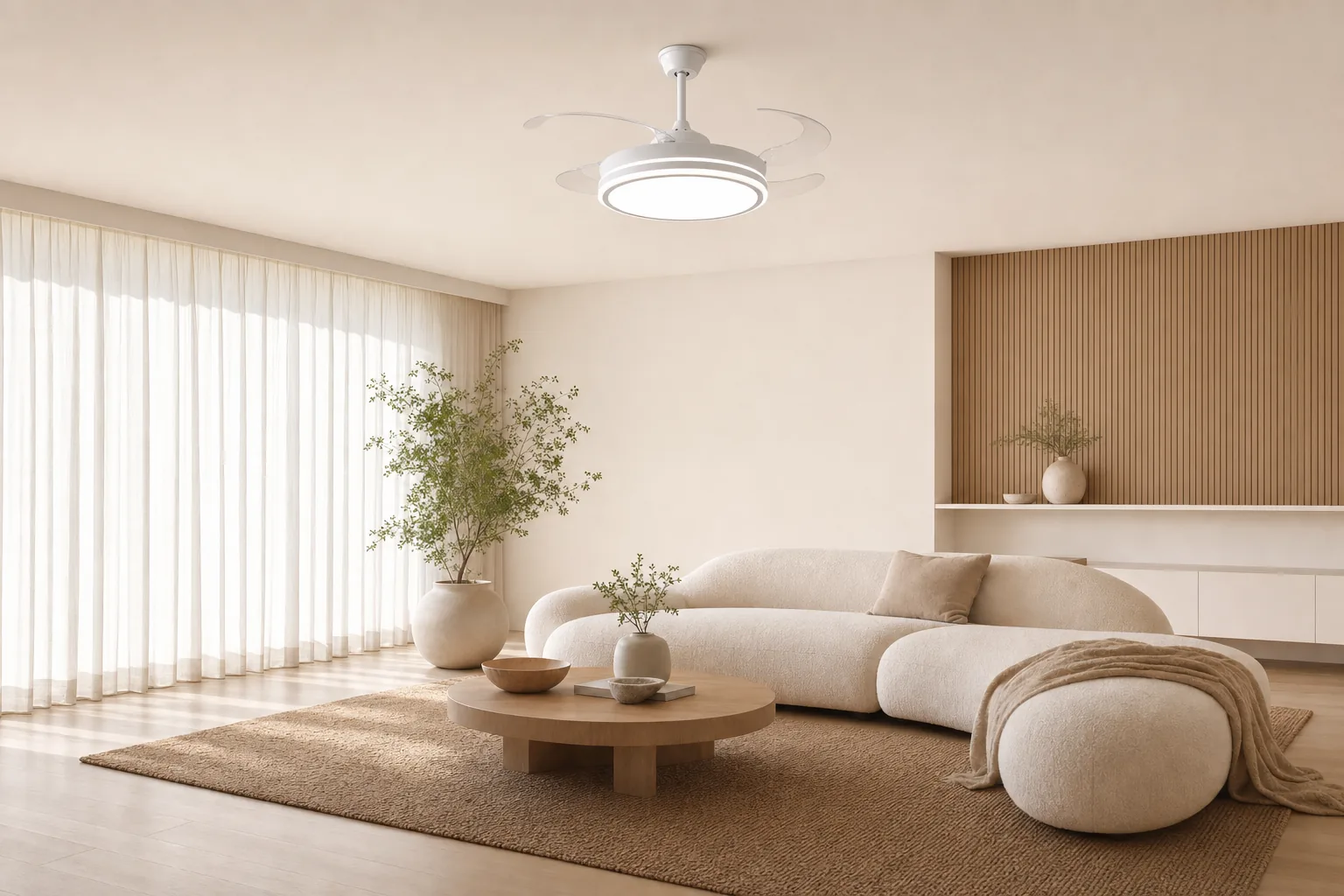
The Boréal 107
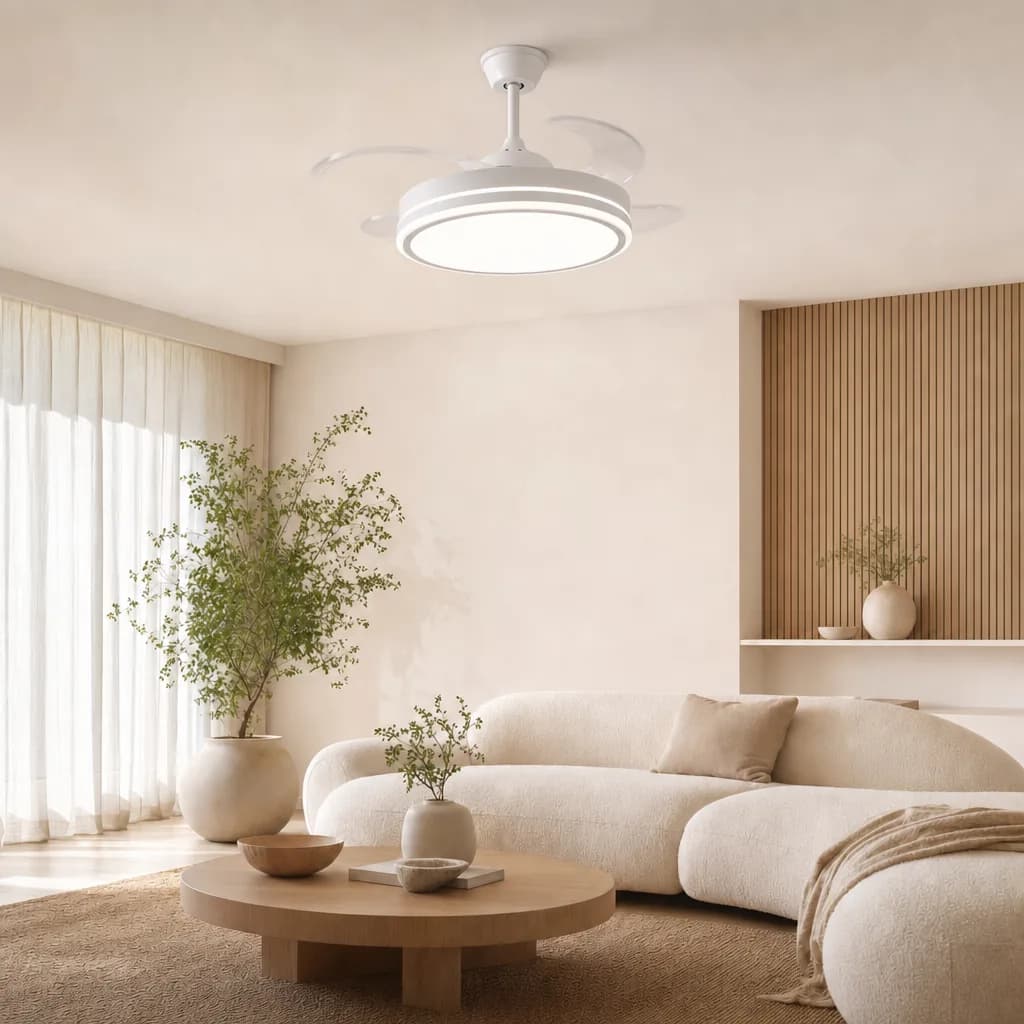
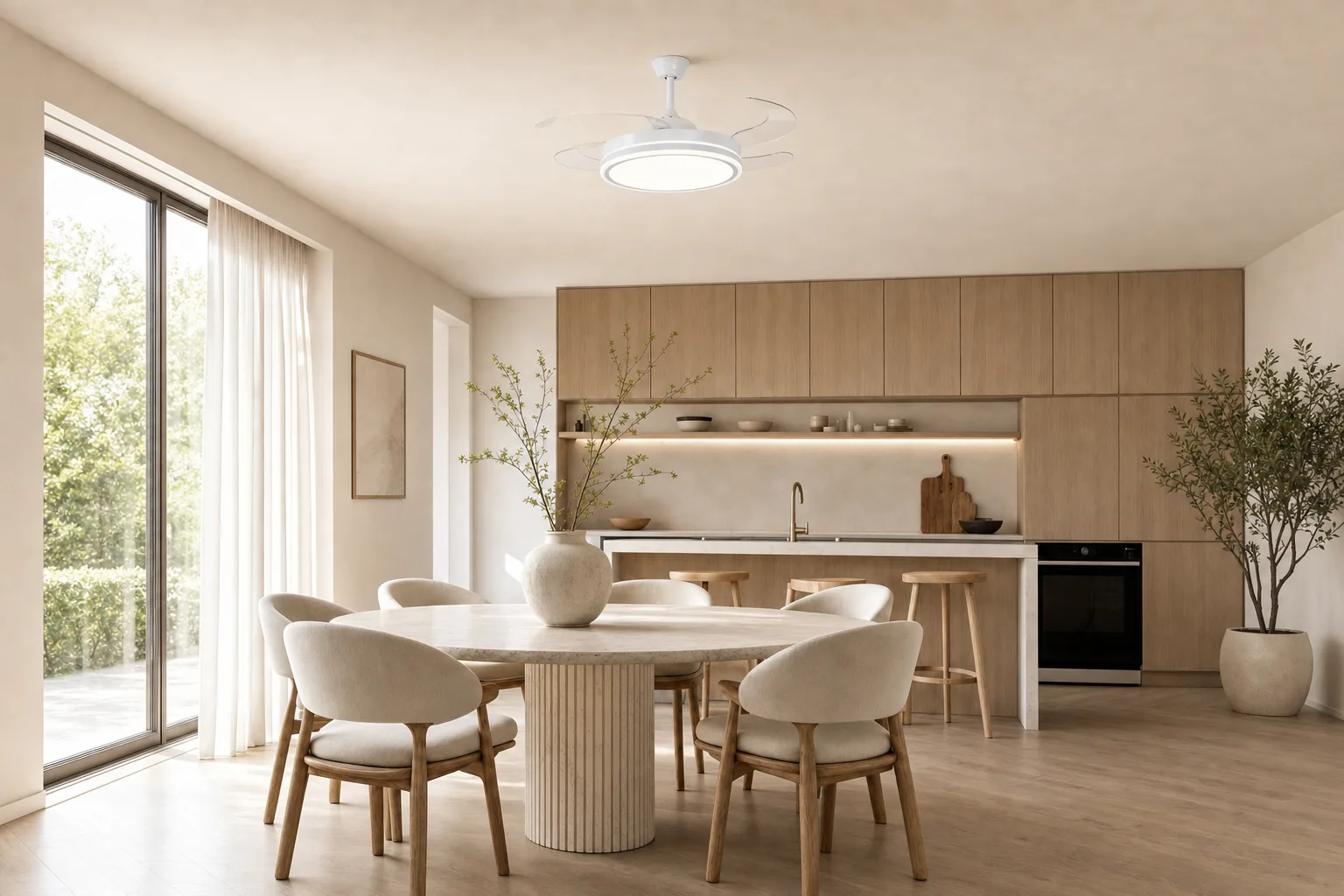
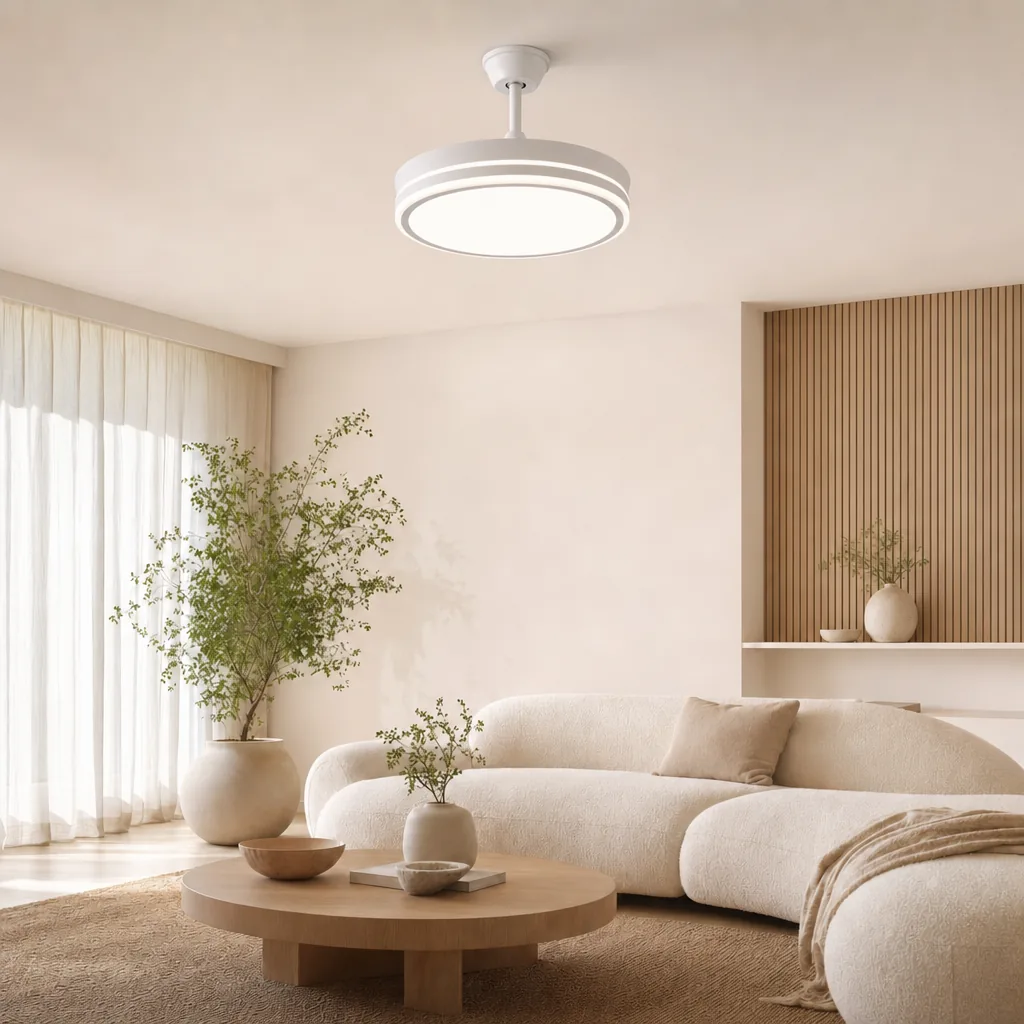
Retractable blades · Ø 107 cm · LED ceiling light & silent fan
- ✓Retractable blades: invisible when off, nobody guesses it's a fan
- ✓Sleep with windows closed, 30 dB, quieter than a whisper
- ✓Integrated LED 2700K → 6000K, dimmable: replaces your ceiling light
Diameter accounts for most of the figure
Airflow depends on four factors: diameter, blade pitch, ideally 12 to 15°, rotation speed and the motor. Diameter weighs the most. Depending on diameter and speed, the airflow of a ceiling fan ranges from 3,000 to 12,000 m³/h, and at equal diameter the differences between models are limited.
The consequence is simple: comparing the airflow of a 107 cm fan with that of a 132 cm fan tells you nothing about the quality of either. The larger one will always show more. The right question comes first: what diameter does the room need? Up to 15 m², 107 cm. From 15 to 25 m², 122 to 132 cm. For 25 to 30 m², 132 cm. Beyond that, 142 cm and more.
A large diameter has another advantage the figure does not show. A 132 cm fan turns at 120 to 150 rpm for the same airflow as a 107 cm fan at 180 to 200 rpm. So it does the same work more slowly, with less air noise.
The figure that really compares: m³/h per watt
If one figure deserves comparing between two models of the same diameter, it is efficiency: airflow divided by power used, in m³/h per watt. A fan that moves 4,000 m³/h for 25 W is twice as efficient as a model that reaches the same airflow for 50 W.
Good DC motors reach 150 m³/h per watt and more. That is consistent with their consumption: 5 to 30 W, against 50 to 100 W for an AC motor. When the sheet does not give efficiency, you can work it out yourself, provided airflow and power are given at the same speed.
That sum has a limit: it says nothing about noise or comfort. A fan that is very efficient at full speed, but noisy, will be of no use to you.
What you feel: the speed of the air, not the airflow
Under a ceiling fan, you do not feel cubic metres. You feel air passing over your skin, and it is its speed, in metres per second, that makes the coolness. At night, air movement of 0.3 to 0.8 m/s is enough to take 2 to 3°C off the temperature you feel. At the table, on a low speed, a 132 cm fan stays below 1 m/s. During the day, the stirring lowers perceived temperature by 3 to 4°C.
That air speed depends on airflow, but also on the area over which it is spread, on the height of the blades and on where you are in the room. An airflow spread by a large diameter gives a wide, gentle breeze. The same airflow concentrated by a small diameter gives a narrow stream, strong in the centre and weak as soon as you move away.
That is why a fan is set by feel, not by the figure: the right speed is the lowest one at which you feel comfortable.
Comparing two product sheets without going wrong, and the case of the Boréal 107
Here is the method, in order. It takes five minutes and avoids choosing a fan on a figure that does not say what you think it says.
The Boréal 107 illustrates what airflow does not say. Its product sheet does not put an airflow figure forward. It gives what can be checked at home: a 107 cm diameter with the blades extended, six speeds on the remote, 30 to 34 dB, a silent copper motor and a dimmable LED in three temperatures.
We have already written it in this journal: at full speed, a retractable-blade fan moves slightly less air than a large fixed-blade model, and its diameter has a ceiling. At the speeds people really use, in a bedroom, a study or a living room of ordinary size, the gap is not felt. Beyond 25 m², a fixed-blade model of 132 cm or more is better suited.
- ·Check the unit and convert everything to m³/h
- ·Compare at equal diameter, never a 107 cm fan against a 132 cm fan
- ·Look for the power in watts and work out the m³/h per watt
- ·Read the noise level, at low speed if it is given
- ·Look at the number of speeds: the more there are, the easier it is to find the right step
Airflow is a useful figure provided you know how to read it: converted to m³/h, compared at equal diameter, set against the watts and completed by the noise level. It is measured at full speed, whereas people live on speeds 1 to 3, and it states a quantity of air, not the breeze you feel. For a bedroom, a study or a living room of ordinary size, the Boréal 107 is chosen on what counts at those speeds: six steps of adjustment, 30 to 34 dB, and blades that disappear when it stops.
Frequently asked questions
What airflow do you need for a 20 m² room?+
Think in diameter first: 122 to 132 cm for 15 to 25 m². At equal diameter, the differences in airflow between models are limited. Noise level and number of speeds separate two fans better.
How do you convert CFM to m³/h?+
Multiply by about 1.7: 1 CFM is roughly 1.7 m³/h. A 5,000 CFM fan therefore moves about 8,500 m³/h.
Does a higher airflow cool better?+
Not necessarily. The coolness you feel comes from the speed of the air on your skin, which also depends on diameter, blade height and where you are. And the airflow shown is the full-speed figure, which is rarely used.
What should you look at when the product sheet gives no airflow figure?+
Diameter, noise level, number of speeds and power in watts. Those four pieces of information are enough to know whether the fan suits the room and whether it will be discreet at the speeds people really use.
The SEY Maison Circle
Every month, an exceptional piece. Never reissued.
The Drops principle: one high-end furniture piece per month, in a numbered edition. Once it's gone, it never comes back. Circle members are notified 48 h early, access each drop 24 h before everyone else, and receive our guides before publication.
Discover the Drops →