Ceiling fan with 3 or 6 speeds: what it really changes
Published on ·7 min read
Three speeds or six: on a product sheet, the line goes almost unnoticed, between the diameter and the warranty. You tell yourself that three are enough, slow, medium, fast, and that six are a sales argument. Then comes the first hot night, when speed 1 blows too hard and there is nothing below it.
The difference between three and six speeds is not at the top of the scale but at the bottom: in the slowest step and in the gap between two steps. This guide explains why, gives the use of each speed, says when three are enough, and presents the Boréal 107, which has six.
What changes: the gap between two steps
At full speed, a three-speed fan and a six-speed fan of the same diameter do roughly the same work. What separates them is the path between off and maximum. With three speeds, that path is cut into three large steps. With six, into six small ones.
And comfort is a matter of small steps. Between feeling nothing and having a draught on the back of your neck, there is sometimes only a single step on a three-speed fan. With six speeds there are two or three, and one of them is the right one.
It is also a technical matter. An AC motor traditionally offers three fairly widely spaced steps. Six-speed models are most often driven by a remote control, which meters the rotation more finely.
The lowest speed is the one that counts
Look at how a ceiling fan is really used. Full speed runs for a few minutes, to stir an overheated room. The rest of the time, people live on speeds 1 to 3. At night, they sleep on speed 1 or 2. In winter, reverse mode is used on speed 1 only.
So everything rests on how slow the first step is. At night, the aim is not a wind but a slight movement of air, 0.3 to 0.8 m/s, which takes 2 to 3°C off the temperature you feel. In winter mode, the warm air must come back down along the walls with no perceptible airflow: going up to speed 2 or 3 creates a cold draught and cancels the benefit.
A fan whose first speed is already a distinct breeze can do neither. That is the risk of a three-step scale: to reach a useful full speed in three steps, the first is often already high. So before the number of steps, check how gentle the first one is.
What each speed is for on a six-step model
On a six-speed fan, each step has a use. The exact matches vary with the room and the diameter, but the spread stays the same: two slow steps, two daytime steps, two steps for a heat spike.
In practice, people mostly use three or four of those six steps. But they are not the same ones depending on the season, the room and the person, and that is precisely what three speeds do not allow.
- ·Speed 1: night in a bedroom of 10 to 15 m², winter mode, between seasons
- ·Speed 2: night in a bedroom of 16 to 21 m², meals at the table, reading
- ·Speed 3: a summer day in a living room, the first hour of a night above 25°C
- ·Speed 4: a very hot afternoon, a room occupied by several people
- ·Speeds 5 and 6: a few minutes to stir an overheated room when you come home
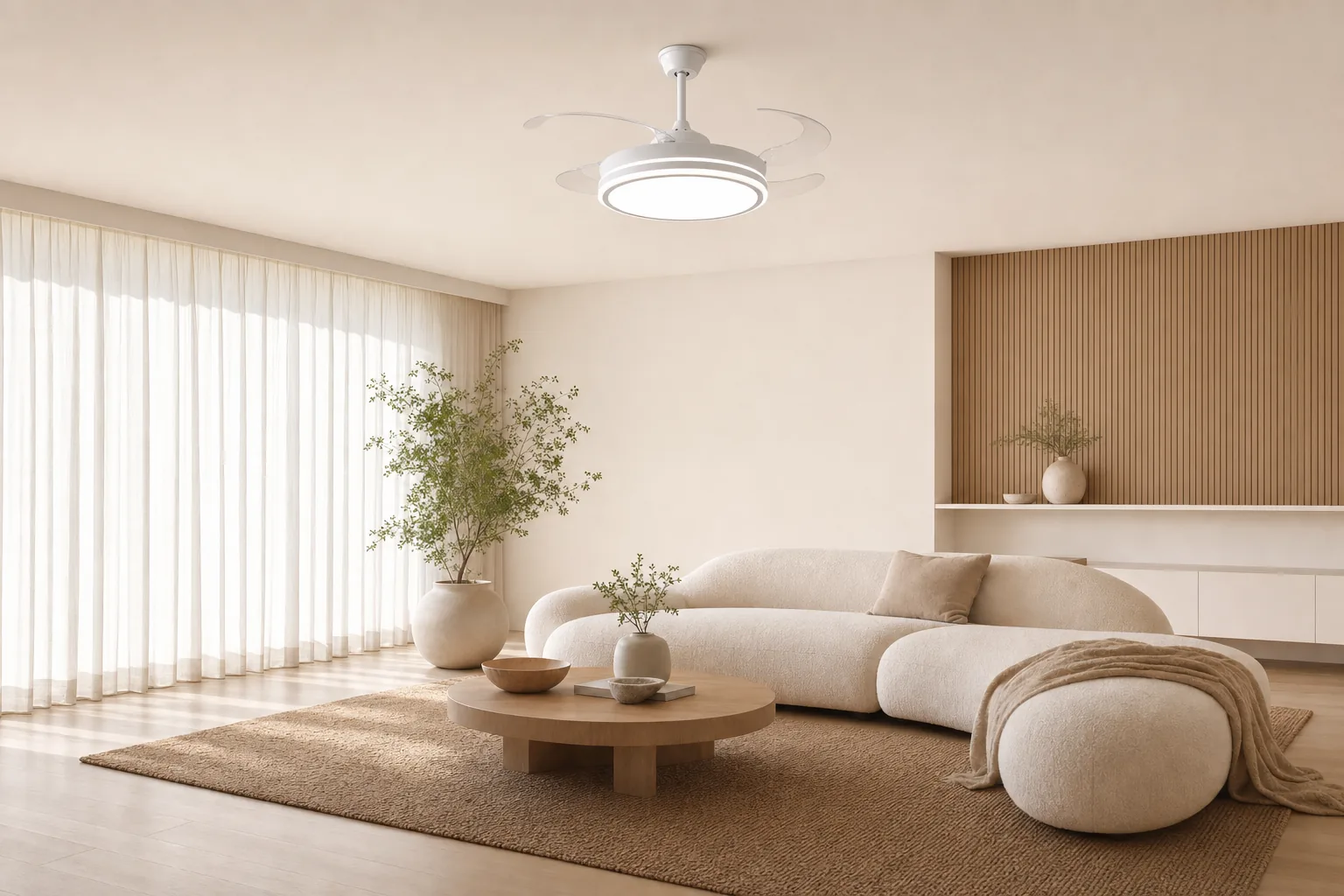
The Boréal 107
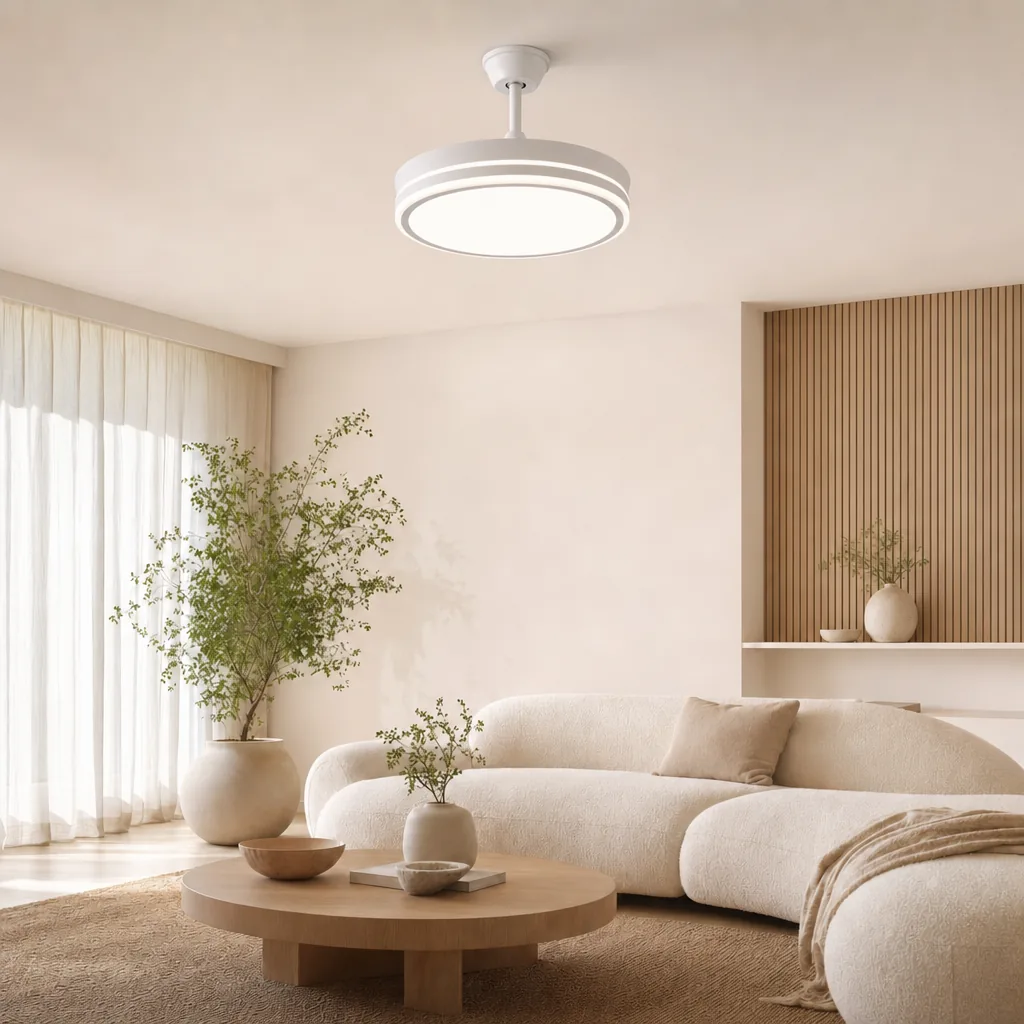
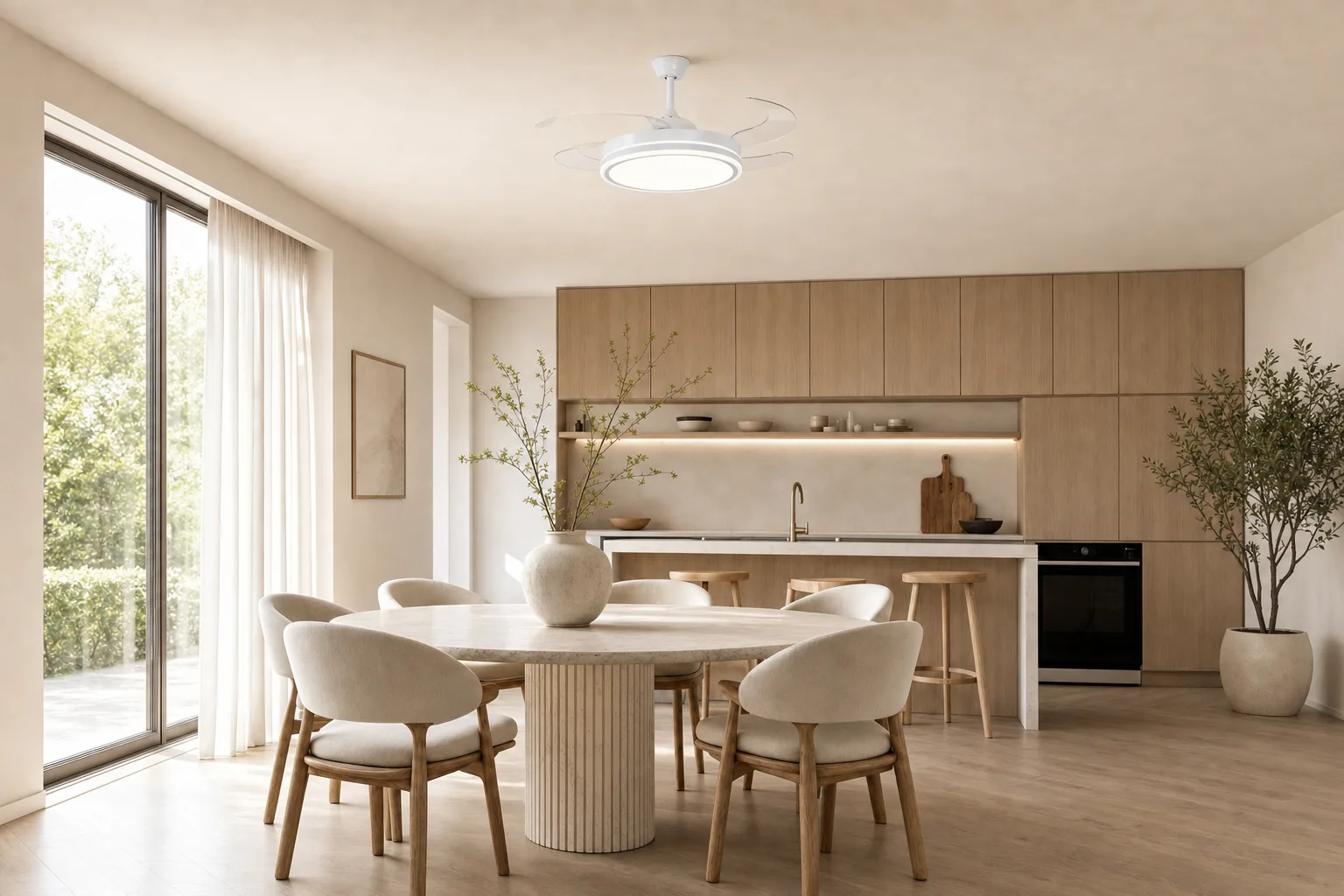
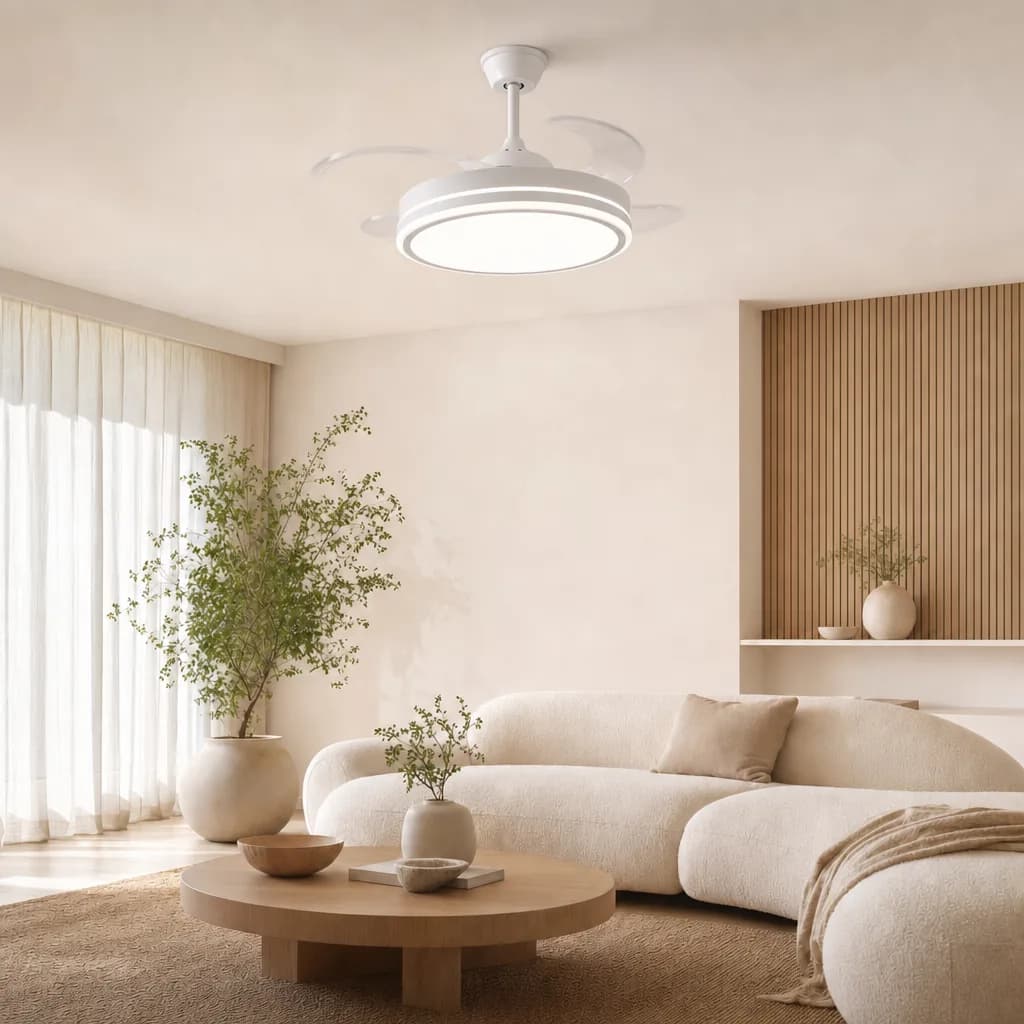
Retractable blades · Ø 107 cm · LED ceiling light & silent fan
- ✓Retractable blades: invisible when off, nobody guesses it's a fan
- ✓Sleep with windows closed, 30 dB, quieter than a whisper
- ✓Integrated LED 2700K → 6000K, dimmable: replaces your ceiling light
Three speeds: when it is enough
Three speeds are not a flaw in themselves. In a room people pass through, a hallway, a corridor, a space where nobody sits for long, fine adjustment adds nothing: you want air, and you get it. The same goes for occasional use, a few days a year.
The three-speed AC motor also keeps its qualities: it is simple, robust and cheaper to buy. If the budget is tight and the fan will go neither in a bedroom nor above a table, it is a defensible choice.
It becomes a poor choice in three cases: the bedroom, where the first step must be very slow and very quiet; the dining room, where you need a breeze that leaves the napkins still; and winter use, which requires a speed 1 with no airflow felt. In those three cases, six speeds are not a luxury.
Noise and consumption: what speed changes
The noise of a ceiling fan rises with speed. That is why a noise level only means something if you know at what speed it is given. Serious product sheets state a range: 30 to 34 dB for the Boréal 107, depending on speed. A bedroom calls for less than 33 dB at night speed, a living room accepts 38 dB.
Having slow steps therefore means having quiet steps. A three-speed fan run on speed 1 for want of anything better turns faster, and louder, than necessary.
Consumption follows the same slope. A DC motor uses 5 to 30 W depending on speed, and only 5 to 10 W on speed 1; an AC motor, 50 to 100 W. A fan that runs all night or all winter on the lowest step costs very little, provided that step exists.
The control: pull chain, wall switch, remote
The number of speeds often goes hand in hand with the type of control. Three-speed models are commonly operated by a pull chain or a stepped wall switch. It is simple and needs no battery, but you have to get up, and you end up never touching the setting.
Six-speed models are operated by a remote control. You change step from the sofa or the bed, which changes how the fan is used more than you would imagine: you adjust when the temperature drops in the night, you go up a step when guests arrive. A setting within reach is a setting you use.
The remote also gives access to the other functions without climbing a stepladder: the light, its dimming and, on some models, reversing the rotation for winter. Check that last point on the product sheet, because on other fans the reversal is done by a switch on the motor housing.
Our six-speed choice: the Boréal 107
The Boréal 107 has six speeds, operated by an included remote control. Its copper motor is rated at 30 to 34 dB depending on speed. On the slow steps it is quieter than a whisper, which lets you sleep with the windows closed.
Its six steps cover the uses described above: the slow speeds for the night and for winter mode, whose reverse rotation is controlled from the remote, the middle speeds for the day, the high speeds to stir the room when you come home. Its integrated LED, dimmable, is set in three temperatures from 2700K to 6000K.
With a 107 cm diameter when the blades are extended, it suits bedrooms, studies and living rooms of ordinary size. Its four blades fold away when it stops: switched off, it is a round ceiling light. It carries a 2-year warranty.
Between three and six speeds, you are not paying for a higher maximum: you are paying for slow steps and fine gaps. Three speeds are enough in a room people pass through or for occasional use. For a bedroom, a table or winter use, you need a first step that is very slow and very quiet, and several steps just above it. That is what the Boréal 107 offers: six speeds on the remote, 30 to 34 dB, and a winter mode controlled from a distance.
Frequently asked questions
Are six speeds really useful on a ceiling fan?+
Yes, as soon as you sleep, dine or heat the room under the fan. The point is not the maximum speed but the slow steps and the small gap between two steps, which let you find the setting with no draught.
Which ceiling fan speed should you use at night?+
Speed 1 in a bedroom of 10 to 15 m², speed 2 in a bedroom of 16 to 21 m². On a night above 25°C, you can go up to speed 2 or 3 for the first hour, then come back down.
Which speed for winter mode?+
Speed 1 only, in reverse rotation. A higher speed creates a cold draught and cancels the benefit.
Does a 3-speed ceiling fan use more electricity?+
It depends on the motor more than on the number of speeds. An AC motor uses 50 to 100 W, a DC motor 5 to 30 W. But without a very slow step, you run the fan faster than necessary.
The SEY Maison Circle
Every month, an exceptional piece. Never reissued.
The Drops principle: one high-end furniture piece per month, in a numbered edition. Once it's gone, it never comes back. Circle members are notified 48 h early, access each drop 24 h before everyone else, and receive our guides before publication.
Discover the Drops →