A 35 m² living room: one large ceiling fan or two?
Published on ·8 min read
Thirty-five square metres is the living room of a family house or a large flat: a corner sofa, a table for six or eight, sometimes an open kitchen at the far end. It is also the floor area where guides stop giving a single answer. Below it, one fan is enough. Above 40 m², you need two. At 35 m², everything depends on the room.
This article gives the three criteria that decide: the shape of the room, the number of zones where people live, and the light points already on the ceiling. It then sets out what to check in each case, and says in which one the Zénith 142 is the right choice.
35 m²: a pivotal floor area between two answers
The guidelines in this journal put rooms of 25 to 35 m² in the 132 to 152 cm range, with 142 cm as the pivotal size. Beyond 35 m², you move to 152 or 178 cm, or to two fans. A 35 m² living room sits exactly on the join: it is the largest living room a single 142 cm fan still covers, and the smallest where two fans are justified.
Both solutions work, but not in the same rooms. A large diameter moves a lot of air per turn: it turns slowly, and therefore quietly, and its airflow is wide. On the other hand, it pushes air from a single point. If part of the room is far from that point, it benefits little. Two fans create two points of air movement, each close to the people it serves.
First criterion: the shape of the room
A compact, almost square living room, for example 5.50 m by 6.40 m, is the ideal case for a single large diameter. Placed in the centre, the fan is less than 4.50 m from every corner, and the column of air it pushes towards the floor spreads evenly in all directions.
A long living room, for example 4.40 m by 8 m, changes things. A fan in the centre leaves each end 4 m from its axis, and air movement weakens with distance. A larger diameter does not correct that: it pushes harder in the centre, not further. Our guides give the benchmark: beyond 6 m in length for a narrow rectangular room, two points of air movement do better than one.
L-shaped rooms always fall under the second solution. No fan, however large, stirs air effectively around a corner.
- ·Almost square, 5.50 m by 6.40 m: a single fan of 142 to 152 cm in the centre
- ·Long, 4.40 m by 8 m: two fans of 122 to 132 cm, one per half
- ·L-shaped: two fans, one per branch
Second criterion: how many living zones, and where
A fan only cools the people in its airflow. Sketch the room and mark the seats: sofa, armchairs, dining chairs. If they form a single group, with the centre of the room in the middle of it, one large fan serves them all. If they form two distinct groups, a seating area on one side and a table on the other, each deserves its own point of air movement.
The test is simple. Measure the distance between the centre of the seating area and the centre of the table. Two fans must be at least 3 m apart, which is 2 to 3 times the diameter of their blades. If the two centres are 3 m or more apart, the room lends itself to two fans. If they are closer, it is a single zone, and a single fan is enough.
Two fans have a practical advantage: they are set separately. You switch off the one over the table when nobody is sitting there, and turn down the one over the sofa during a film. If the second zone is an open kitchen, the fan goes above the table or the island, never directly above the hob, where it would disturb the extractor hood.
The Zénith 142
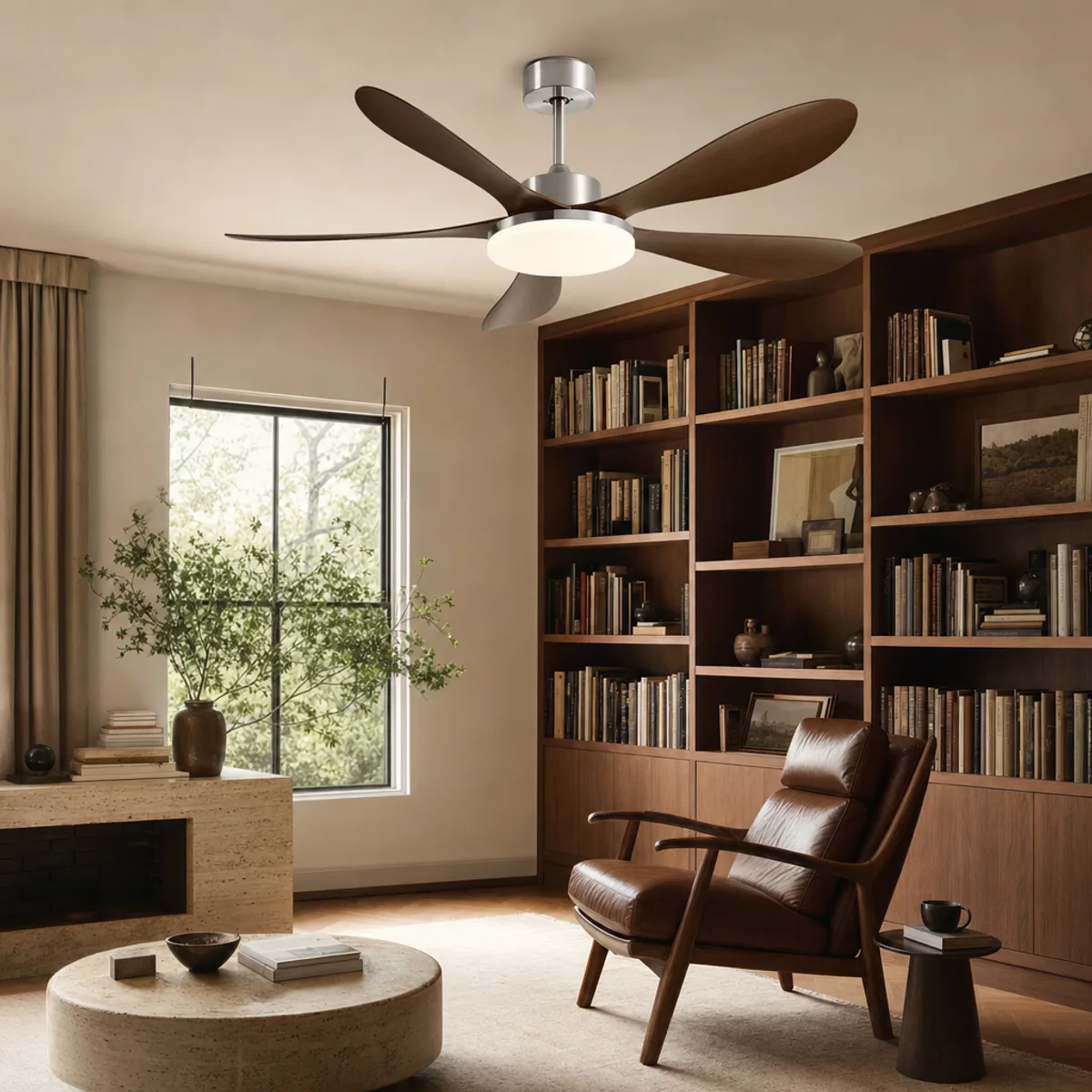
Five walnut blades · Brushed nickel · Integrated LED
- ✓Silent DC motor, 6 reversible speeds
- ✓Integrated dimmable LED + remote control
- ✓30-minute installation, illustrated manual
€379€479
Third criterion: the light points already in place
A ceiling fan is fixed and wired where there is a light point. So look at your ceiling before choosing. A single point in the centre of the room: one large fan goes up with no other work. Two points, one on the seating side and one on the table side: two fans go up with no other work, and a single large model would end up in the wrong place.
When the ideal layout does not match the existing points, a light point has to be created or moved. That is an electrician's job, which depends on the type of ceiling and the cable route, and whose cost is set by a quote. It is not a reason to give up the right layout, but it is something to include in the budget before ordering.
A single large diameter: what to check
With a 142 cm fan, three checks are needed. Width first: blade tips must stay at least 50 cm from walls and tall furniture, preferably 60 cm. You therefore need 2.42 m of clear width, and 2.62 m with the comfortable margin, which a 35 m² living room offers without difficulty.
Height next: at least 2.10 m between the floor and the underside of the blades. The specification sheet of the Zénith 142 does not state its total height. Ask for that figure, measured from the ceiling to the underside of the blades, before ordering if your ceiling is lower than 2.60 m. Finally the fixing: a large fan is fixed into a load-bearing element able to take the weight given in the manual, never into plasterboard alone.
The Zénith 142 is designed for this case: five slender walnut blades around a brushed-nickel hub and a disc of light, a wide and steady airflow for large rooms. Its DC motor is set across six reversible speeds from the remote control, and its integrated dimmable LED replaces the central ceiling light.
Two fans: diameters, positions, settings
When the room calls for two fans, each is sized for its half, that is 17 to 18 m² in a 35 m² living room. The reference table gives 107 cm up to 20 m² and 122 cm from 20 to 25 m². In a living space, where you use higher speeds than in a bedroom, 122 cm is the right size, and 132 cm remains possible on the seating side if the width allows it.
Each fan is placed in the centre of its zone. In a living room of 4.40 m by 8 m, that gives two points on the central axis, 2 m from each end, and therefore 4 m apart. The two fans do not need to be identical: a larger diameter over the sofa and a smaller one above the table work well, provided they belong to the same family to the eye.
Before any work on a light point, switch off the power at the circuit breaker. If you have any doubt about the ceiling or the wiring, call an electrician. In winter, both fans in reverse rotation bring the warm air gathered under the ceiling back down, which counts in a large volume.
- ·At least 3 m between the two centres, which is 2 to 3 times the blade diameter
- ·At least 50 cm between blade tips and walls
- ·Never directly above the hob
- ·At least 2.10 m between the floor and the underside of the blades, for each fan
At 35 m², floor area does not decide: the room does. If your living room is compact, used as a single zone and has a central light point, take a single large diameter. The Zénith 142 suits this case: 142 cm, five walnut blades, a wide airflow at slow speed, a DC motor with six reversible speeds, an integrated dimmable LED, a remote control and a 2-year warranty. If your living room is long, L-shaped, or shared between a seating area and a table 3 m or more apart, fit two fans of 122 to 132 cm, one per zone. In both cases keep 2.10 m under the blades and 50 cm between the blades and the walls.
Frequently asked questions
What ceiling fan diameter for a 35 m² living room?+
142 to 152 cm for a single fan in the centre of a compact room. If the room is long or split into two zones, two fans of 122 to 132 cm, one per zone, cover better.
Is one fan enough for 35 m²?+
Yes, if the living room is almost square and the seats form a single group around the centre. No, if the room is more than 6 m long and narrow, L-shaped, or used as two zones far apart: air movement weakens with distance.
How far apart should two ceiling fans be?+
At least 3 m apart, measured centre to centre, which is 2 to 3 times the blade diameter. Each one goes in the centre of its zone, with at least 50 cm between blade tips and walls.
Can you fit two fans of different sizes in the same living room?+
Yes. Each fan is sized for the zone it serves: a larger diameter over the seating area, a smaller one above the table. Choose two models from the same family to keep the ceiling coherent.
The SEY Maison Circle
Every month, an exceptional piece. Never reissued.
The Drops principle: one high-end furniture piece per month, in a numbered edition. Once it's gone, it never comes back. Circle members are notified 48 h early, access each drop 24 h before everyone else, and receive our guides before publication.
Discover the Drops →