Ceiling fan for a 20 m² living room: which diameter
Published on ·8 min read
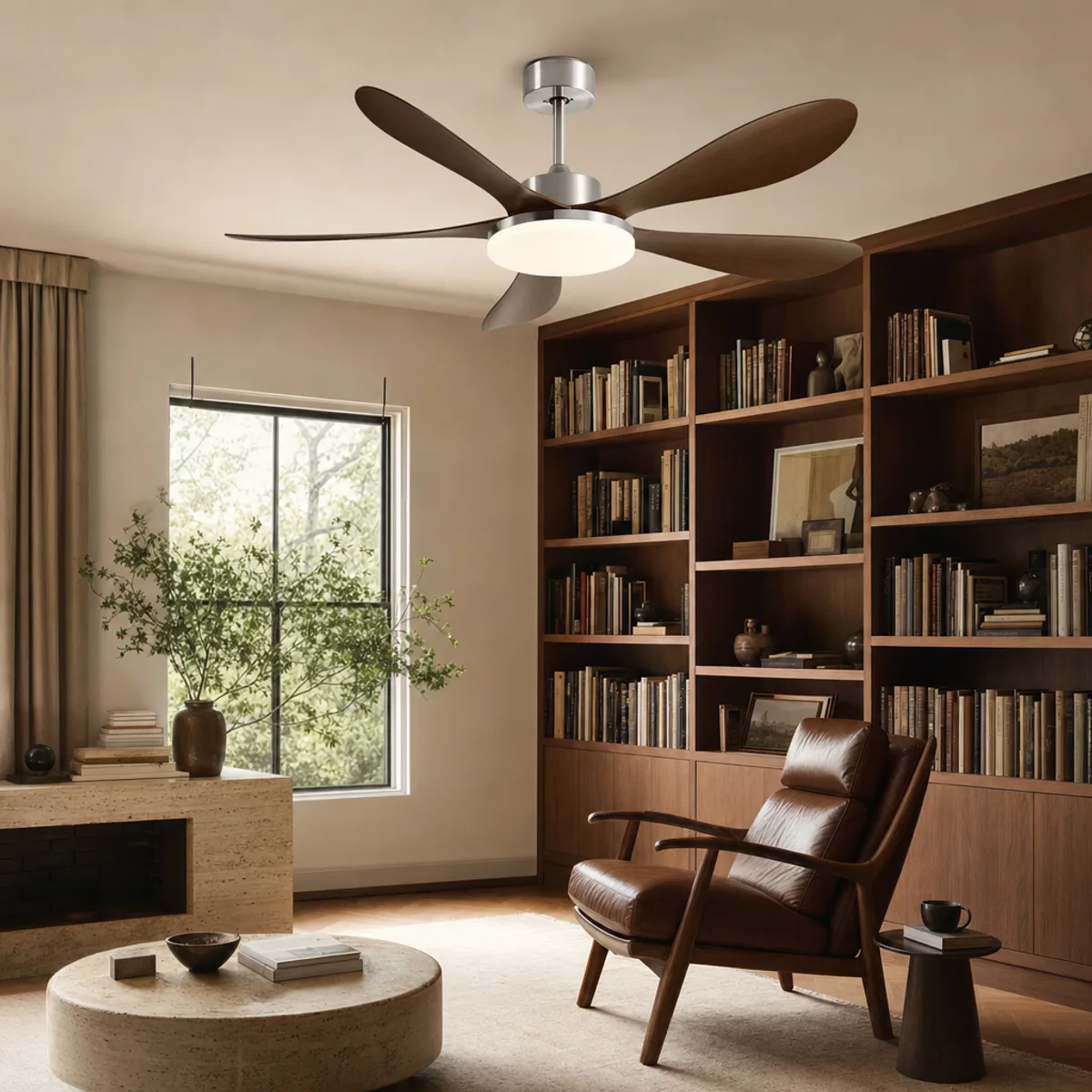
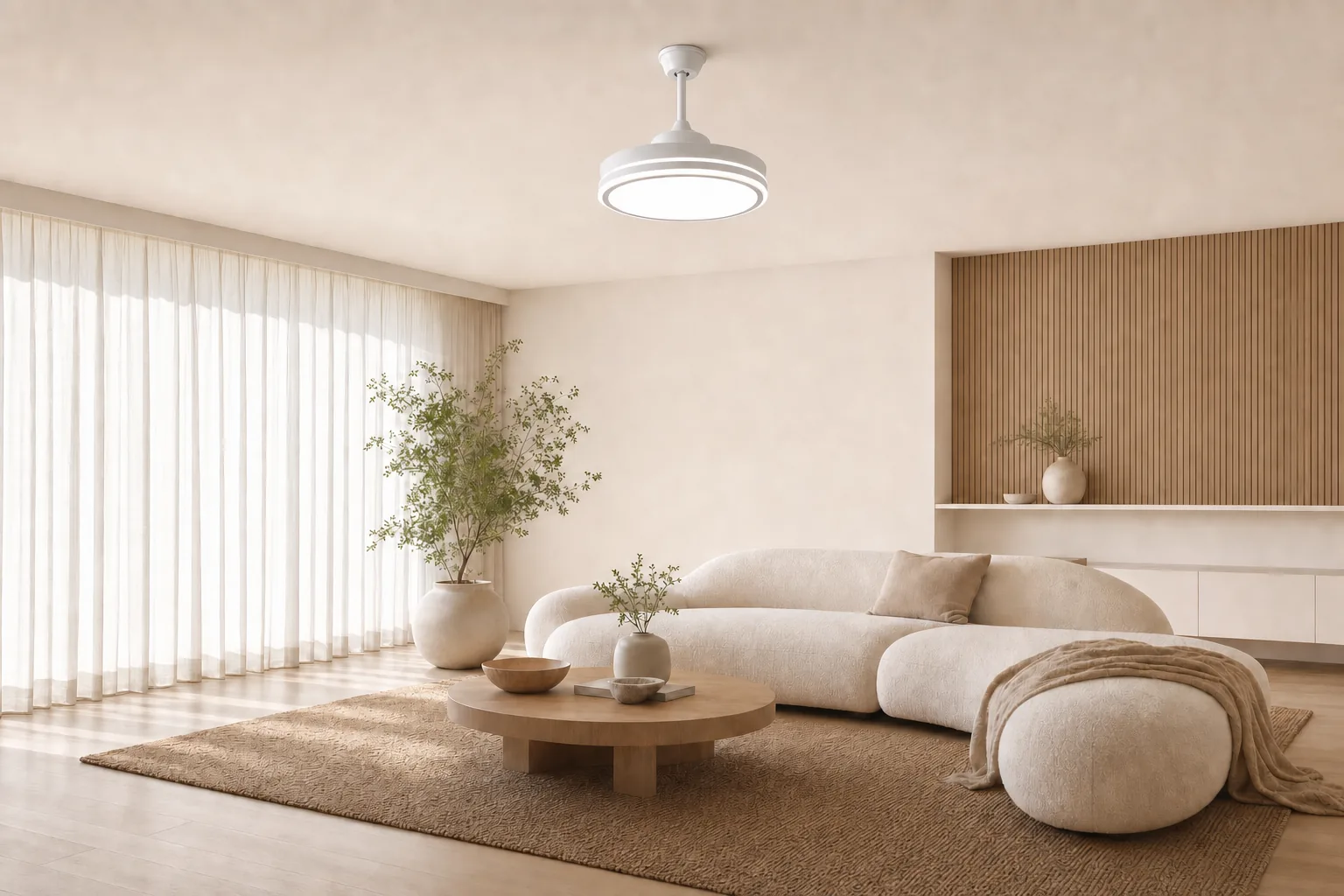
Twenty square metres is the living room of a great many flats: a sofa, an armchair, a television unit, sometimes a table pushed against a wall. In the afternoon the sun comes in through the window, and in the evening the room holds the heat of the day just when everyone gathers there. It is the room where a ceiling fan runs the most hours, and the one where a poorly chosen diameter shows fastest.
For a closed living room of this size, the diameter to choose is 122 cm. The answer changes as soon as the room opens onto a kitchen. This article gives the rule, how to count the real floor area, the position, the height to check, and the reasons why the Alma 122 matches this case.
A 20 m² living room: why 122 cm
The reference table in this journal gives 107 cm for 15 to 20 m², 122 cm for 20 to 25 m² and 132 cm for 25 to 30 m². A 20 m² living room is therefore at the upper limit of 107 cm and at the lower limit of 122 cm. In a living space, the second clearly wins.
The reason lies in how the room is used. In a bedroom only one zone matters: the bed. In a living room, people are spread across the whole space, on the sofa, in the corner armchair, at the table. The air movement has to reach each of them, including the one furthest from the fan. A 107 cm fan manages it by raising its speed, and so its noise. A 122 cm fan manages it one step lower.
The living room is also the room of heat peaks: coming home after a 35°C day, six people for dinner, a west-facing window. On those days you use the high speeds, and that is where a slightly generous diameter keeps its advantage. At a sustained speed it stirs the whole room instead of blowing hard on a single spot.
Counting the real floor area: closed or open living room
The floor area to use is not always the one on the plan. If the living room is closed by doors, count its 20 m² and stay with 122 cm. If it opens without a door onto a kitchen, a hallway or a wide corridor, the air of those spaces mixes with its own. Our guides give the rule: reason on the volume that actually has to be stirred and go up one size.
A 20 m² living room open to an 8 m² kitchen makes 28 m² to stir. That falls in the 132 cm range. Beyond 30 m² in one piece, the question changes in nature and is asked in terms of zones: one fan above the seating area, possibly a second elsewhere.
- ·Closed living room of 15 m² or less: 107 cm
- ·Closed living room of 18 to 22 m²: 122 cm
- ·Living room open to a kitchen, 25 to 30 m² in total: 132 cm
- ·More than 30 m² in one piece: think in living zones
Where to place it: over the seating area
The comfort of a fan only benefits the people in its airflow. The fan is therefore centred on the area where people sit for a long time, not necessarily on the geometric centre of the room. In a 20 m² living room the two points are often less than a metre apart, and the existing light point nearly always works. If it does not, an electrician can move it, on a quote.
Then check the clearances. Blade tips must stay at least 50 cm from walls and tall furniture, preferably 60 cm. For a 122 cm fan, that requires 2.22 m of clear width, and 2.42 m with the comfortable margin. A bookcase that rises to the ceiling counts as a wall.
Two precautions specific to the living room. Avoid having recessed spotlights directly above the circle of the blades: light chopped by the rotation flickers. And if the room opens onto the kitchen, never place the fan directly above the hob: the downward flow disturbs the extractor hood and pushes the steam back down.
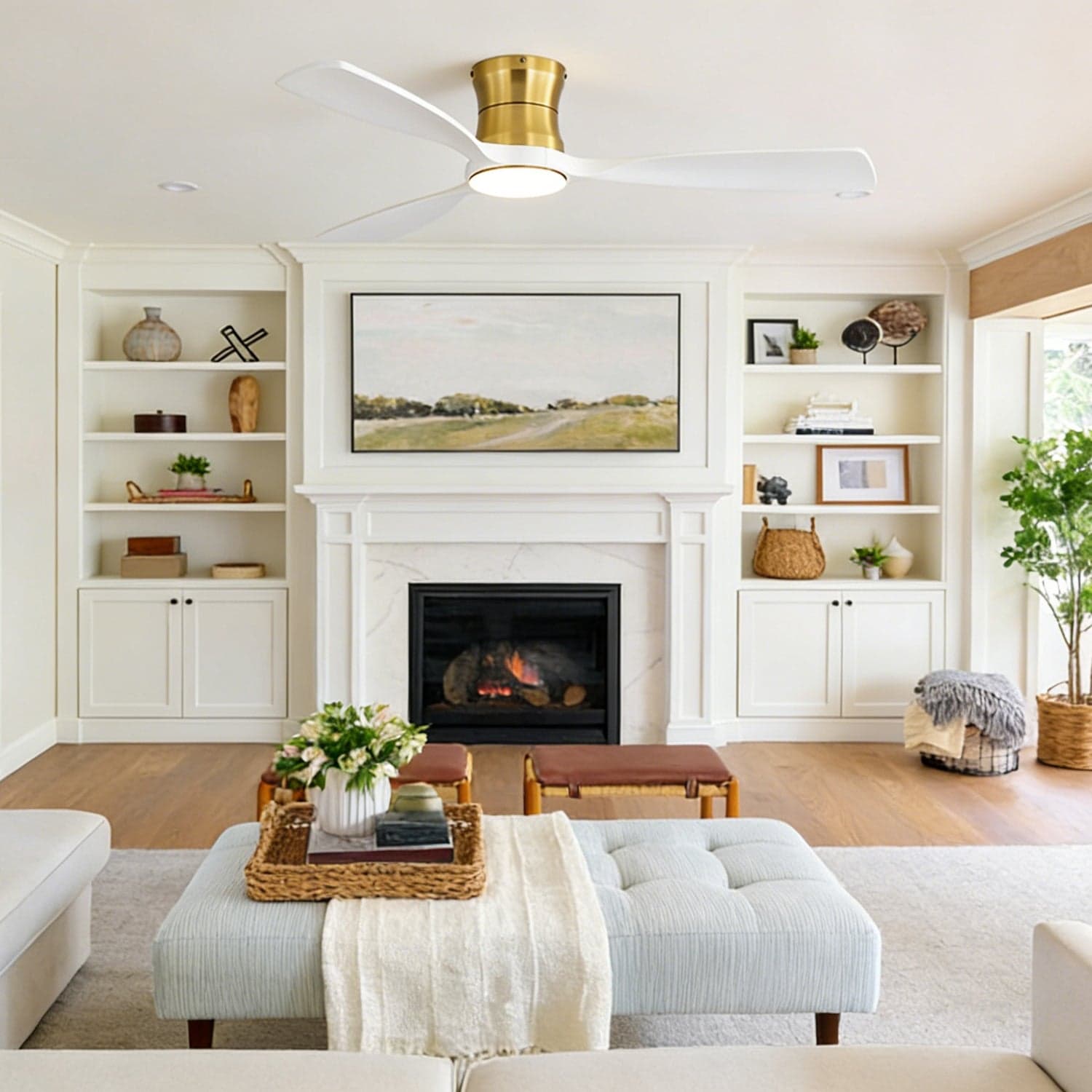
The Alma 122
Contemporary design · Ø 122 cm · LED & remote
- ✓Clean contemporary design, three curved blades
- ✓The best value in the collection
- ✓Dimmable LED, 3 temperatures + remote
€279€349
Ceiling height: the figure to check
A living room is a room where people stand, stretch, and carry a child on their shoulders. The safety clearance takes on its full meaning there: at least 2.10 m between the floor and the underside of the blades. Under a 2.50 m ceiling, the fan has 40 cm; under 2.40 m, 30 cm. Below 2.50 m, rule out models hung from a downrod.
There is a second, less well-known figure: the distance between the ceiling and the blades. A fan draws air in from above. If the blades skim the ceiling, the intake is choked and the airflow drops. The effective zone lies around 25 to 30 cm. A very flat fan gains headroom, but you should not expect the same air movement from it.
The specification sheet of the Alma 122 does not state its total height. Ask for that figure, measured from the ceiling to the underside of the blades, before ordering if your ceiling is lower than 2.50 m. For low ceilings, the Horizon 132 lists a total height of 25 cm.
Noise, speeds and consumption day to day
The living room is the room of conversations and films. The Alma 122 is rated at 34 dB at most, that is, at its highest speed. Its DC motor is set across six speeds from the remote control: a low step during a meal, so as not to cool the plates or send napkins flying, a high step when you come home on a hot day.
The result is measured in perceived temperature: moving air lowers it by 3 to 4°C. At 28°C in the room, you live as if at 24 or 25°C under the airflow. Consumption stays modest. DC motors draw in the order of 5 to 30 W depending on speed, against 50 to 100 W for an AC motor, which counts for a fan that runs all afternoon and all evening.
- ·Meals: low speed, for comfort without a draught over the table
- ·Film evening: low speed, dimmed light
- ·Coming home on a hot day: high speed for a few minutes, then back to a middle step
- ·Empty room: fan off, a fan cools people, not the air
Light and winter: one point on the ceiling for the whole year
In a 20 m² living room, the central ceiling point is often the only general lighting. The fan that replaces it must therefore provide light. The Alma 122 has an integrated LED whose brightness can be dimmed and which offers three colour temperatures: a clear light for cleaning or a board game, a low, warm light for the evening. Side lamps do the rest.
In winter the fan keeps working. Its six speeds are reversible: reverse rotation brings the warm air that gathers under the ceiling back down along the walls, without a noticeable draught on the people seated. In a living room, where you sit still for a long time, the difference is felt at sofa level.
For installation, the rules are those of any appliance hung above people's heads. Fixing into a load-bearing element: suitable plugs in concrete, a metal rail, a joist or a reinforcement above plasterboard, never the board alone. Power switched off at the circuit breaker before any work. An electrician if there is any doubt about the ceiling or the wiring.
For a closed 20 m² living room, choose 122 cm: this diameter reaches every seat without raising its speed and keeps power in reserve for very hot days. If the living room opens onto a kitchen and the whole makes 25 to 30 m², move up to 132 cm. Centre the fan on the seating area, keep 50 cm between the blades and the walls, and check the 2.10 m under the blades. The Alma 122 matches this case: 122 cm, three curved blades, a DC motor with six reversible speeds, 34 dB at most, a dimmable LED with three colour temperatures, a remote control and a 2-year warranty.
Frequently asked questions
What ceiling fan diameter for a 20 m² living room?+
122 cm for a closed living room. This diameter covers the 20 to 25 m² range and reaches every seat at low or middle speeds. A 107 cm fan is at its upper limit at this floor area.
122 or 132 cm for a 20 m² living room?+
122 cm if the living room is closed by doors. 132 cm if it opens without a door onto a kitchen or a hallway and the total area to stir reaches 25 to 30 m². In both cases check the clear width: 2.22 m for a 122 cm fan, 2.32 m for a 132 cm fan.
Can the fan go above the dining table?+
Yes, centred on the table and kept on a low speed during meals. The blades should not extend over the chairs at the ends of the table. It never goes directly above the hob.
Is a ceiling fan enough to cool a living room without air conditioning?+
It does not lower the air temperature but the perceived temperature, by 3 to 4°C for people in the airflow. Combined with shutters closed during the day and airing when the outside air is cooler, it keeps a living room comfortable through most hot spells.
The SEY Maison Circle
Every month, an exceptional piece. Never reissued.
The Drops principle: one high-end furniture piece per month, in a numbered edition. Once it's gone, it never comes back. Circle members are notified 48 h early, access each drop 24 h before everyone else, and receive our guides before publication.
Discover the Drops →