Silence & sleep
Which pillow for back sleeping? The height you actually need
Published on ·5 min read

Back sleeping is the easiest position to align, and yet the one where people most often get the pillow wrong. The reason is almost cultural: we associate comfort with a big soft pillow, and on the back the opposite is what works. The less material under the skull, the better the head stays in line with the body.
This article explains what gap really has to be filled on the back, what a thick pillow does in that position, which height suits most builds, and how to handle the very common case of a sleeper who moves from back to side during the night.
On the back, a small gap to fill
Lie on your back without a pillow. Your skull touches the mattress, your shoulders too, and between them there is a hollow at the neck. That hollow measures a few centimetres, it matches the natural curve of the neck. It is all the pillow has to fill in this position. Compare that with side sleeping, where the equivalent of a shoulder width has to be filled.
The aim is the same in every position: keep head, neck and spine on one line. But the tool has to be far more discreet. A 12 cm pillow on the back does not support better, it deforms. Many people who complain that they sleep badly on their back are in fact sleeping with a pillow designed for another position altogether.
What a pillow that is too thick does
Too thick, the pillow pushes the head forward. The chin comes closer to the chest and the neck stays stretched for seven hours. The discomfort is often felt at the base of the skull on waking, sometimes between the shoulder blades. Breathing is also less free in that position, which explains why some people snore more with a thick pillow on their back than with a flat one.
There is a less visible effect too. When the head is too high, the shoulders often stay off the pillow and the upper back rests on nothing continuous. The body then looks for a fallback position and rolls onto the side in the middle of the night, at a height that was never planned for it. You wake up without knowing why the night was broken up.
- ·Chin pushed towards the chest, neck stretched all night.
- ·Frequent discomfort at the base of the skull on waking.
- ·Breathing less free, snoring sometimes increased.
- ·Involuntary roll onto the side, at an unsuitable height.
The 7 cm wave, the right measure on the back
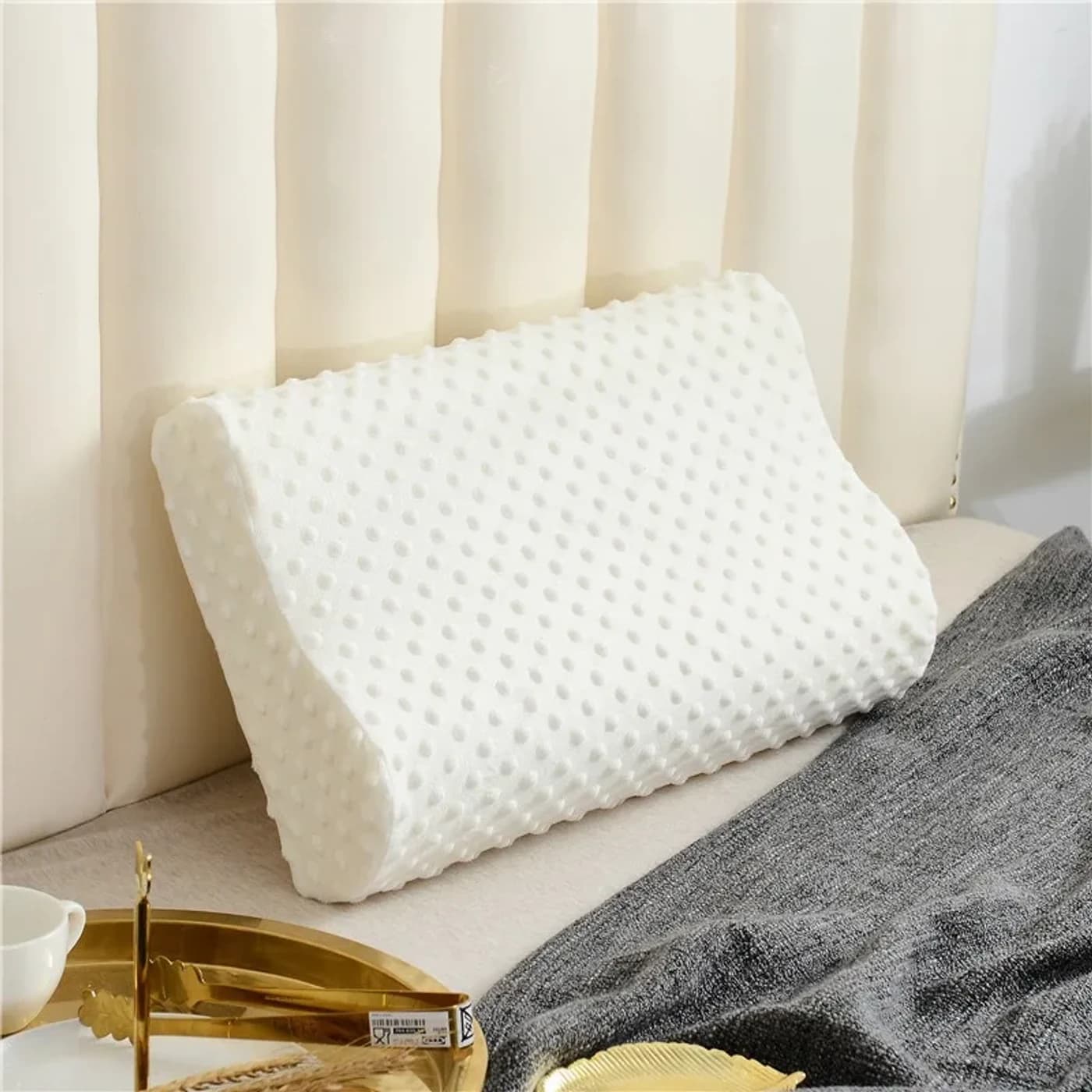
Once the sinking of the skull into the pillow is taken into account, most adults who sleep on their back land around 6 to 8 cm of useful height. That is the zone covered by the low wave of the Nuage 50, at 7 cm. Here again the shape does as much as the height: the relief rises under the neck to occupy the hollow, then comes back down under the skull so as not to push the head forward.
Slow rebound foam is useful here for a precise reason. On the back, the weight is spread over a small surface, at the back of the skull. A classic filling hollows out there quickly and leaves the neck unsupported after a few minutes. Foam sinks then stabilises, and the part supporting the neck stays in place, which is exactly what this position asks for.
The case of people who change position
Most people do not sleep in a single position. You fall asleep on your back, end up on your side, and return to your back in the early morning. The problem is well known: the ideal height is not the same in both cases, roughly double from one to the other. Picking an in between pillow gives an average compromise, slightly too high on the back and slightly too low on the side, so never really right.
The simplest answer is a pillow that carries both heights. On the Nuage 50, the 10 cm wave serves side sleeping, the 7 cm wave serves back sleeping, and you move from one to the other by turning the pillow over. In practice, set it for the position you spend the most time in, then test the other face for a few nights. If neck discomfort lasts or wakes you, the opinion of a health professional remains the right step.
On the back it is not about raising the head, it is about filling the hollow of the neck, so about 7 cm. A thick pillow tips the head forward and makes the night less restful without you identifying the cause. The Nuage 50 carries both useful heights, 7 and 10 cm, on the same 50 × 30 cm pillow.
Frequently asked questions
What pillow height for sleeping on your back?+
Around 7 cm of useful height for most adults, so clearly less than on the side. The pillow only has to fill the hollow of the neck. Beyond 9 or 10 cm on the back, the chin moves towards the chest and the neck stays stretched.
Can you sleep on your back without a pillow?+
It is possible but rarely ideal. Without a pillow the hollow of the neck stays empty and the head tips slightly backwards. A low support, around 7 cm, keeps the head in line without pushing it forward.
Which pillow if you sleep both on your back and on your side?+
A pillow with two heights avoids the compromise. Use the high face, around 10 cm, for side sleeping, and the low face, around 7 cm, for back sleeping. You simply turn the pillow over depending on the position that dominates the night.
The SEY Maison Circle
Every month, an exceptional piece. Never reissued.
The Drops principle: one high-end furniture piece per month, in a numbered edition. Once it's gone, it never comes back. Circle members are notified 48 h early, access each drop 24 h before everyone else, and receive our guides before publication.
Discover the Drops →