
Silence & sleep
Which pillow for side sleeping? Height and how to measure it
Published on ·5 min read
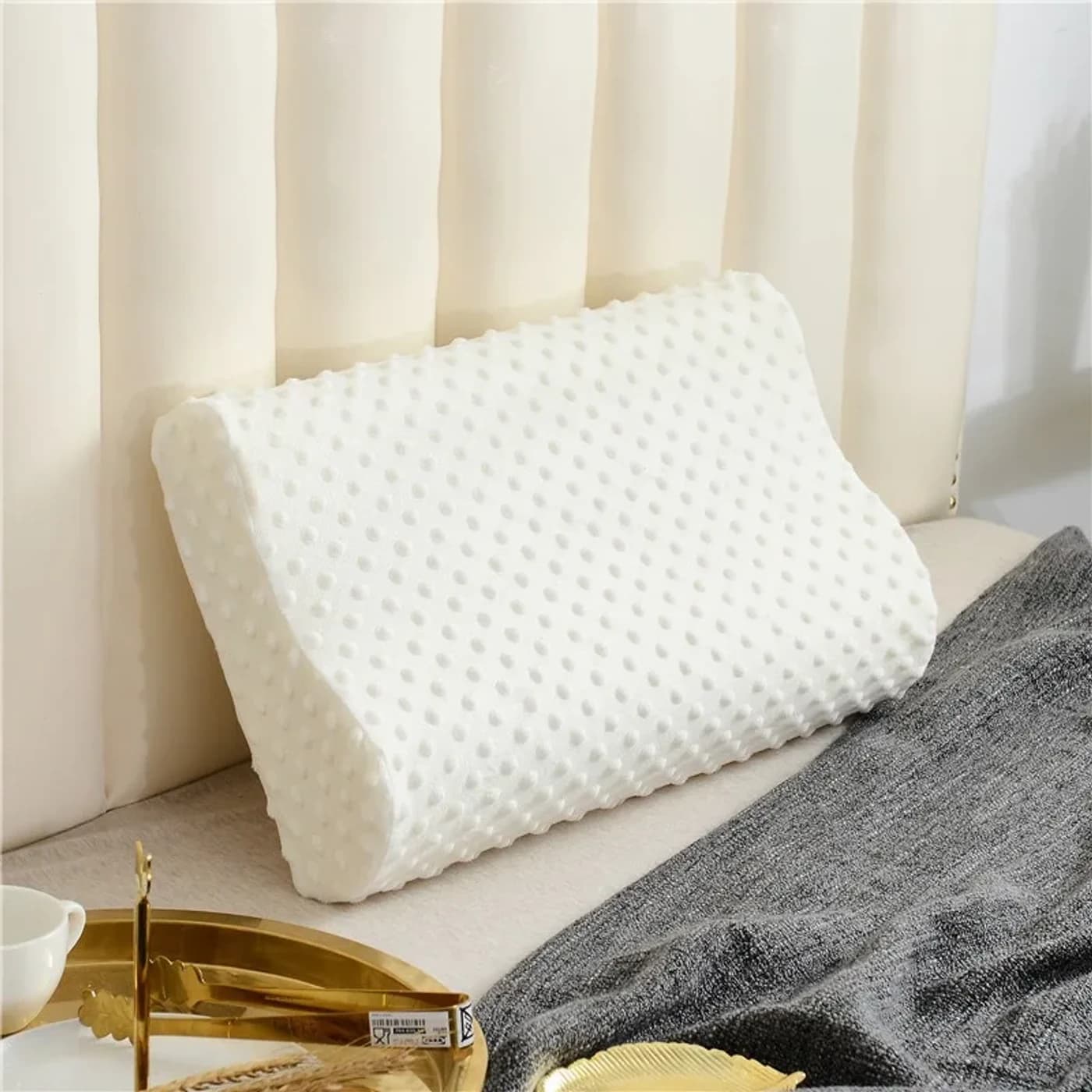
Side sleeping is the most common adult position. It is also the one that asks the most of a pillow. Lying on your flank, your shoulder rests on the mattress and your head ends up suspended above a gap the width of a shoulder. That gap has to be filled, otherwise the neck works all night to hold the head up.
So the question is not whether the pillow should be soft or firm, but how many centimetres it has to fill. This article gives a measuring method you can use at home, the order of magnitude that suits most builds, and what concretely happens when the pillow is too low.
On the side, a wide gap to fill
Lie on your side without a pillow and look at the line of your body in a mirror, or have someone photograph it. The head drops. It is no longer in line with the spine, it dives towards the lower shoulder. The empty space sits between the side of your face and the mattress, and its height roughly matches the width of your shoulder, minus however far the shoulder sinks into the mattress.
That is the widest gap of any sleeping position. On the back it is only the hollow of the neck, a few centimetres at most. On the side people often talk about double that figure. Which is why a single household pillow never suits everyone: two people of different build, lying in exactly the same position, do not need the same height at all. The number depends on the shoulder, not on the taste of the sleeper.
Working out the height you need
Measure standing, against a wall, with a plain tape measure. Put the zero on the side of your neck, at the base, and measure horizontally to the outer edge of your shoulder. You get a value, usually between 10 and 16 cm depending on build. Then subtract how far the shoulder sinks into the mattress, about 2 to 4 cm on a medium surface, more on a very soft mattress.
The result gives the order of magnitude of the useful height, once the pillow is compressed under the weight of the head. That matters: a pillow advertised at 12 cm that flattens to 6 cm does not fill 12 cm. Slow rebound foam has the advantage of holding a stable height once compressed, whereas a fibre filling loses height over the hours and over the washes.
- ·Measure from the side of the neck to the edge of the shoulder, horizontally.
- ·Subtract 2 to 4 cm for the shoulder sinking into the mattress.
- ·Compare the result to the real height of the pillow under load, not to its height at rest.
- ·Check in the morning: stiffness on one side almost always points to an unsuitable height.
Why the 10 cm wave matches this case
Once the 2 to 4 cm of sinking are subtracted, the large majority of adults who sleep on their side land around 9 to 12 cm. That is exactly the zone covered by the high wave of the Nuage 50, at 10 cm. The shape matters as much as the number: the wave is higher under the neck and comes back down under the skull, which props the neck instead of simply raising the head.
The 50 × 30 cm format plays a part too. A large square pillow lets the head slide towards the edges, where the height is no longer the same, and alignment is lost without you noticing. A more containing format keeps the head centred, on the part that was designed for it. Finally, slow rebound foam holds that height until morning, which is the whole point in this position.
What happens if the pillow is too low
Too low, the head goes down towards the mattress and the neck bends towards the lower shoulder. The muscles on the opposite side stay stretched for hours. That is the configuration that most often leaves stiffness on one side on waking, the side the head was leaning towards. Many people compensate without thinking by slipping a hand or an arm under the pillow, which fixes the height but creates pressure on the shoulder.
The second common reflex is stacking two pillows. The height is there, but the surface becomes unstable and slides during the night. One pillow at the right height, holding its shape, is better. On the Nuage 50 you move from the 10 cm wave to the 7 cm one by turning it over, which lets you try both without buying twice. If neck discomfort lasts or wakes you, ask a health professional.
On the side, everything comes down to height: you have to fill the shoulder width minus the sinking into the mattress, often around 10 cm. Slow rebound foam keeps that height until morning, unlike a filling that packs down. The Nuage 50 offers the 10 cm wave for the side and the 7 cm wave for the back on the same pillow, on its own at 55 € or with its textured cover at 65 €.
Frequently asked questions
What pillow height for sleeping on your side?+
Around 10 cm for most adults. The exact value matches the distance between the side of the neck and the edge of the shoulder, minus 2 to 4 cm of sinking into the mattress. Broader builds go towards 12 cm, slighter builds down towards 9 cm.
Do you need a firm pillow for side sleeping?+
What you mainly need is a pillow that keeps its height. A very soft pillow flattens under the weight of the head and lets the neck drop after a few minutes. Slow rebound foam sinks then stabilises, which maintains the space between ear and shoulder.
Can you stack two pillows for side sleeping?+
It is not ideal. The combined height is often about right, but the two pillows slide on each other during the night and the surface becomes unstable. A single pillow at the correct height holds the position better until morning.
The SEY Maison Circle
Every month, an exceptional piece. Never reissued.
The Drops principle: one high-end furniture piece per month, in a numbered edition. Once it's gone, it never comes back. Circle members are notified 48 h early, access each drop 24 h before everyone else, and receive our guides before publication.
Discover the Drops →