Silence & sleep
One sleeps hot, one sleeps cold: the ceiling fan as the couple's compromise
Published on ·3 min read
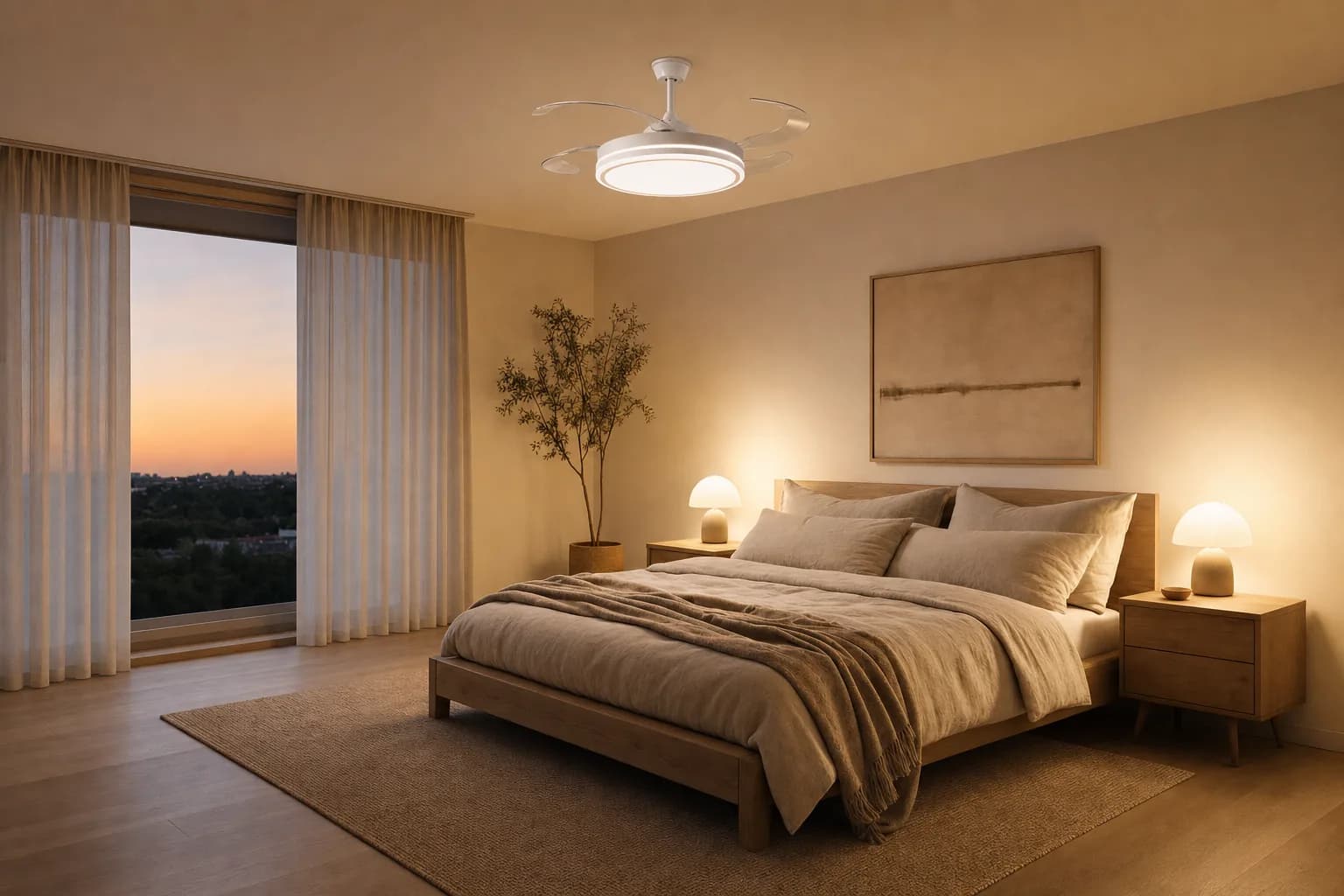
It is one of the most universal disagreements of life as a couple: the bedroom temperature. One kicks off the duvet at 20°C, the other wraps up at 22°C. Summer makes it worse, and every classic fix favours one sleeper against the other.
There is a setting that works for both, because it never touches the room's actual temperature: air circulation. Here is why couples rarely sleep at the same temperature, and how a silent ceiling fan reconciles both sides of the bed.
Why don't two people sleep at the same temperature?
Night-time thermoregulation depends on basal metabolism, body mass and hormonal variation, parameters that differ between sleepers. Comfortable sleep-onset temperature commonly varies by 2 to 3°C between partners.
Falling asleep requires the core body temperature to drop by about 1°C. The hot sleeper cannot manage it in a 26°C bedroom; the cold sleeper tenses up under 21°C air conditioning. The problem is not the couple, it is the tool: one air setting for two physiologies.
Why the classic compromises fail
Each improvised fix treats one sleeper and penalises the other. Air conditioning imposes a single temperature and a localised cold draught. A pedestal fan on one side of the bed blasts one body, drying airways and stiffening necks, while the other half of the bed receives nothing.
- ·Air conditioning: one imposed temperature, localised cold flow, compressor noise
- ·Pedestal fan: direct draught on one side only, drying, noisy oscillation
- ·Open window: weather-dependent, lets in noise and mosquitoes, useless in a heatwave
- ·Two separate duvets: settles the fabric dispute, not the air dispute
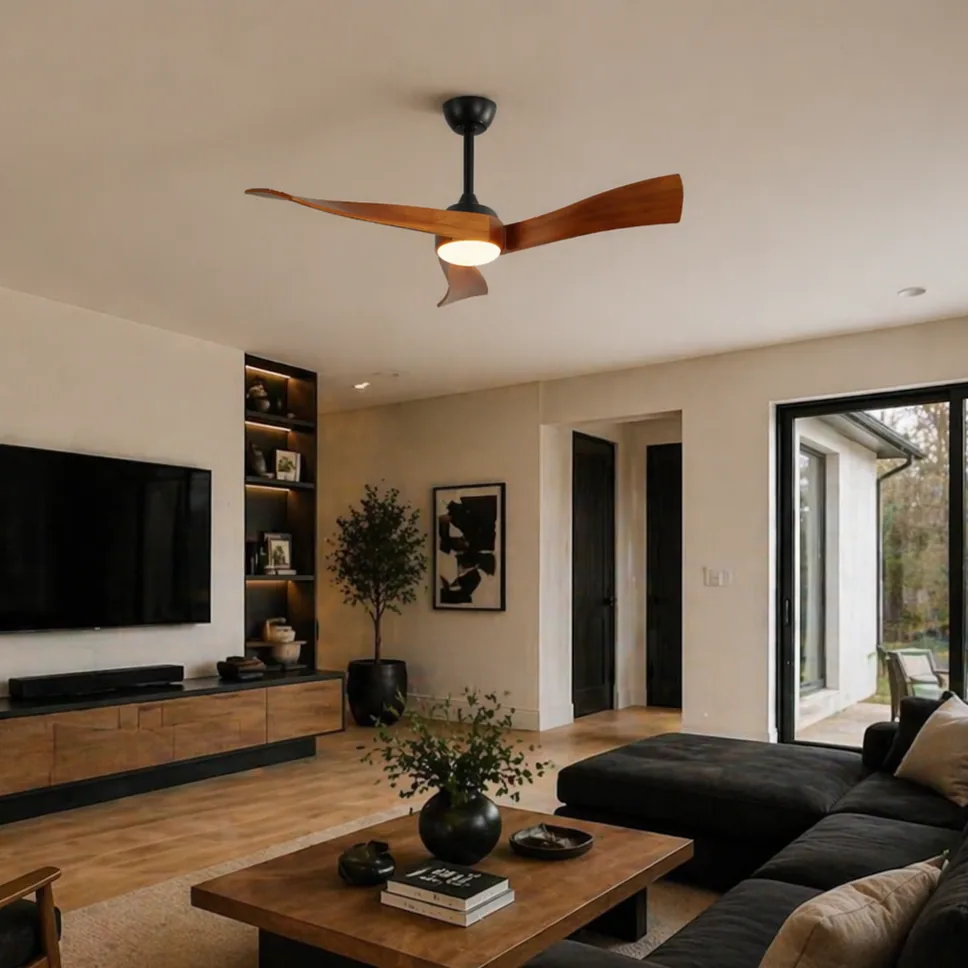
The Nord 132
Nordic black & walnut · Ø 132 cm · LED & remote
- ✓Silent DC motor, 6 reversible speeds
- ✓Remote control included
- ✓30-minute installation, illustrated manual
€339€429
Air circulation: the one setting that satisfies both
Wind-chill reframes the problem: moving air speeds up evaporation at the skin's surface and lowers perceived temperature by 3 to 4°C without changing the room's actual temperature. At an actual 26°C, the hot sleeper perceives 22-23°C.
The cold sleeper simply keeps the duvet: under covers, the airflow effect is largely filtered out and the sleeper's microclimate stays warm. Each partner tunes their own temperature by covering up more or less, two individual thermostats in the same bed. And the downward flow of a ceiling fan is even across the whole mattress, with no jet aimed at a face.
Which speed and noise level for sleeping together?
At night, use the lowest effective speed: on speed 1 or 2 of 6, a DC motor runs at 28-32 dB, less than a refrigerator. That steady hum has a second benefit for couples, masking the other sleeper's small noises, breathing, sheets, turning over.
The remote on the nightstand settles the matter without anyone getting up. A model like the Nord 132, three slender walnut blades on a minimal black body, adds a dimmable LED for evening reading before disappearing into the night's silence. And in winter, reversible mode redistributes the warm air trapped at ceiling level, arbitrating the couple's other seasonal dispute.
The temperature disagreement has no single answer because it is a two-body problem, but it does have an excellent referee. A silent ceiling fan gives the hot sleeper 3 to 4°C of perceived cooling, lets the duvet do its work for the cold sleeper, and runs at 28-32 dB without waking anyone. For shared beds we recommend the Nord 132, walnut and black drawn with Nordic restraint, dimmable LED and remote included.
Frequently asked questions
Won't the airflow bother the sleeper who is already cold?+
No: under a duvet the wind-chill effect is largely filtered and the sleeper's microclimate stays warm. The airflow only cools exposed skin, so each partner adjusts comfort by covering up more or less.
What fan diameter above a double bed?+
For a 12 to 25 m² bedroom, a 132 cm diameter delivers an even flow across a 160 or 180 cm bed. Blades must turn at least 2.10 m above the floor, which a standard ceiling allows.
Can the fan run all night with two sleepers?+
Yes. On night speed a DC motor draws very little power, runs at 28-32 dB and never blows directly onto faces, unlike a pedestal fan. Its steady hum even masks the other sleeper's movements.
The SEY Maison Circle
Every month, an exceptional piece. Never reissued.
The Drops principle: one high-end furniture piece per month, in a numbered edition. Once it's gone, it never comes back. Circle members are notified 48 h early, access each drop 24 h before everyone else, and receive our guides before publication.
Discover the Drops →