Silence & sleep
Ceiling fan at night: the ideal speed for sleeping, room by room
Published on ·4 min read
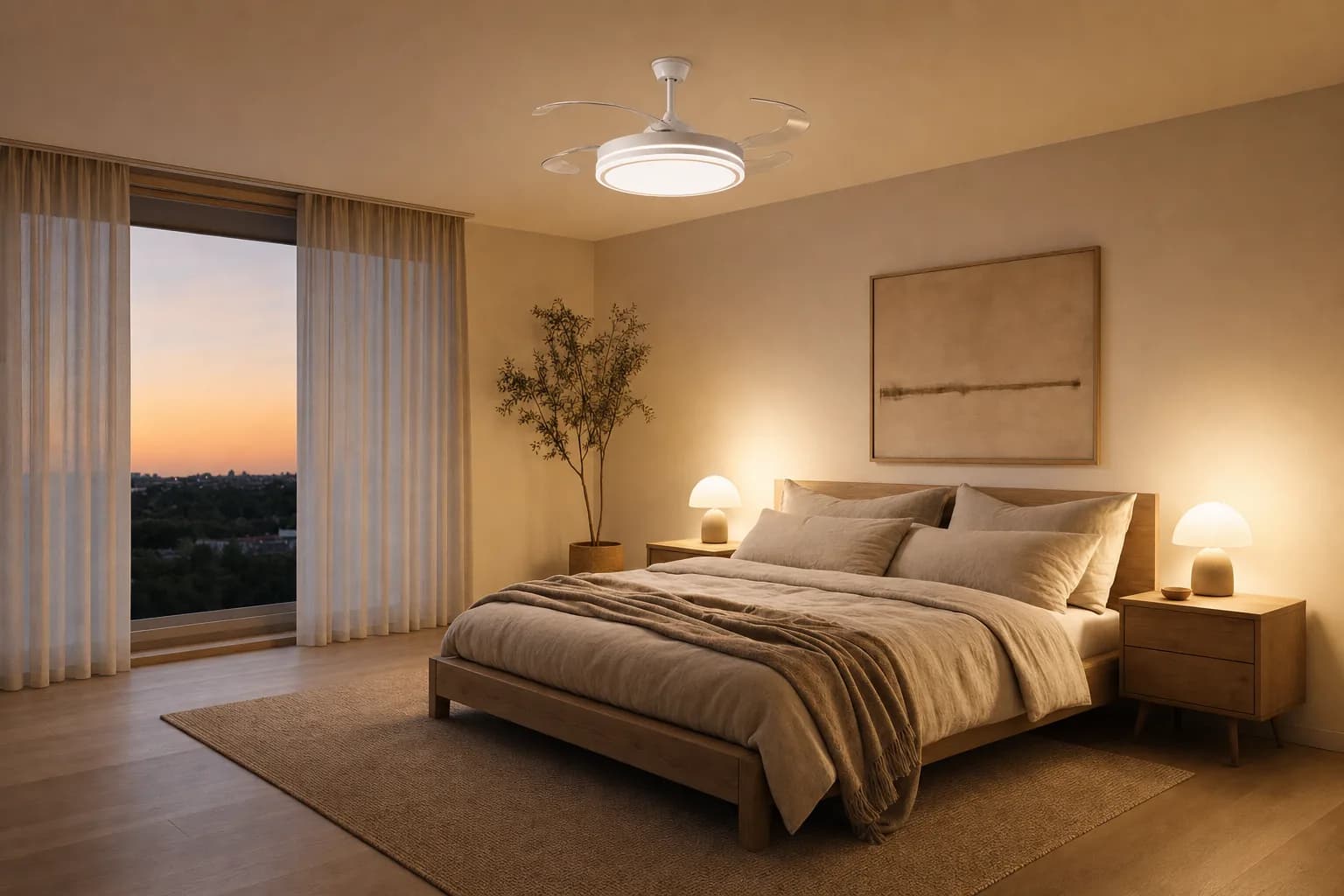
A ceiling fan is not set at night the way it is in the afternoon. The aim changes: it is no longer about feeling a breeze on a terrace, but sleeping eight hours without waking, without feeling cold at three in the morning, without hearing the unit.
This guide gives the settings that work, speed by speed and room by room, with the physiology behind them: why light air movement is enough, at what noise level you sleep, and how to combine the fan with window management.
Why a low speed is enough: the physiology of sleep
The body falls asleep when its core temperature drops. Air moving at 0.3 to 0.8 m/s over the skin speeds up the evaporation of perspiration and takes 2 to 3 °C off the felt temperature without changing the room temperature. That is exactly what a ceiling fan delivers at speed 1 or 2 from 2.5 m up.
A high speed does not help more: above 1 m/s the body perceives a draught, the skin cools too fast and you end up pulling the duvet, then feeling hot again. Deep sleep dislikes jolts. The right speed is the one you forget.
Noise level: 30 dB, the sleep threshold
Noise wakes you from 35 to 40 dB peaks in a quiet bedroom. A whisper is 30 dB, a library 40 dB. A quality ceiling fan goes down to 30 dB at speed 1: the sound is there, steady, but below the waking threshold. Many sleepers even find it soothing, a constant background that masks street noise.
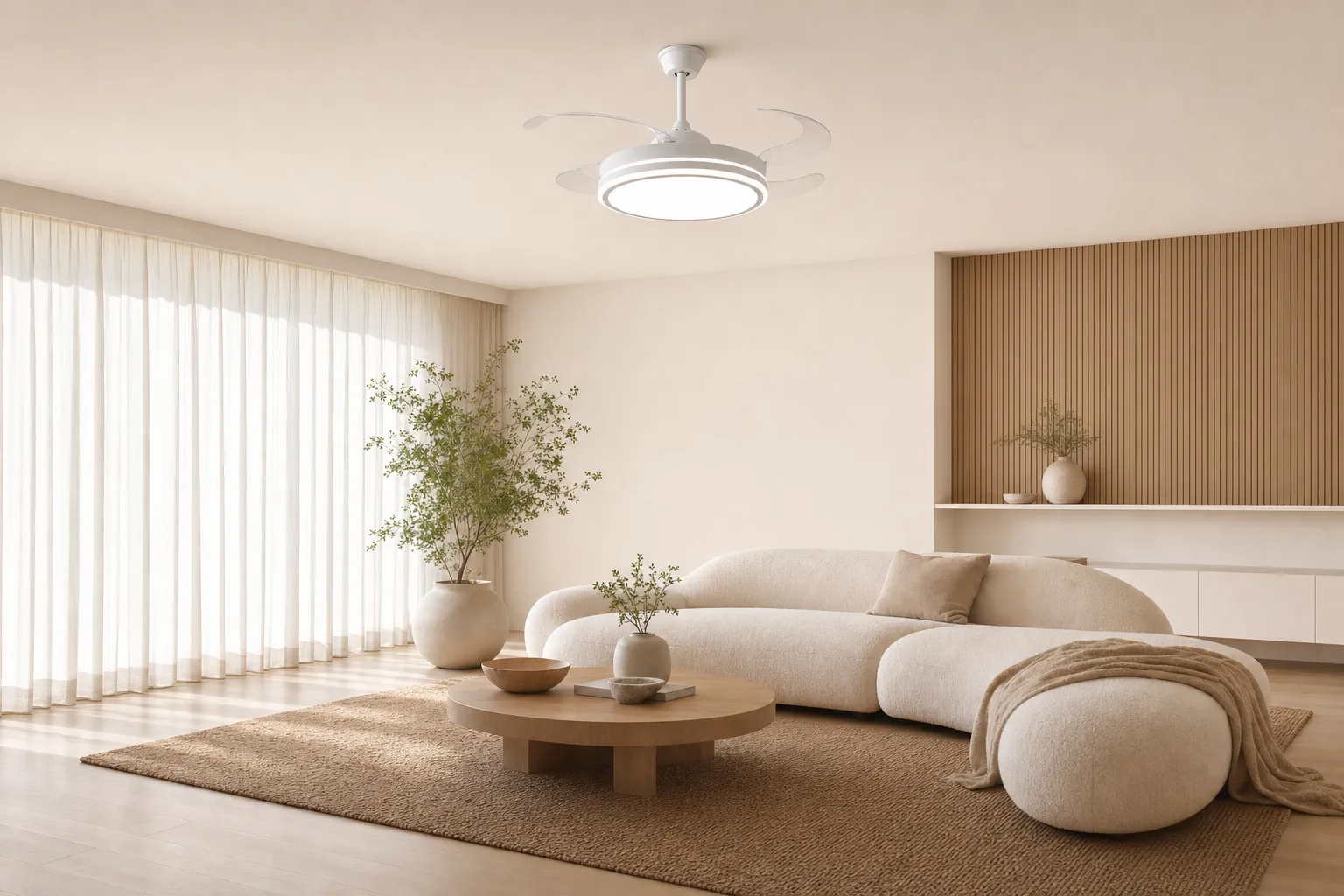
What wakes you is not the level but the irregularity: a click, an imbalance, a motor changing pitch. Hence the importance of a well-balanced copper motor and symmetrical blades. The Boréal 107 sits at 30 to 34 dB depending on speed, with no variation: at night you stop hearing it after two minutes.
The Boréal 107
Retractable blades · Ø 107 cm · LED ceiling light & silent fan
- ✓Retractable blades: invisible when off, nobody guesses it's a fan
- ✓Sleep with windows closed, 30 dB, quieter than a whisper
- ✓Integrated LED 2700K → 6000K, dimmable: replaces your ceiling light
The right setting by room and season
Speed depends on floor area, ceiling height and room temperature. As a rule, start one speed below what you think you need and adjust after one night. The remote on the bedside table lets you correct without getting up.
- ·Bedroom of 10 to 15 m², 2.5 m ceiling: speed 1 all night
- ·Bedroom of 16 to 21 m²: speed 2, or speed 1 if the bed is right under the unit
- ·Tropical night above 25 °C: speed 2 to 3 for the first hour, then speed 1
- ·Child's or baby's room: speed 1, unit offset from the bed
- ·Mid-season: speed 1 in winter mode to even out the temperature without a draught
Fan and windows: the duo that makes the night
The fan does not lower the room temperature, it makes the existing temperature bearable. To sleep at 22 °C rather than 27, let coolness in at the right moment: windows wide open between 5 and 8 am when outside air is at its lowest, then shutters and windows closed all day. In the evening the bedroom keeps a 2 to 4 °C lead on the outside.
The fan takes over at night: speed 1, door ajar to let air circulate, and you sleep. Add a dimmed warm-white 2700 K light in the evening rather than a cool-white ceiling light, and the body understands it is time to cool down. The Boréal 107 combines both in one unit, controlled from the bed.
At night a ceiling fan is set low, very low: speed 1 or 2, an air movement you forget, at 30 dB. Combined with windows opened early and closed during the day, it turns a 27 °C night into sleep at 22. The Boréal 107, 30 dB at speed 1, remote on the bedside table and dimmable warm light, is built for exactly that setting.
Frequently asked questions
What ceiling fan speed for sleeping?+
Speed 1 in a 10 to 15 m² bedroom, speed 2 up to 21 m². The aim is 0.3 to 0.8 m/s of air movement, taking 2 to 3 °C off the felt temperature without a draught. Beyond that the body cools too much and sleep fragments.
Is it bad to sleep under a ceiling fan?+
No, at low speed. The stiff-neck myth comes from pedestal fans pointed at the face at full power. A ceiling fan at speed 1 spreads a gentle, even air movement over the whole room, without a localised jet.
Does a ceiling fan make noise at night?+
A quality model drops to 30 dB at speed 1, less than a whisper and below the waking threshold. What wakes you is irregular noise: clicking or imbalance. A well-balanced copper motor produces only a constant hum you stop hearing after two minutes.
The SEY Maison Circle
Every month, an exceptional piece. Never reissued.
The Drops principle: one high-end furniture piece per month, in a numbered edition. Once it's gone, it never comes back. Circle members are notified 48 h early, access each drop 24 h before everyone else, and receive our guides before publication.
Discover the Drops →