Silence & sleep
A ceiling fan in the nursery: safety, silence and best practice
Published on ·4 min read
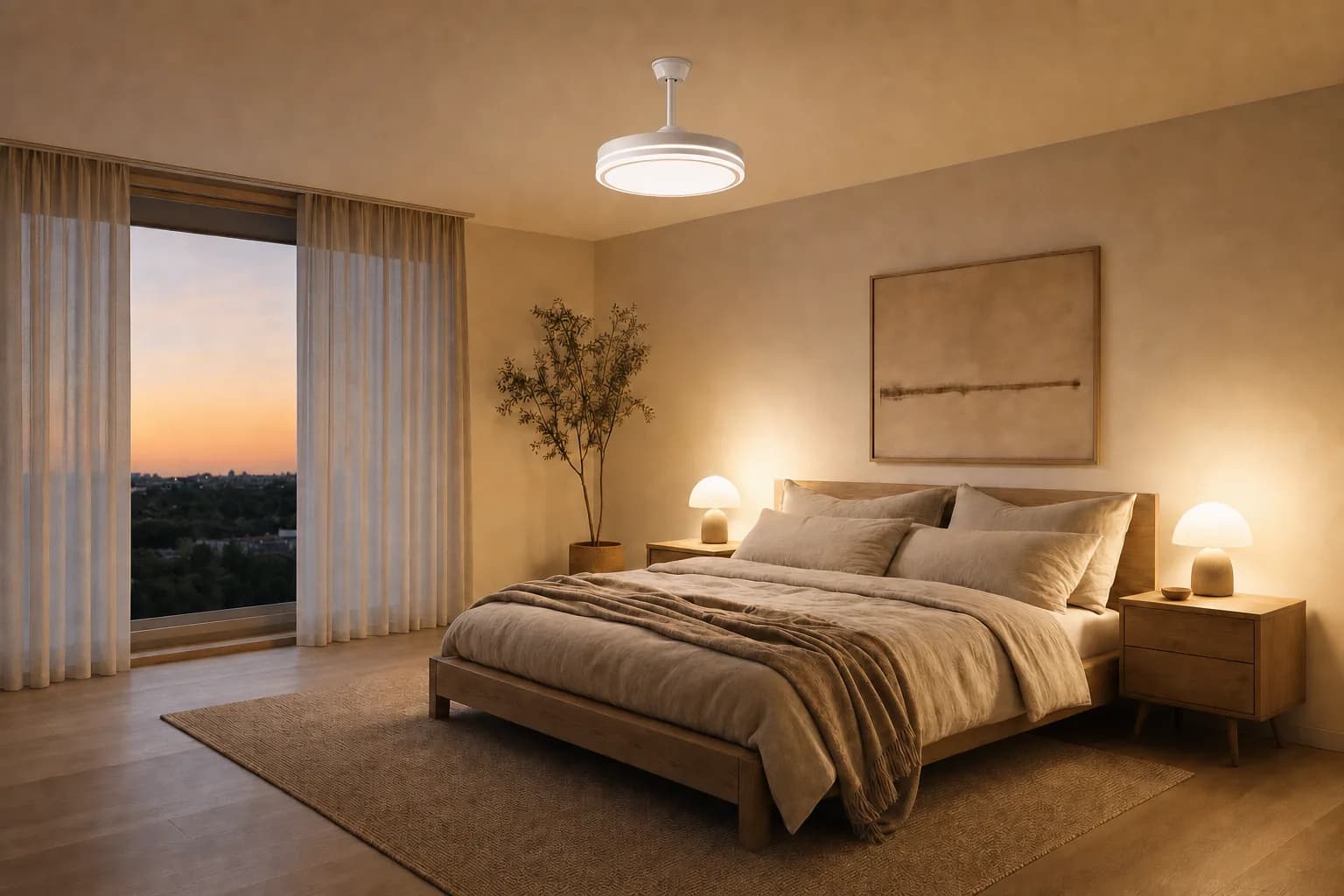
In summer, the nursery concentrates every new parent's worry: too hot to sleep well, too risky to open wide, too noisy to add an appliance. A ceiling fan, well chosen and well used, answers all three at once, precisely because it lives out of reach.
This guide covers safety first, then the noise level compatible with infant sleep, the temperatures paediatricians recommend, and placement, with one constant: caution, and no promise the appliance cannot keep.
Is a ceiling fan safe in a baby's room?
It is the safest configuration of all air-moving options. A pedestal fan brings three risks into a child's room: a cable on the floor, a grille at hand height, and a unit that can tip over. A ceiling fan removes all three: fixed to the structure, out of reach, nothing accessible.
Safety then comes down to installation: a solid mounting point, tightened blade screws, blades at least 2.30 m above the floor. Crucially, a ceiling fan does not blow directly at the child: it creates a gentle, even circulation without a localised cold draft, exactly what an infant needs.
What temperature for infant sleep?
Paediatric guidance converges on 18 to 20°C for a nursery, with back sleeping and a season-appropriate sleep bag, no duvet, no bumper. Those sleep rules remain the absolute priority whatever the equipment.
In summer those numbers are often unreachable without AC. Here honesty matters: moving air lowers the perceived temperature by 3 to 4°C, never the actual room temperature. The fan complements closed shutters by day and evening airing, it does not replace them. A room thermometer remains the most useful accessory to adjust the baby's sleepwear to reality.
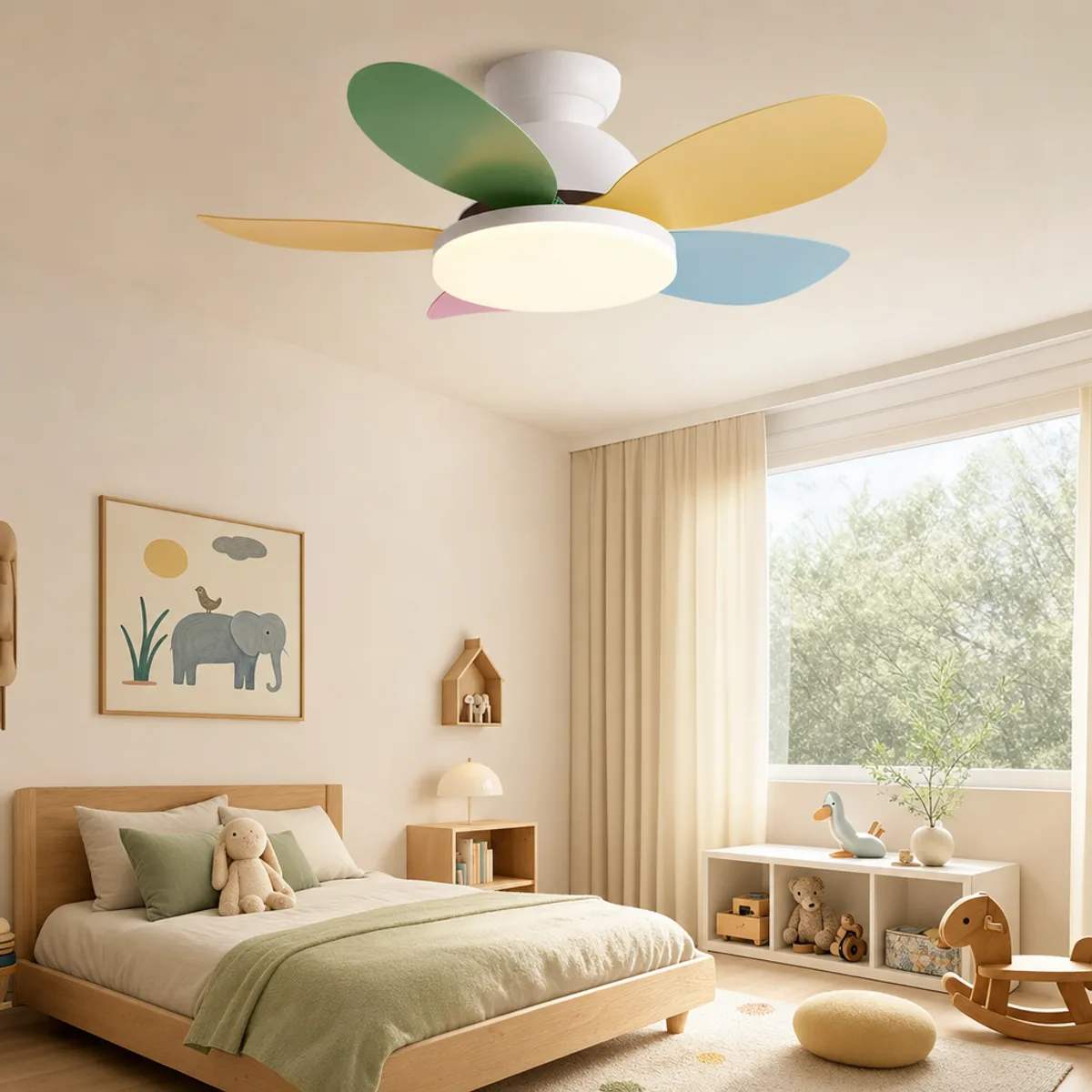
The Comptine 91
Pastel petals · Ø 91 cm · Children's rooms
- ✓Silent DC motor, 6 reversible speeds
- ✓Integrated dimmable LED + remote control
- ✓30-minute installation, illustrated manual
€239€229
How quiet does it need to be?
Infant sleep is light and fragmented: a noisy or irregular appliance multiplies micro-wakings. The decisive criterion is a DC motor, whose low speeds run around 28 dB, quieter than a whispered story, without mechanical surges.
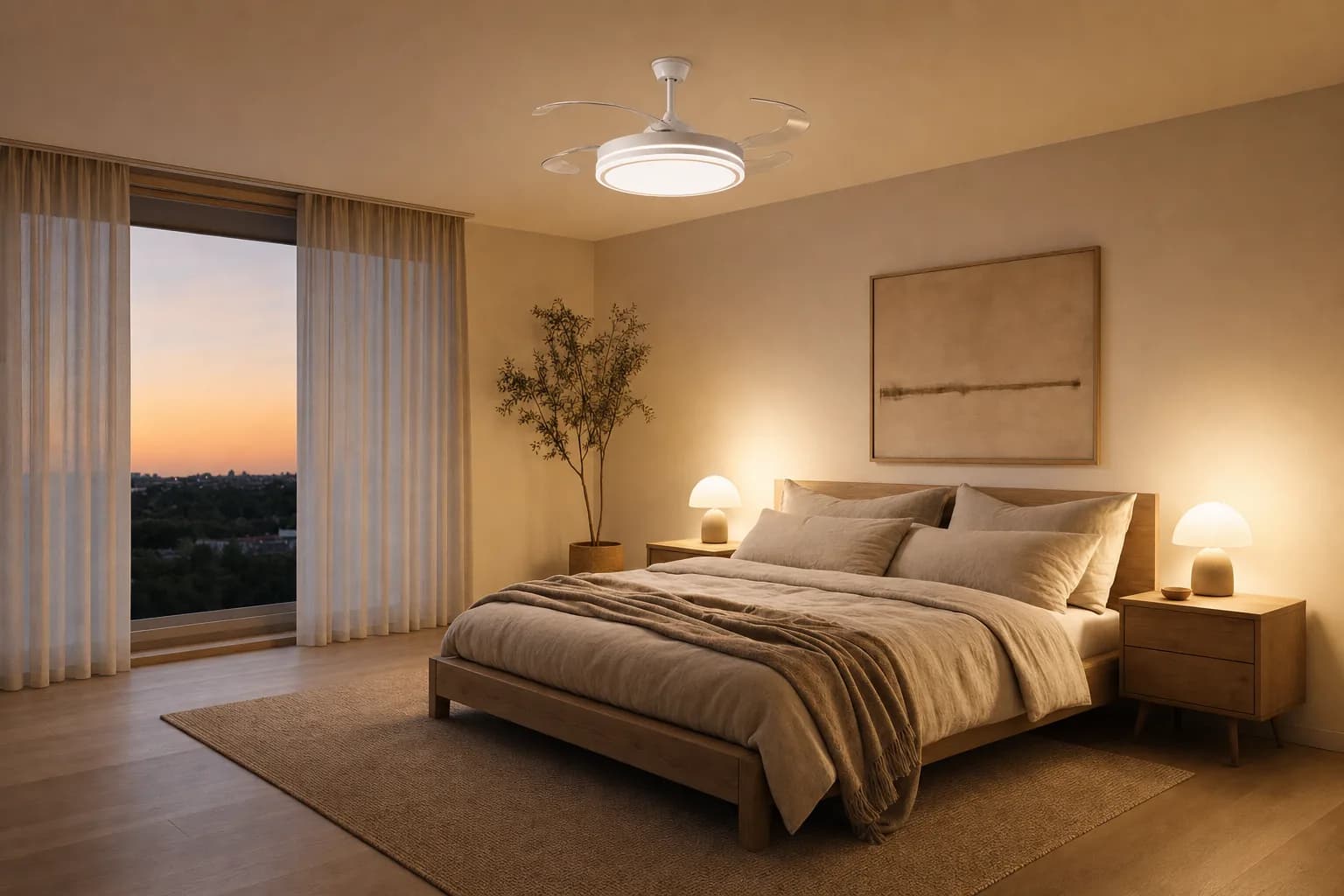
That is exactly the Comptine 91's brief: designed for children's rooms, it cools summer nights at 28 dB, five softly coloured petals, sage green, pale yellow, powder blue, around a round nightlight whose soft glow eases children to sleep. Its 91 cm span is calibrated for typical nursery sizes of 9 to 14 m². Its steady soft breath even acts like a discreet white noise, masking doors, floors and voices.
Crib placement and speed settings
The golden rule is indirect airflow: ideally the crib sits slightly offset from directly below the fan, so air circulates through the room without falling continuously onto the child. In a small room where the ceiling centre inevitably overlooks the bed, use the minimum speed: it stirs the air without any perceptible breeze at mattress level.
Low speed is the right setting for an infant anyway, the goal is to keep air from stagnating, not to create wind. The remote lets you adjust without entering the room, precious from the first hot night. Air the room daily: a fan circulates air, it does not renew it.
- ·Crib slightly offset from directly under the fan
- ·Minimum speed at night, no perceptible breeze at mattress level
- ·Blades at least 2.30 m above the floor, solid mounting
- ·Thermometer in the room, sleepwear adapted to actual temperature
- ·Daily airing, remote adjustments without entering the room
Yes, a ceiling fan belongs in a nursery, on three conditions: solid out-of-reach installation, indirect airflow at low speed, and genuine silence around 28 dB that protects sleep instead of disturbing it. Paediatric guidance stays the foundation, 18-20°C when possible, back sleeping, the right sleep bag, and the fan is its best summer ally. The Comptine 91 was drawn precisely for this brief: 91 cm, 28 dB, integrated dimmable nightlight, remote control and a reversible DC motor, with a 2-year warranty.
Frequently asked questions
Can the fan run all night in a baby's room?+
Yes, at low speed and with indirect airflow, never blowing continuously onto the crib. A DC motor around 28 dB does not disturb infant sleep, and its steady soft background even masks household noises.
What nursery temperature do paediatricians recommend?+
Generally 18 to 20°C, with back sleeping and a season-appropriate sleep bag. In summer, a fan does not lower the actual temperature: it lowers the perceived temperature by 3 to 4°C and makes residual heat far more bearable.
Can the crib sit directly under the fan?+
Prefer a slightly offset position for indirect airflow. If the room layout leaves no choice, use the minimum speed: it circulates the room's air without creating any perceptible breeze at mattress level.
The SEY Maison Circle
Every month, an exceptional piece. Never reissued.
The Drops principle: one high-end furniture piece per month, in a numbered edition. Once it's gone, it never comes back. Circle members are notified 48 h early, access each drop 24 h before everyone else, and receive our guides before publication.
Discover the Drops →