Cooling without AC
The upstairs is unbearable in summer while the ground floor stays cool: why, and what to do
Published on ·5 min read
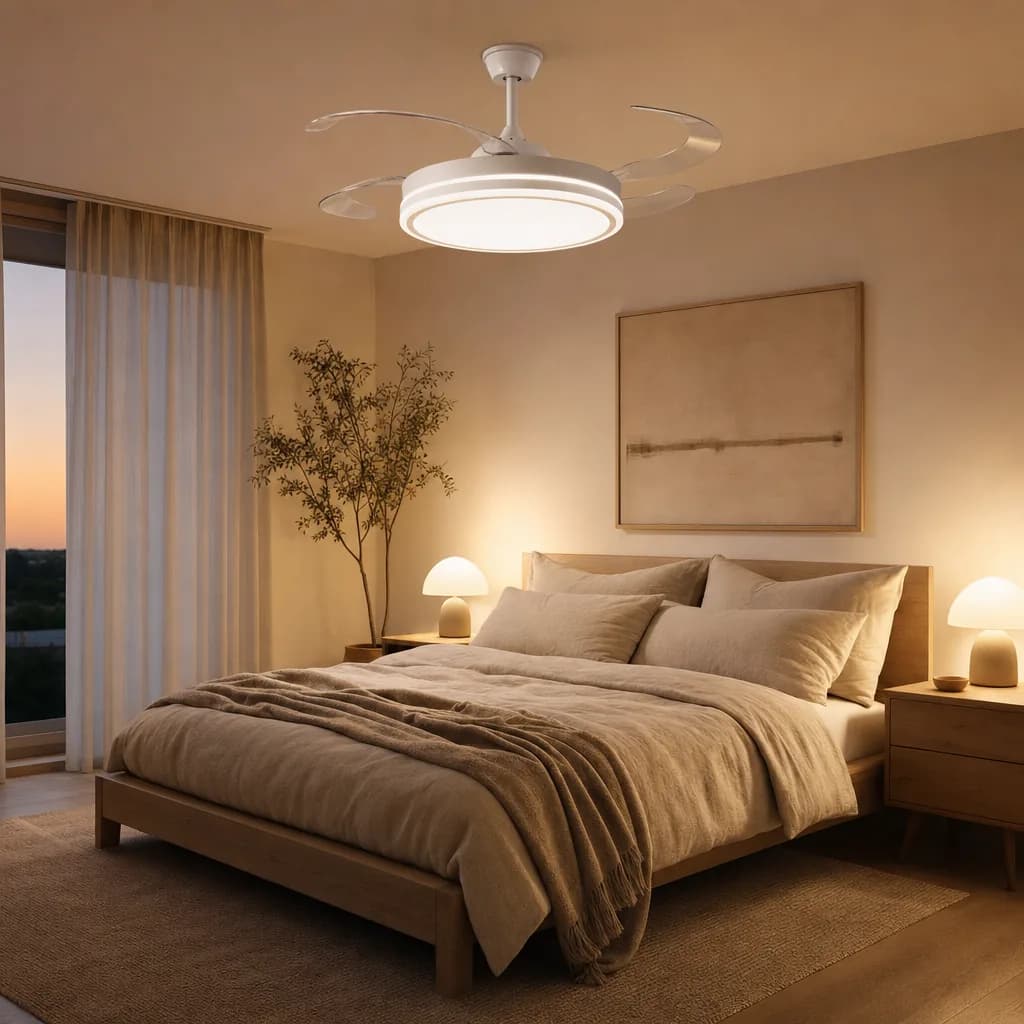
The scene repeats itself in thousands of homes: the living room stays bearable, you go up to bed, and the bedroom is an oven. The gap is easy to measure with two thermometers, and it always surprises: 5 to 8°C is common, up to 10°C when the loft is barely insulated.
This is neither fate nor a building defect: it is the result of two physical effects adding up, and each one is treated by a different lever. It is worth knowing which to pull first, because they differ in both cost and effect.
Two distinct causes, often confused
The first is stratification. Warm air is less dense, it rises and stacks up under the highest point of the volume. In a house with an open stairwell, all the heat produced downstairs, cooking included, ends up upstairs. The effect exists in winter too, except that then you want it.
The second is the roof's contribution. A roof exposed to the sun accumulates heat all day and releases it inwards for hours, including after sunset. That explains the most baffling part: the bedroom can be hotter at 11 pm than at 7 pm.
Telling the two apart matters, because they are not treated the same way. Stratification is solved by moving the air. The roof's contribution is solved by insulating or shading. A fan under an uninsulated roof brings genuine relief, but it will never replace the centimetres of insulation missing above it.
What a ceiling fan changes upstairs
A ceiling fan does not lower the air temperature: it gains 3 to 4°C of felt temperature for anyone in the flow. In a bedroom at 29°C, you go to bed in the sensation of 25 to 26°C, which is enough to get back to sleep.
It also acts on stratification, and that is the most useful effect upstairs: by circulating, it brings back down the hottest layer of air stuck to the ceiling and evens out the volume. The difference between bed level and ceiling level disappears, instead of widening all night.
In a converted attic bedroom the constraint is the slope: you need a downrod model with a ball joint, 40 cm between blades and rafters, and 2.10 m above the floor. Under a level ceiling at 2.40 m it is the opposite, you need a flush-mounted profile. The format follows the room, never the catalogue.
- ·Bedroom of 12 to 20 m²: Ø 107 cm is enough, silence on night speed first
- ·Bedroom of 20 to 30 m² or open room: Ø 132 cm
- ·Sloped ceiling: downrod and ball joint, 40 cm clearance to the rafters
- ·Level ceiling under 2.50 m: flush profile, never a shortened downrod
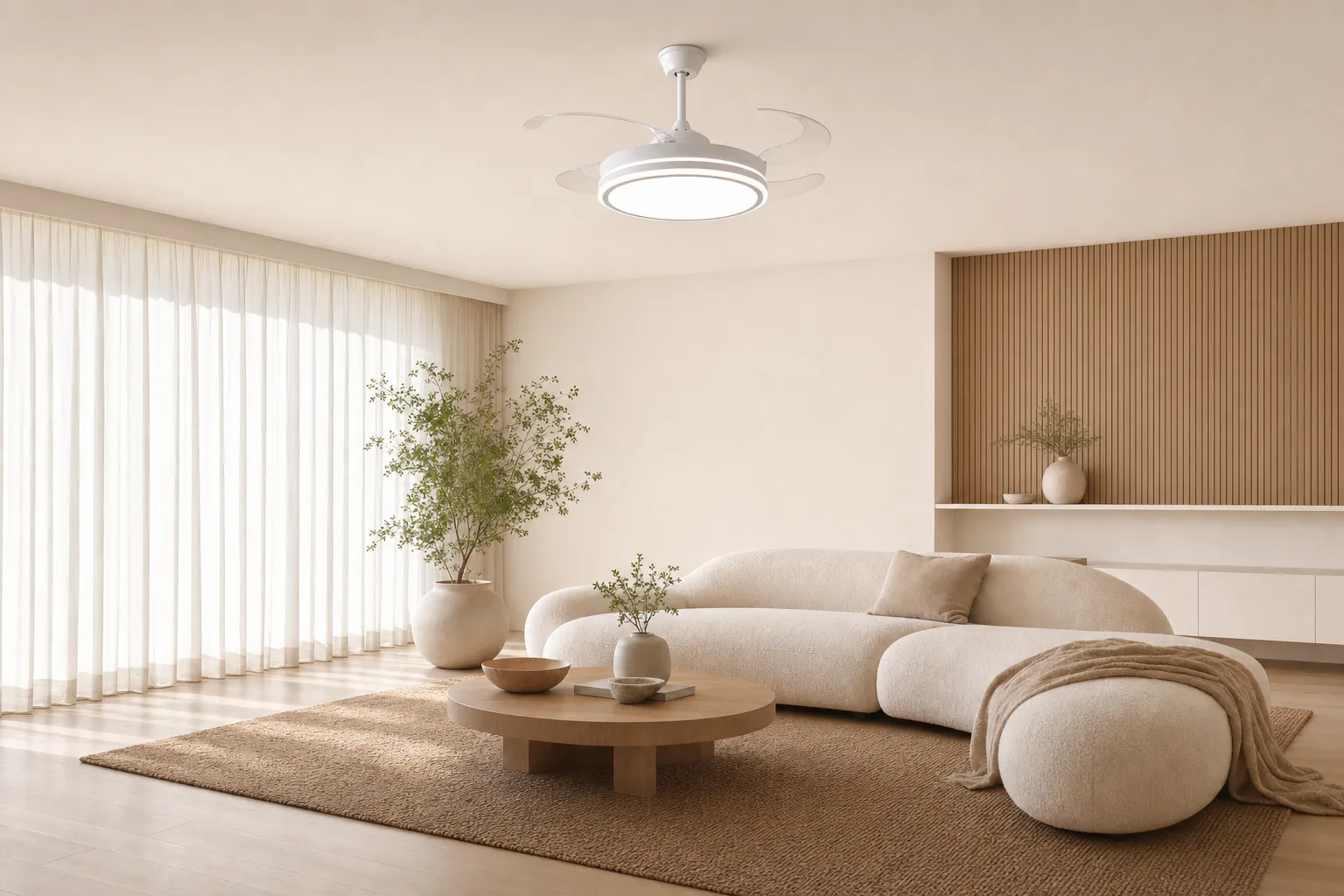
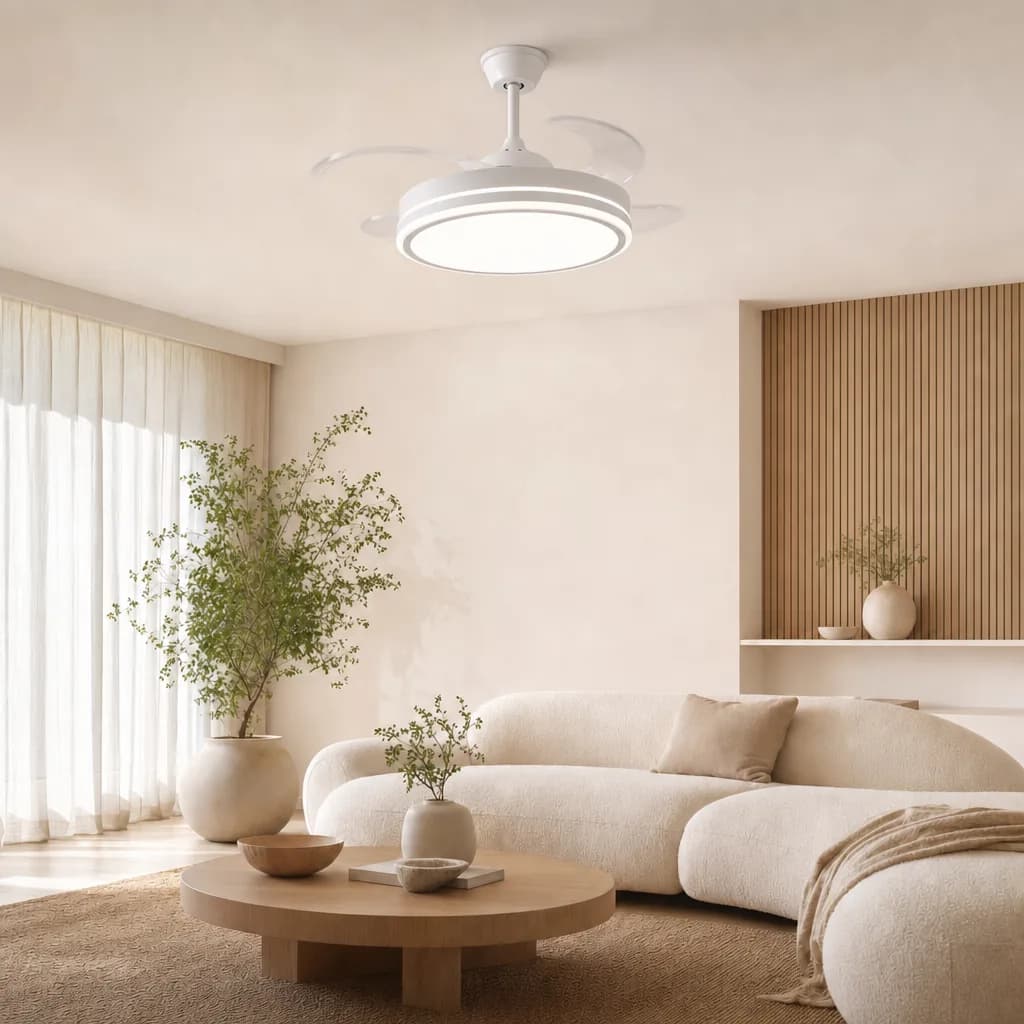
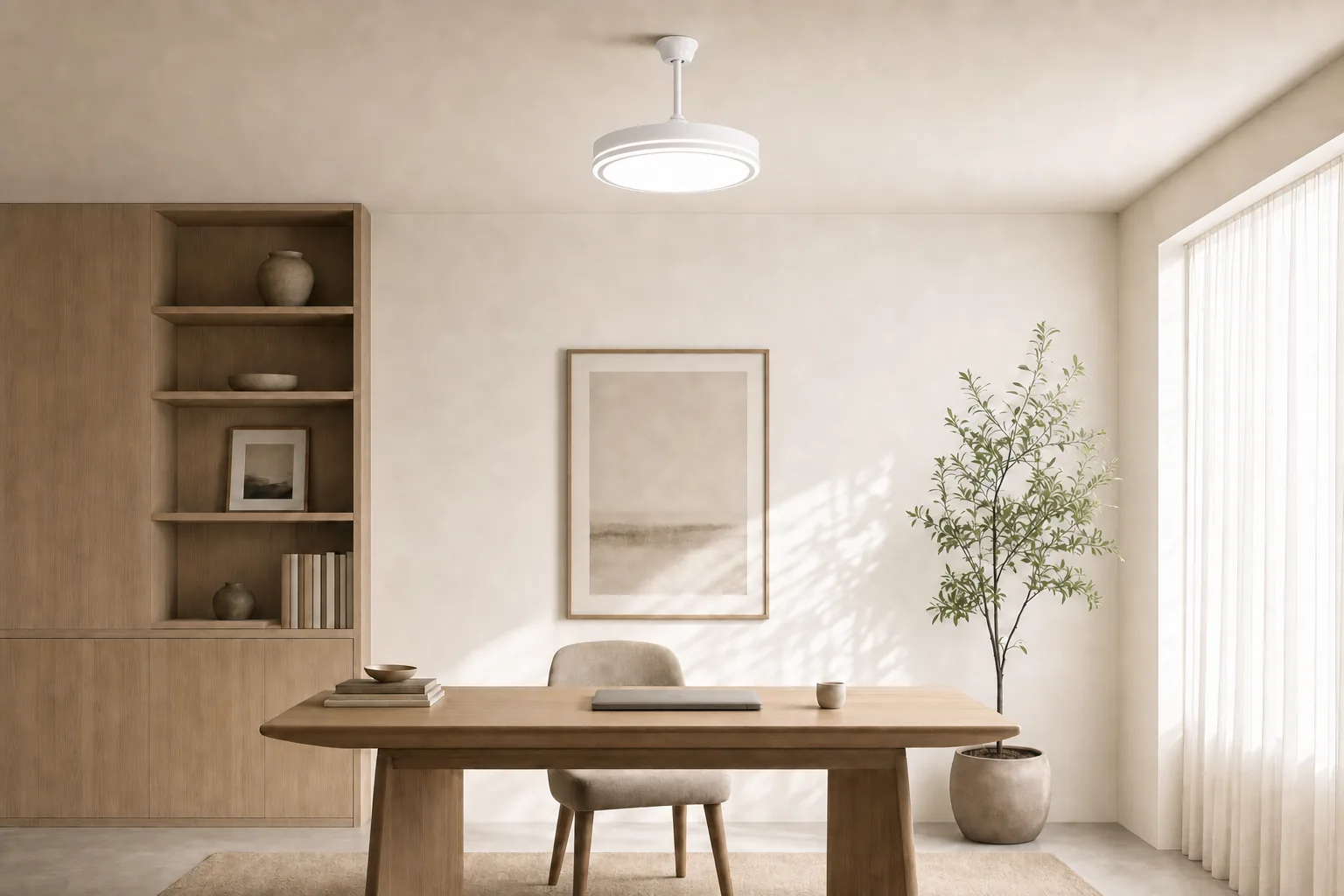
The Boréal 107
Retractable blades · Ø 107 cm · LED ceiling light & silent fan
- ✓Retractable blades: invisible when off, nobody guesses it's a fan
- ✓Sleep with windows closed, 30 dB, quieter than a whisper
- ✓Integrated LED 2700K → 6000K, dimmable: replaces your ceiling light
The three levers, in the right order
The first lever is roof insulation, by far the most powerful when it is thin. It does not merely cool in summer: it works in winter too, which no other solution does. It is building work, with a cost, but everything that follows will be less effective if this step is missing.
The second is shading. Shutters, external blinds or reflective films stop the radiation before it crosses the glass. Closing from 10 am and reopening in the evening easily gains 4 to 6°C indoors, at no cost where shutters already exist.
The third is air circulation, and it is the one that acts on immediate comfort, tonight, without any building work. It is also the only one that works on nights when the outside air never drops far enough for opening the windows to help. All three add up, and together they make an upstairs liveable.
In winter, the same floor becomes an advantage
The stratification that burdens you in summer works for you in winter, provided you retrieve it. Radiator heat rises in exactly the same way and gathers at the ceiling, above people's heads, while the bed stays in the cold air.
A reversible motor inverts the rotation and gently pushes that warm layer back towards the floor, with no perceptible draught. In an upstairs bedroom, that amounts to reusing heat you have already paid for, and often allows the heating to come down by a degree. The same appliance therefore works twelve months a year, which changes the arithmetic of the purchase.
An unbearable upstairs is no fate: it is the sum of heat that rises and a roof that gives back. Insulation treats the second, shading keeps it out, and air circulation solves the first while returning the 3 to 4°C of felt temperature that let you sleep. If you can pull only one lever tonight, pull the last one: it works immediately, without building work, and still serves in winter in the opposite direction.
Frequently asked questions
Why is it hotter upstairs than downstairs?+
Two causes add up: warm air is less dense and rises to gather under the highest point, and the roof releases inwards the heat absorbed during the day. The usual gap is 5 to 8°C, up to 10°C under a barely insulated loft.
Why is the bedroom hotter at 11 pm than at 7 pm?+
Because the roof releases the heat it has stored with several hours of delay. The indoor peak therefore arrives well after the outdoor one, often in the middle of the evening, sometimes right at bedtime.
Is a ceiling fan enough to solve the problem?+
It solves the stratification and gains 3 to 4°C of felt temperature where you sleep, which is enough to get back to sleep in most cases. It does not replace missing roof insulation: it makes the upstairs liveable, it does not remove the cause.
Where should you start on a limited budget?+
With shading, which is free where shutters already exist: closed from 10 am to 8 pm, they gain 4 to 6°C. Then air circulation, which works the same evening. Roof insulation comes first as soon as the budget allows building work, because it also serves in winter.
Which model suits an attic bedroom?+
A downrod model with a ball joint, which takes up a pitch of around 30°, keeping 40 cm between blade tips and the slope and 2.10 m above the floor. Flush-mounted profiles should be ruled out: they are designed for a horizontal surface.
The SEY Maison Circle
Every month, an exceptional piece. Never reissued.
The Drops principle: one high-end furniture piece per month, in a numbered edition. Once it's gone, it never comes back. Circle members are notified 48 h early, access each drop 24 h before everyone else, and receive our guides before publication.
Discover the Drops →