The art of the home
A ceiling fan for an open-plan living space: moving air across a large floor
Published on ·3 min read
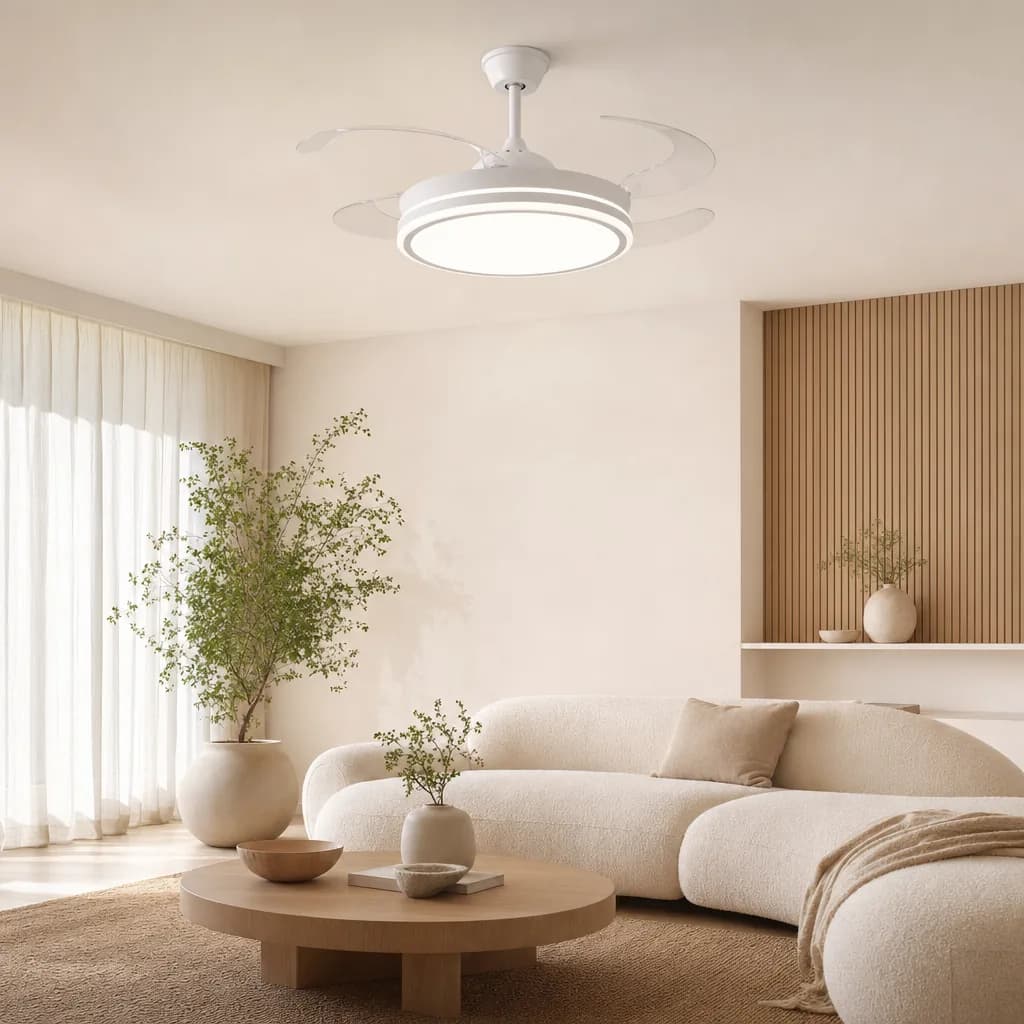
The open-plan living space is the favourite layout of the last twenty years, and the hardest to cool in summer: glazing captures heat, cooking adds more, and nothing pushes the air around.
A properly sized ceiling fan changes the nature of the problem. This guide answers the three deciding questions: where to place it, which diameter, and whether to choose one large fan or two medium ones.
Why is an open space so hard to cool?
An open floor has several temperatures: the cooking zone runs 3 to 5°C above the rest, the sofa corner absorbs the afternoon solar gain through the glazing, and with no walls to guide it, warm air stagnates where it is produced.
A mobile air conditioner sized for 20-25 m² struggles against a double volume. A ceiling fan takes the problem differently: it does not cool the air, it moves it across the whole surface, breaking up the thermal zones and delivering 3 to 4°C of perceived cooling for a few dozen watts.
Where should the fan go in an open-plan room?
Not the geometric centre, which often falls over the dining table or a walkway. Centre the fan over the zone where people sit still the longest, usually the sofa area, because wind-chill only benefits those under the flow.
- ·Centre over the sofa zone
- ·Keep 20 cm minimum to the ceiling, 2.10 m minimum under the blades
- ·Never directly above the hob: the downward flow disturbs the extractor hood
- ·Avoid conflict with low pendant lights (strobe effect)
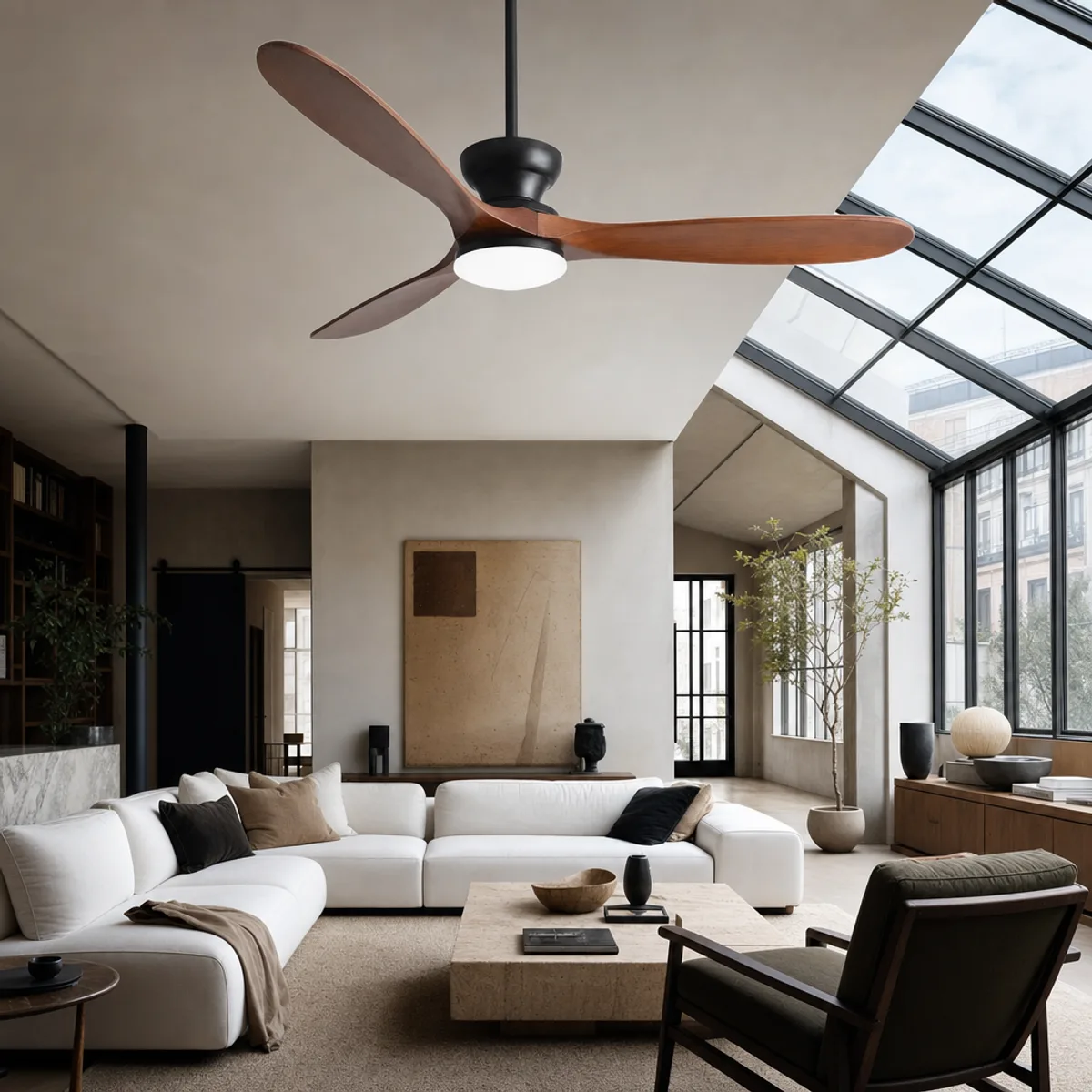
The Panorama 178
Giant Ø 178 cm · Walnut & black · Integrated LED
- ✓Silent DC motor, 6 reversible speeds
- ✓Integrated dimmable LED + remote control
- ✓30-minute installation, illustrated manual
€449€569
Which diameter for which surface?
Diameter comes before style and before price. Too small a fan must spin fast to be felt: narrow, noisy, unpleasant. A large diameter does the opposite, moving a lot of air slowly and silently over a wide zone.
Installer consensus: up to 15 m², 107-122 cm; 15 to 25 m², 132 cm; beyond 25 m² in one volume, step up to a very large span. That is exactly the Panorama 178's role: a 178 cm span, three long walnut blades on a black body, built for lofts and open-plan living rooms nothing else can cover, moving an entire floor of air at slow speed in surprising silence.
One large fan or two medium ones?
As long as the floor is one roughly rectangular volume, one large diameter wins: one electrical point, one object on the ceiling, a wide homogeneous flow, a lower rotation speed and less noise.
Two medium fans become the right answer in an L-shaped layout, when a work or sleeping zone needs independent control, or when the ceiling structure offers no central fixing point. Year-round, the reversible DC motor keeps paying: in winter it pushes the heat accumulated under high ceilings back down. The Panorama 178 adds a dimmable integrated LED, remote control included, 28-34 dB, 2-year warranty, free delivery over €150.
Cooling an open-plan space is a geometry problem: identify the thermal zones, place the flow where you live, size the diameter to the real surface. Up to 25 m², a 132 cm does the job; beyond that, the Panorama 178 is built precisely for these floors, a 178 cm span, slow wide flow, integrated LED and 28-34 dB of quiet. One object on the ceiling, and the whole space breathes, summer and winter.
Frequently asked questions
What ceiling fan diameter for 40 m²?+
For 40 m² in one volume, aim for a very large diameter around 178 cm, moving air at slow speed in silence. If the floor is L-shaped or larger, two 132 cm fans over each living zone work better than one unit.
Can you install a ceiling fan over an open kitchen?+
Over the dining area yes, never directly above the hob: the downward flow disturbs the extractor hood and spreads vapours and grease. Place the fan over the sofa or table zone instead.
Does a large ceiling fan use a lot of electricity?+
No: a DC motor draws a few dozen watts even at large diameters, nothing like air conditioning. At slow speed a 178 cm fan moves more air than a small model at full speed, at 28 to 34 dB.
The SEY Maison Circle
Every month, an exceptional piece. Never reissued.
The Drops principle: one high-end furniture piece per month, in a numbered edition. Once it's gone, it never comes back. Circle members are notified 48 h early, access each drop 24 h before everyone else, and receive our guides before publication.
Discover the Drops →