The art of the home
Ceiling fan rotation direction: summer, winter, how to set it and how to check
Published on ·4 min read
Most ceiling fans have two rotation directions, and most owners use only one. The second, winter mode, is however what makes a fan useful twelve months a year instead of three.
This article explains what each direction does to the room's air, how to switch from one to the other, how to check the setting is right without climbing on a chair, and which setting mistakes wrongly lead people to say winter mode is useless.
Summer: anticlockwise, air downwards
In summer mode the blades turn anticlockwise when you look at the fan from the floor. The blades' angled profile then pushes air down: a column of air descends in the centre of the room, spreads over the floor and rises along the walls. Under the fan you clearly feel the breeze. That air movement on the skin is what lowers the felt temperature by 2 to 4 °C.
All speeds suit summer. Speed 1 for the night, at 30 dB; speed 2 for an evening in the living room; speed 3 to cool a room quickly after it has heated all day, before dropping down. Summer mode is used with windows open or closed, with no difference in principle: it does not cool the air, it moves it.
Winter: clockwise, air upwards, minimum speed
In winter, warm air from the heating rises and gathers under the ceiling: up to 4 °C between feet and ceiling in a 2.50 m room. In winter mode the blades turn clockwise seen from below and draw air upward. Warm ceiling air is pushed to the walls, comes down along them and returns to floor level. The room evens out, with no perceptible breeze in the centre.
The absolute condition: minimum speed. At speed 1 the air movement is too slow to be felt, and heat comes down gently. At speed 2 or 3 the movement becomes a draught, and 20 °C air moving over the skin feels cold. That is the mistake that makes people say winter mode cools: it is not the direction at fault, it is the speed. The real benefit: 1 to 2 °C less on the thermostat for the same comfort, 7 to 14% of heating over the season, for 5 W of consumption.
- ·Clockwise seen from below
- ·Speed 1 only
- ·Continuously during heating hours
- ·Thermostat lowered 1 to 2 °C after a few days
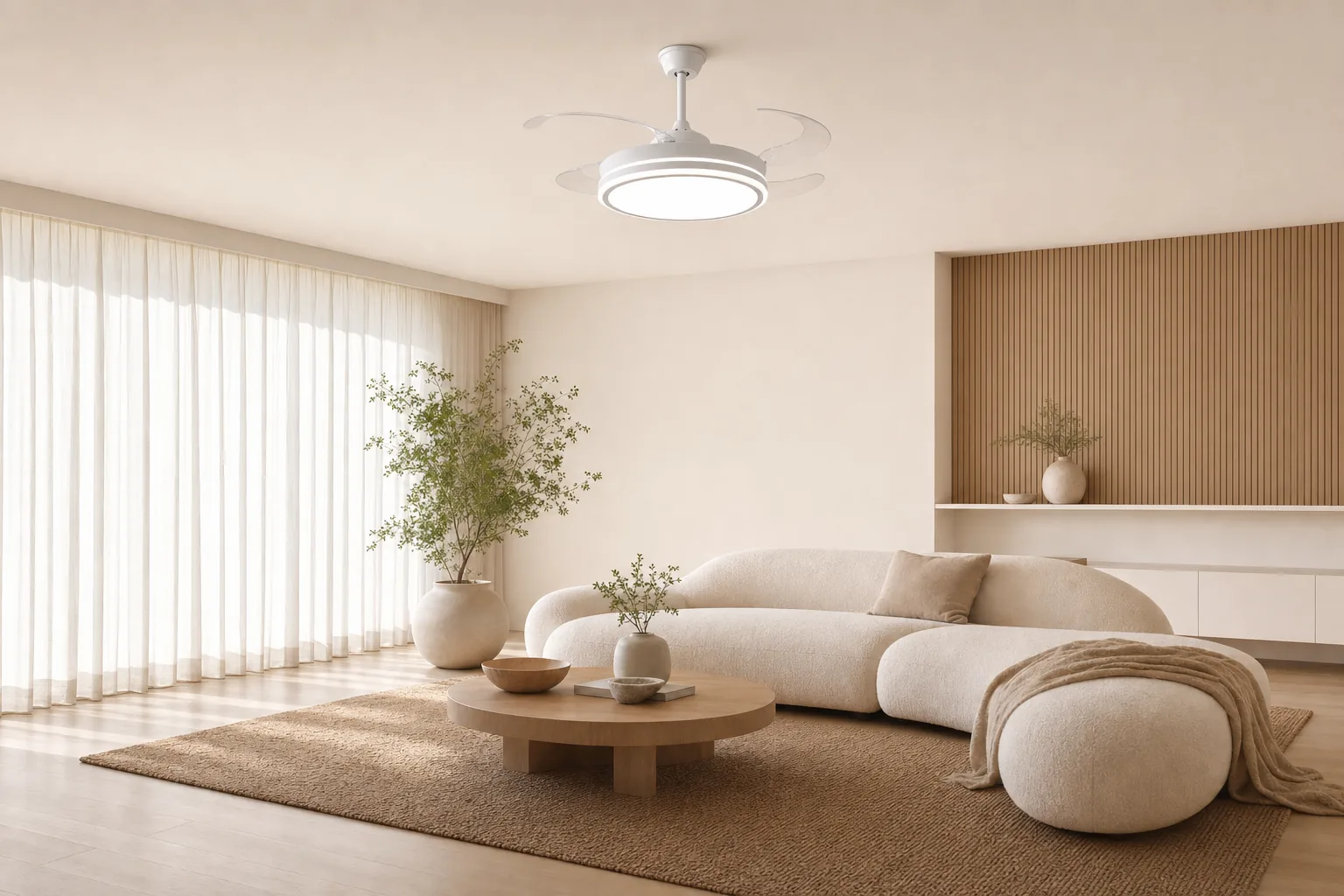
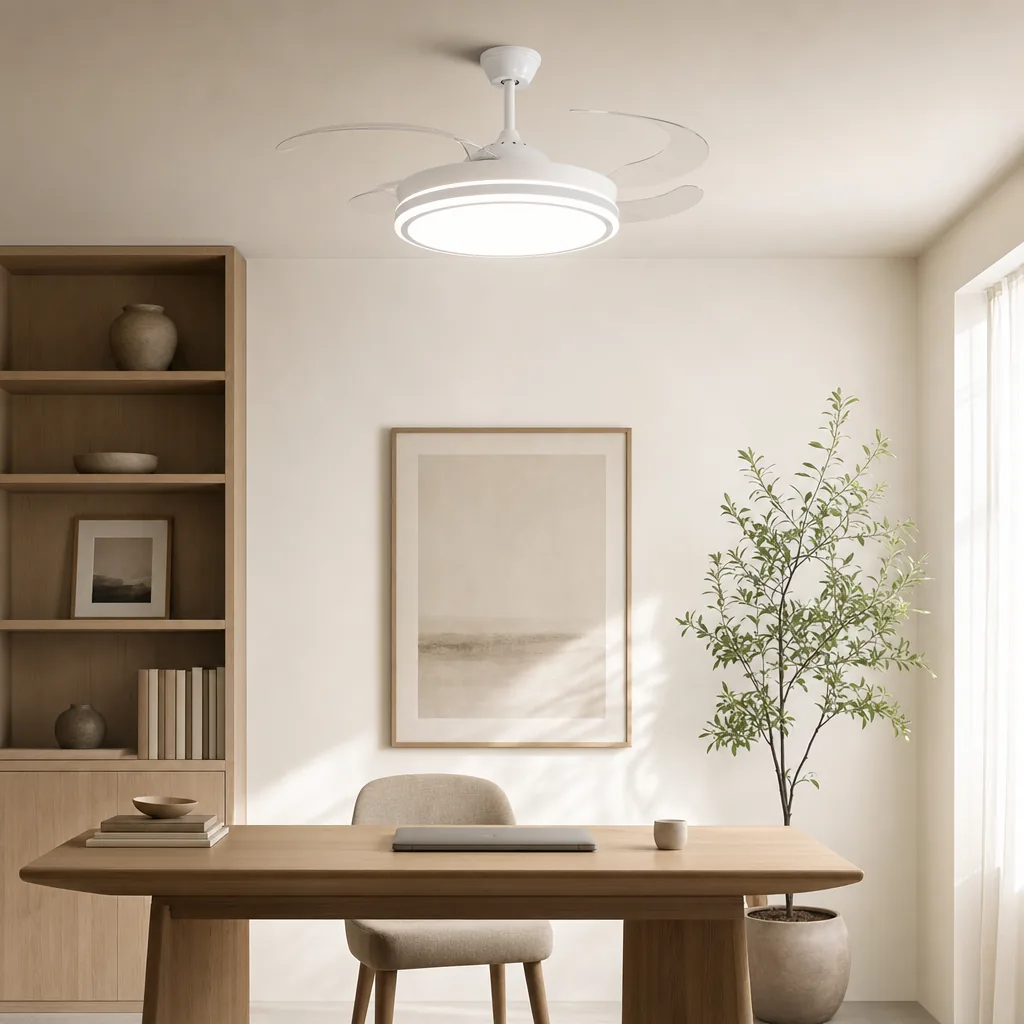
The Boréal 107
Retractable blades · Ø 107 cm · LED ceiling light & silent fan
- ✓Retractable blades: invisible when off, nobody guesses it's a fan
- ✓Sleep with windows closed, 30 dB, quieter than a whisper
- ✓Integrated LED 2700K → 6000K, dimmable: replaces your ceiling light
Changing direction and checking without climbing
On the Boréal 107, reversal is done from the remote, fan stopped or running depending on the receiver model: stop, press the reverse command, restart. On other models a small switch on the motor body does the same, which means climbing a stepladder twice a year. The remote avoids that chore and lets you switch in ten seconds the day the season changes.
To check direction without watching the blades, two tests. First: stand under the fan on speed 2; if you feel air, it is summer mode; if you feel nothing, winter mode. Second, more precise: a sheet of paper held at arm's length under the blades is pushed down in summer mode and slightly drawn up in winter mode. A glance at the blades confirms: anticlockwise seen from below in summer.
The mistakes that cancel the benefit
Three mistakes recur. The first we have seen: winter mode at speed 2 or more, which creates a cold draught. The second: winter mode in an unheated room, where there is no ceiling heat to redistribute; the fan moves cool air for nothing. Winter mode is justified in heated rooms, living room, office, bedroom with a radiator.
The third: forgetting to switch back to summer mode in June. A fan running clockwise at speed 3 in high summer moves air toward the ceiling and gives no breeze on the skin; you conclude it does nothing. The simple reflex: the first day you turn the heating back on, reverse; the first day you unfold the blades to cool down, reverse. Two presses on the remote a year.
Anticlockwise in summer, you feel the breeze; clockwise in winter at speed 1, you feel nothing but the thermostat drops a notch. The sheet-of-paper test confirms the direction in ten seconds, and the Boréal 107 remote reverses without a stepladder. Two settings a year for a unit that serves twelve months.
Frequently asked questions
Which way should a ceiling fan turn in summer?+
Anticlockwise, seen from below. The blades then push air to the floor and you feel the breeze on your skin, which lowers the felt temperature by 2 to 4 °C. All speeds suit.
Is a ceiling fan's winter mode really useful?+
Yes, at minimum speed only: it brings warm air gathered at the ceiling back to the floor without perceptible draught, which allows lowering the thermostat 1 to 2 °C. At speed 2 or 3 it creates a cold draught and the benefit disappears.
How do I know if my fan is turning the right way?+
Under the fan on speed 2: if you feel air, it is summer mode; if you feel nothing, winter mode. A sheet of paper held under the blades is pushed down in summer and drawn up in winter.
The SEY Maison Circle
Every month, an exceptional piece. Never reissued.
The Drops principle: one high-end furniture piece per month, in a numbered edition. Once it's gone, it never comes back. Circle members are notified 48 h early, access each drop 24 h before everyone else, and receive our guides before publication.
Discover the Drops →