Comparisons & guides
Budget or premium ceiling fan: the real 10-year maths
Published on ·5 min read
On paper the gap is obvious: a budget ceiling fan sells for a fraction of a premium model. But a ceiling fan is not an impulse buy, it is equipment screwed to your bedroom ceiling, running thousands of hours a year for years. At that scale, purchase price becomes minor and three invisible lines take over: consumption, noise and lifespan.
This guide lays out the full calculation to answer the only question that matters: what does each fan really cost per year of use?
Cost per year of use: the only honest metric
Apply the mattress logic: divide total cost of ownership by years of service. A budget fan that dies after 4 to 5 summers must be repurchased, reinstalled, and the old one recycled. Two replacements later, the initial saving has vanished.
A premium model reasons the other way: a motor sized for 50,000 hours, over 15 years at 8 h a day, quality bearings, available parts. That is exactly the equation of the Boréal 107: a silent copper motor rated for 50,000 hours, a 2-year warranty with EU support, installed once in 30 minutes.
AC or DC motor: the difference that pays for itself
This is the real dividing line. Budget fans almost always carry an AC induction motor: robust but hungry, 60 to 75 W at full speed. An electronically driven DC motor delivers the same airflow for 20 to 30 W, up to 70 % less, plus six genuinely distinct speeds and a reversible winter mode.
Run the summer maths: 8 h a day for 4 months is about 960 hours. At full speed the AC motor burns around 67 kWh, the DC about 24 kWh. At current electricity rates the gap is close to 10 € per season, more if the fan also runs at night or in winter mode.
- ·Budget AC motor: 60-75 W at full speed, 3 poorly spaced speeds
- ·Premium DC motor: 20-30 W at full speed, 6 speeds, reversible winter mode
- ·Gap over one summer (960 h): about 45 kWh, roughly ten euros a year
- ·On night speed a DC motor draws just a few watts: a full night costs less than a cent
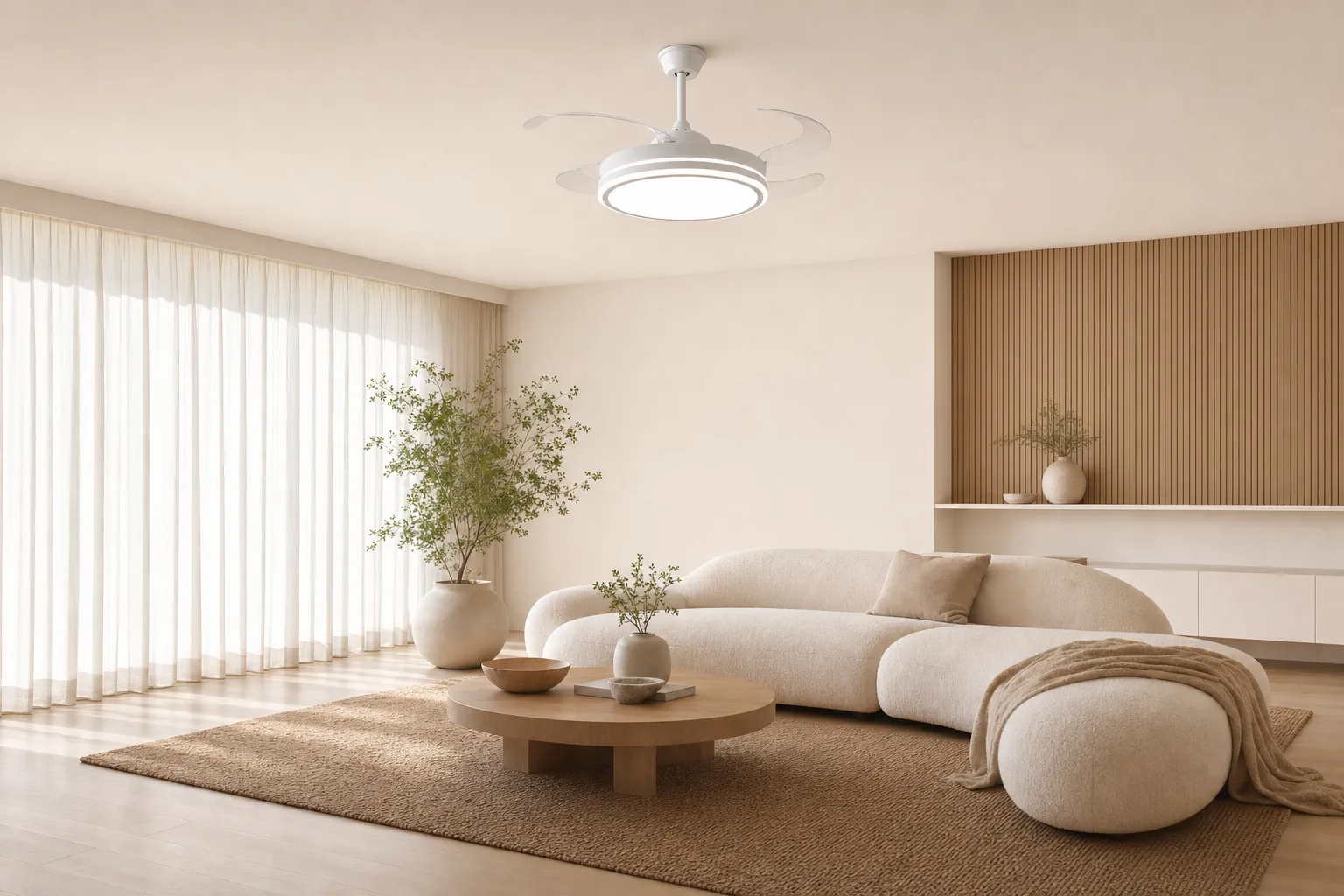
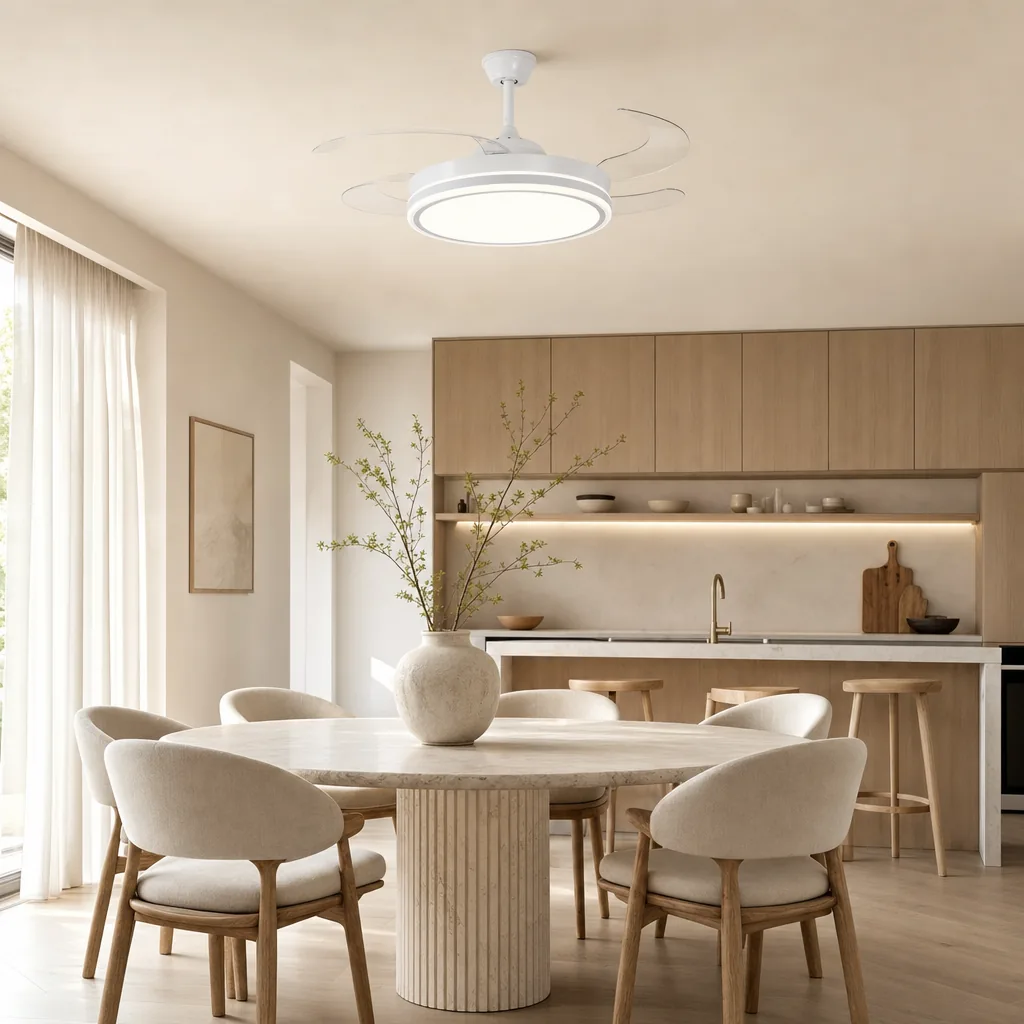
The Boréal 107
Retractable blades · Ø 107 cm · LED ceiling light & silent fan
- ✓Retractable blades: invisible when off, nobody guesses it's a fan
- ✓Sleep with windows closed, 30 dB, quieter than a whisper
- ✓Integrated LED 2700K → 6000K, dimmable: replaces your ceiling light
Noise that creeps in: the budget fan's hidden flaw
Out of the box, many budget fans seem acceptable. The problem comes with the seasons: lightweight blades warp slightly, imbalance appears, cheap bearings loosen, and the first summer's 40-45 dB hum becomes an audible beat above 50 dB, exactly the noise that rules out night use, a bedroom fan's main job.
A premium fan treats the problem at the root: factory-balanced motor, rigid matched blades, play-free mounting. A quality DC motor runs at 28 to 34 dB and stays there, whisper level, compatible with sleep every summer night.
Warranty, support, parts: what the label doesn't say
The warranty is a maker's most honest message: it says how long they bet on their own product. Six to twelve months with nobody to call means a product built to be replaced. Two years with EU support and spare parts, remote, mounting kit, downrod, means a product built to be repaired and to last.
Add the details no spec sheet shows: a manual genuinely written in your language turning installation into 30 minutes instead of an afternoon, a remote included rather than optional, a quality dimmable LED that saves buying a separate light. Each one removes a hidden cost.
The verdict in figures: what remains of the price gap?
Over 10 years for a bedroom used every summer: the budget path means two to three fans bought and installed, double or triple the consumption, noise that ends up limiting use, and no recourse after year one. The premium path: one purchase, one installation, night-light consumption, constant silence and two years of reachable support.
Once lifespan, electricity and replacements are counted, the real gap shrinks, then reverses. What never reverses: ten summers of silent nights on one side, ten summers of compromise on the other. The Boréal 107 adds an argument no budget fan offers: retractable blades, a discreet LED ceiling light in winter, a fan in summer, two fixtures for one installation.
- ·Lifespan: 4-5 years (budget) versus 50,000 hours, over 15 years at 8 h/day (premium)
- ·Consumption: 60-75 W (AC) versus 20-30 W (DC), about 10 € per summer
- ·Noise: drifts past 50 dB over the years versus a stable 28-34 dB
- ·Warranty: 6-12 months without support versus 2 years with EU support and parts
- ·Installation: repeated at every replacement versus once, 30 minutes
A cheap ceiling fan is not a bad deal because it is cheap: it is a bad deal because you buy it again. Measured in cost per year of use, consumption, replacements and silence included, premium is almost always the cheaper option, and by far the better one to live with. With its silent 30-34 dB copper motor rated for 50,000 hours, 6 remote-controlled speeds, three-temperature dimmable LED, retractable blades and 2-year warranty with EU support, the Boréal 107 is exactly that calculation: one purchase, amortised every summer for fifteen years. Free delivery from 150 €.
Frequently asked questions
How long does a budget ceiling fan last?+
Typically 4 to 5 summers before the AC motor, capacitor or bearings tire, usually announced by growing noise. A premium motor rated for 50,000 hours exceeds 15 years at 8 h per day.
Is a DC motor really worth the extra cost?+
Yes, three times over: it consumes up to 70 % less than an AC motor, it runs at a stable 28 to 34 dB over the years, and it offers six genuinely useful speeds plus a reversible winter mode. Over 10 years, the electricity gap alone covers a large share of the premium.
How much electricity does a ceiling fan use per night?+
On night speed a DC motor draws only a few watts: a full 8-hour night costs less than a cent. Even at full speed (20-30 W), a night costs about 5 cents, no comparison with air conditioning.
The SEY Maison Circle
Every month, an exceptional piece. Never reissued.
The Drops principle: one high-end furniture piece per month, in a numbered edition. Once it's gone, it never comes back. Circle members are notified 48 h early, access each drop 24 h before everyone else, and receive our guides before publication.
Discover the Drops →