
Cooling without AC
Ceiling fans and mosquitoes: air movement as a natural repellent
Published on ·5 min read
There are two ways to spend a summer night without mosquitoes: stop them getting in, or stop them flying properly. The first means closed windows and a bedroom that heats up. The second relies on a well-documented and underused fact: mosquitoes are very poor pilots, and moving air defeats them.
Air circulation combines both: sleeping with windows shut without suffocating, with 3 to 4°C of extra perceived coolness, in a room where moving air discourages whatever insects are already inside. This guide covers the mechanism, its limits, and how to use it, no diffuser or skin spray required.
Why do mosquitoes avoid moving air?
A mosquito weighs about 2.5 milligrams and cruises at 1 to 2 km/h, under 0.6 metres per second, one of the slowest and most fragile flights in the insect world, sustained by hundreds of wingbeats per second.
In a room stirred at 1 m/s at bed level, the insect finds itself in a wind tunnel at its own scale. It can still fly, but it cannot hold a chosen trajectory, and above all it cannot land cleanly: settling on skin demands a precision now out of reach. Entomologists observe that mosquitoes largely stop hunting once wind exceeds a light breeze. It is not fear, it is physics.
CO2 and scent: how circulation scrambles their sensors
The second mechanism works at a distance. A mosquito barely sees: it follows a plume of carbon dioxide. Every human exhalation leaves a concentrated CO2 wake its receptors detect from tens of metres away, and which it tracks in zigzags back to the source.
In a continuously stirred room, that plume no longer exists: CO2 dilutes instantly into the room volume instead of forming a scent corridor. The mosquito loses the trail before knowing there was anyone to find. The same applies to proximity cues, lactic acid, ammonia and sweat compounds.
- ·Flight disrupted: under 0.6 m/s of own speed against 1 m/s of airflow
- ·Landing prevented: settling on skin demands impossible precision in a draft
- ·CO2 plume dispersed: the main tracking cue disappears
- ·Skin scent diluted: proximity landmarks are scrambled
- ·Cooler, drier skin surface: less clammy, therefore less signalling

The Boréal 107
Retractable blades · Ø 107 cm · LED ceiling light & silent fan
- ✓Retractable blades: invisible when off, nobody guesses it's a fan
- ✓Sleep with windows closed, 30 dB, quieter than a whisper
- ✓Integrated LED 2700K → 6000K, dimmable: replaces your ceiling light
Sleeping with closed windows and no insecticide: the real benefit
The most effective mosquito barrier is the simplest: a closed window. The problem is that in August, closing it often means a bedroom at 27-28°C, which is what pushes people to open up, then reach for the spray or the plug-in diffuser.
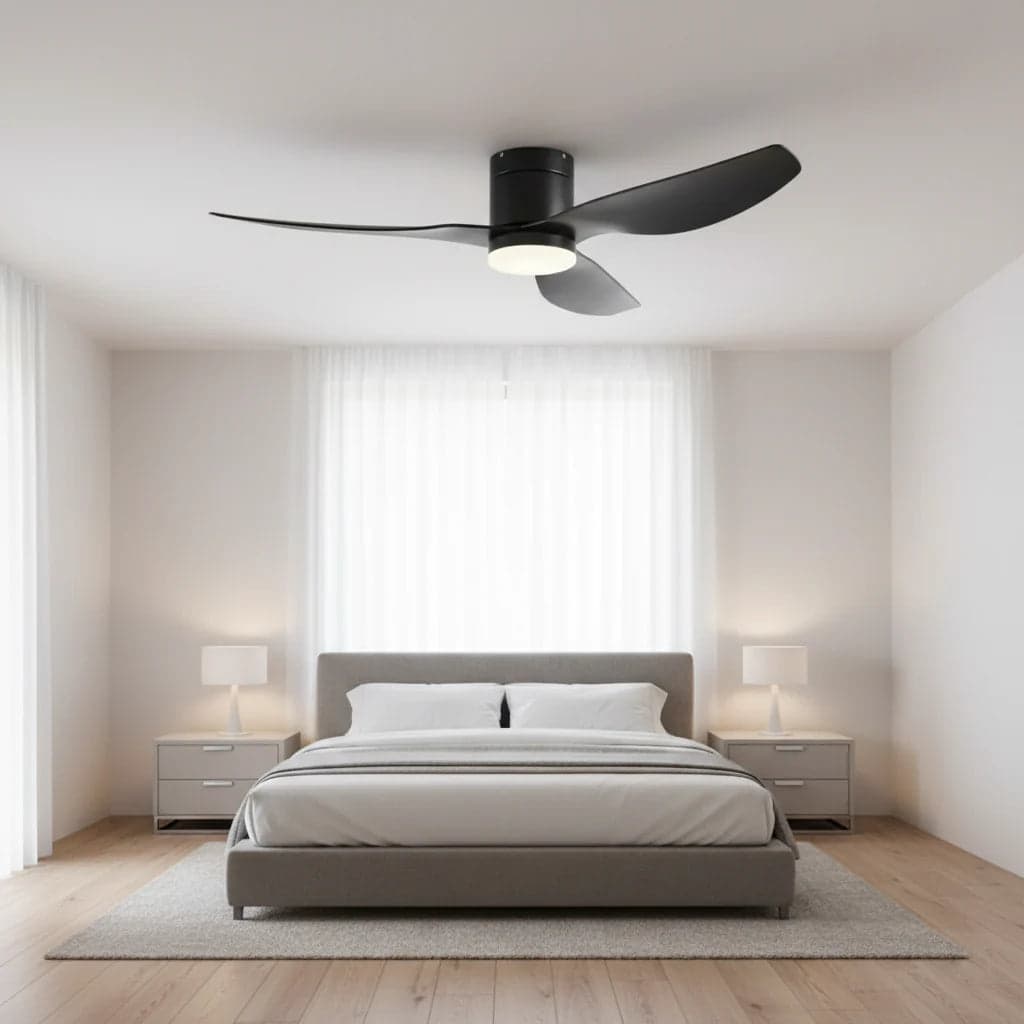
A ceiling fan solves the equation: wind chill lowers perceived temperature by 3 to 4°C, so an actual 27°C feels like 23-24°C, compatible with deep sleep behind closed windows. No night-time airing needed, no mosquitoes let in, and nothing diffused into the air you breathe for eight hours. A model like the Boréal 107 fits this nightly use: 30 dB, quieter than a whisper, six speeds on the remote from the bed, and the silhouette of a plain round ceiling light when the blades are retracted.
How to set your fan to keep mosquitoes away
The aim is a perceptible flow at bed level, not a draft. Low to medium speed is enough: the sheet barely stirs and the skin feels continuous movement. If you have to pull the blanket up, you went too far.
Geometry matters as much as speed: centre the fan on the bed, not the room, so the protected zone matches the zone to protect. Feet and ankles, favourite targets because they are more odorous, must not sit outside the airflow, especially if the bed is tucked under a slope or into a corner.
The limits: what air circulation does not do
Honesty requires precision. A fan does not kill mosquitoes nor stop them entering: it makes their work far harder inside the stirred zone. A determined insect can still bite at the edge of the flow. It does not replace a mosquito net in regions where the tiger mosquito is established.
But it wins on two points where other solutions fail: it works all night without recharging or burning down, and it releases absolutely nothing into the air you breathe. Combined with closed windows, it is the most comfortable protection layer available, since it brings coolness too.
The best repellent of the summer may not come in a bottle: it is a metre of moving air above the bed, destabilising the mosquito's flight, dispersing the CO2 plume that guides it, and above all letting you sleep with windows closed without suffocating. The Boréal 107 does this at 30 dB, with six remote-controlled speeds, a 2-year warranty and the look of a plain ceiling light once the blades retract. Against mosquitoes as against heat, the most elegant answer is the same: keep the air moving.
Frequently asked questions
Does a ceiling fan really keep mosquitoes away?+
Yes, through two mechanisms: airflow disrupts their very slow flight, under 0.6 m/s, making landing on skin nearly impossible, and it disperses the CO2 plume they follow to locate targets. It does not kill them, it discourages them inside the stirred zone.
What fan speed works against mosquitoes?+
Low to medium is enough: the goal is a continuous, perceptible flow at bed level, around 1 m/s, not a draft. The fan should be centred on the bed and also cover feet and ankles, mosquitoes' preferred targets.
Can a ceiling fan replace insecticide?+
In most cases yes, because circulation lets you sleep with windows closed while gaining 3 to 4°C of perceived coolness: mosquitoes stay out and nothing is diffused into the air you breathe. Where the tiger mosquito is established, a net remains a recommended complement.
The SEY Maison Circle
Every month, an exceptional piece. Never reissued.
The Drops principle: one high-end furniture piece per month, in a numbered edition. Once it's gone, it never comes back. Circle members are notified 48 h early, access each drop 24 h before everyone else, and receive our guides before publication.
Discover the Drops →Also worth reading
Does sleeping under a fan give you a stiff neck? What physiology says, and what really matters
Read the article →

Buying a ceiling fan in autumn: four reasons not to wait until June
Read the article →

The upstairs is unbearable in summer while the ground floor stays cool: why, and what to do
Read the article →