The art of the home
A ceiling fan for mezzanines and double-height spaces: taming rising heat
Published on ·3 min read
The mezzanine is a thermal paradox: the most seductive space on the plan, the least comfortable in practice. Abandoned in June, overheated in January, while the sofa below stays cool.
The cause is one word, stratification; the answer is another, circulation. This guide covers the numbers, then the placement, diameter and season-by-season use of a ceiling fan in a double-height volume.
Why is the mezzanine so hot?
Without circulation, air settles into stable layers, warmest on top: between the living-room floor and the mezzanine bed, the gap commonly reaches 4 to 6°C. A room at 24°C below can read 29°C at mattress height, and a 30 m² double-height space holds 130 to 150 m³ of air, twice a normal room. Roof windows load the upper layer directly with solar heat, and once the air calms, the layers re-form within tens of minutes.
Destratification: how a fan solves it
A ceiling fan forces the layers to mix. In summer its downward flow returns the heat pooled under the ridge to the bottom, pulls cooler air up to the mezzanine, and adds 3 to 4°C of perceived wind-chill cooling for anyone under the flow, all for a few dozen watts on a DC motor.
Silence is non-negotiable when the mezzanine is a bedroom: a DC motor runs at 28 to 34 dB, below 30 dB on night speed, quieter than a refrigerator, three metres from the pillow.
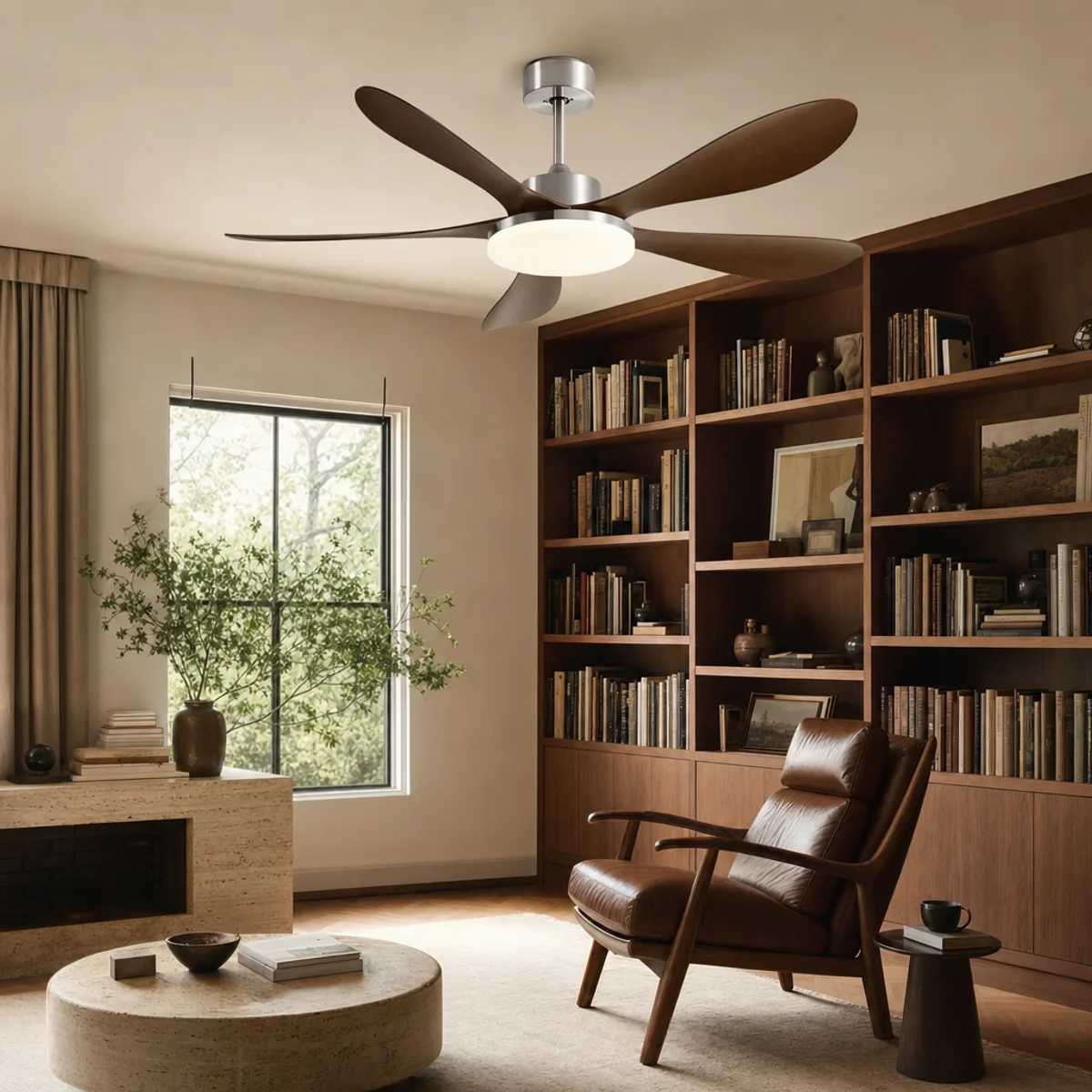
The Zénith 142
Five walnut blades · Brushed nickel · Integrated LED
- ✓Silent DC motor, 6 reversible speeds
- ✓Integrated dimmable LED + remote control
- ✓30-minute installation, illustrated manual
€379€479
Where to install it in a double-height space
Not tight against the ridge, where it stirs the hot layer onto itself: lower the motor into the volume on a downrod so the flow actually crosses the layers.
- ·Place it over the void, centred on the living zone below
- ·Downrod sized to bring the blades into the lower third of the air volume
- ·2.10 m minimum above any floor the blades overhang, mezzanine included
- ·50 cm minimum from railings, beams and roof slopes
- ·Remote control reachable from both levels
Winter, and which model to choose
In winter, reverse mode inverts the rotation: air is drawn gently upward and returned down the walls, no direct draught, and the heating finally serves the living zone instead of the ridge. In a tall volume a reversible fan works 12 months a year.
The criteria: span, since the air volume is doubled; reversibility; remote control, the appliance being out of reach by design; and integrated light, the centre of the volume often being the only overhead lighting point. The Zénith 142 ticks them precisely: a 142 cm span, five slender walnut blades around a brushed-nickel hub, a wide steady flow built for large rooms, a dimmable integrated LED and 6 reversible speeds by remote, also available in 102 and 117 cm. Installation in 30 minutes, 2-year warranty, free delivery over €150.
An uncomfortable mezzanine is not an architectural fate, just a lack of circulation. By breaking stratification, a ceiling fan closes the 4 to 6°C gap between levels, adds 3 to 4°C of perceived summer cooling and returns winter heating to the floor. With its 142 cm span, wide slow flow, dimmable LED and reverse mode, the Zénith 142 is drawn to hang at that point of balance. The double height stays spectacular, and finally becomes livable year-round.
Frequently asked questions
How much warmer is a mezzanine than the floor below?+
Without air circulation, the gap commonly reaches 4 to 6°C, hot air pooling under the roof's highest point. A running ceiling fan narrows the gap by mixing the air layers.
Where should a ceiling fan go in a double-height room?+
Over the void, centred on the living zone, lowered on a downrod into the lower third of the air volume rather than against the ridge. Keep 2.10 m minimum above any overhung floor and 50 cm from railings and beams.
Is a ceiling fan useful in winter in a tall room?+
It is its favourite terrain: in reverse mode it returns the heating warmth stored up high back down the walls, with no perceptible draught. The gap between levels closes and the heating finally benefits the living zone.
The SEY Maison Circle
Every month, an exceptional piece. Never reissued.
The Drops principle: one high-end furniture piece per month, in a numbered edition. Once it's gone, it never comes back. Circle members are notified 48 h early, access each drop 24 h before everyone else, and receive our guides before publication.
Discover the Drops →