
Interior design
Industrial-style ceiling fans: the loft's design signature
Published on ·4 min read

Industrial style is not invented, it is quoted: steel-framed glazing, exposed brick, riveted beams. The ceiling fan belongs to that vocabulary by right, it was already turning in 19th-century warehouses long before reaching living rooms.
That is what sets it apart from most 'industrial-look' objects: it does not imitate the industrial past, it descends from it. Here is how to choose one that plays both roles, style signature and answer to the real problem of tall volumes: stratified air.
Why is the ceiling fan the industrial object par excellence?
Before becoming decor, the ceiling fan was a production tool, moving air through mills, print works and warehouses. Its form, a motor hung from a rod, bare blades, nothing superfluous, is pure industrial functionalism: nothing about it is decorative, which is precisely what makes it beautiful.
In a loft it plays the same role as steel-framed glazing: it authenticates. A designer pendant says 'I decorated a loft'; a fan on an exposed downrod says 'this place has a history'.
Tall volumes: the downrod is not just about style
A loft means height: 3 m, 3.50 m, sometimes more. At those heights, a fan hugged to the ceiling stirs the ceiling's air. The blades must come down into the living zone, which is the downrod's job, while always keeping at least 2.10 m below the blades.
Aesthetics follow function, as always in industrial style: the rod suspending the motor in the void is exactly what gives the fan its workshop silhouette. The right technical choice and the right design choice are the same one.
- ·2.60 to 3 m ceilings: short rod, blades around 2.40 m from the floor
- ·3 to 4 m ceilings: long rod, aim for 2.50 to 3 m under the blades
- ·Always keep a minimum of 2.10 m between floor and blades
- ·25 m² and up: 132 cm diameter minimum, 152 cm beyond 30 m²
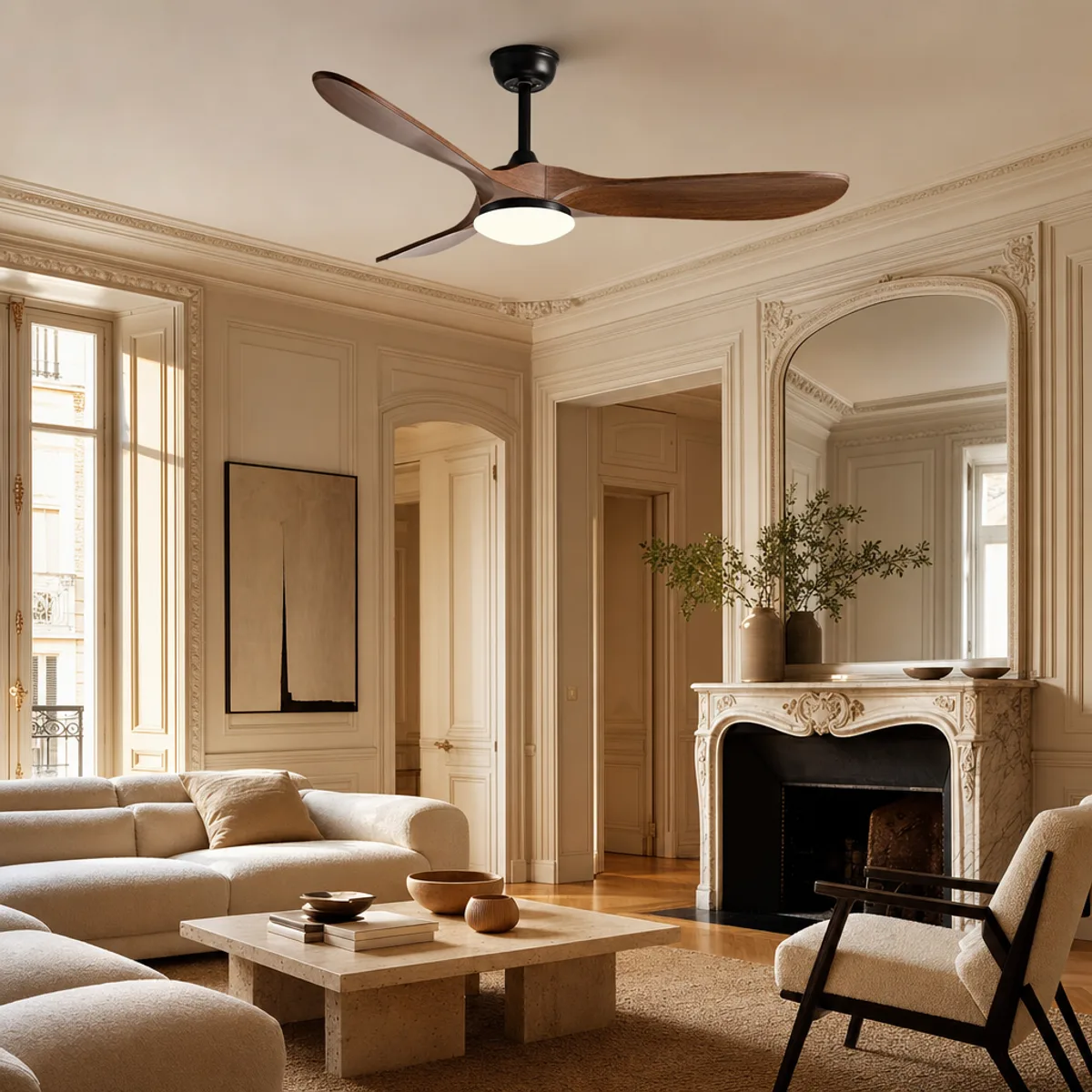
The Loft 132
Black & walnut · Exposed downrod · Integrated LED
- ✓Silent DC motor, 6 reversible speeds
- ✓Integrated dimmable LED + remote control
- ✓30-minute installation, illustrated manual
€309€379
Black metal and raw wood: composing with the loft's materials
Industrial style rests on two founding materials: the black metal of the structure and the raw wood of workshop benches. A fan built on that duo matches the room by default: matt black body in line with the window frames, walnut blades in line with the furniture.
That is the exact drawing of the Loft 132: black body on an exposed downrod, three walnut blades, completed by a dimmable LED disc that lights a tall volume without multiplying pendants. On scale, a loft rarely forgives timid objects: 132 cm is the starting point, with a 152 cm version beyond 30 m².
Comfort in a large volume, summer and winter
In summer, permanent circulation delivers 3 to 4°C of wind-chill on perceived temperature across the whole living zone. In winter the problem inverts: heated air rises and is lost under the ceiling, with up to 5 to 8°C between floor and ridge. You are heating the rafters.
The DC motor's reverse mode draws air upward and pushes the warm layer back down along the walls, draught-free: the floor recovers the degrees the ceiling was hoarding. And silence is not optional in an open plate where everything is heard: a contemporary DC motor runs at 28 to 34 dB, remote-controlled from anywhere on the floor.
In a loft, the ceiling fan is the rare object that is at once historical quotation, design gesture and four-season comfort equipment. The specification fits in one line: exposed downrod to descend into the volume, black body and wood blades to speak the building's language, silent reversible DC motor to serve it year-round. The Loft 132 was drawn word for word on that brief, dimmable LED included, remote in hand, 2-year warranty, with 107 and 152 cm versions to match the volume. The signature of the place, in motion.
Frequently asked questions
What downrod length for a loft ceiling fan?+
Aim for blades at 2.50-3 m from the floor in a tall volume: a short rod under 3 m ceilings, a long rod between 3 and 4 m. Always keep at least 2.10 m between floor and blades.
Does a ceiling fan reduce a loft's heating bill?+
It contributes: in a tall volume, 5 to 8°C can separate floor from ceiling in winter. Reverse mode pushes that stratified warmth back into the living zone, so you heat less for the same comfort at floor level.
What fan diameter for a 35 m² loft?+
Beyond 30 m², move up to 152 cm, or install two 132 cm fans if the floor plate is very elongated. A large diameter turning slowly moves air better and more quietly than a small fan at full speed.
The SEY Maison Circle
Every month, an exceptional piece. Never reissued.
The Drops principle: one high-end furniture piece per month, in a numbered edition. Once it's gone, it never comes back. Circle members are notified 48 h early, access each drop 24 h before everyone else, and receive our guides before publication.
Discover the Drops →Also worth reading

Lighting a painting at home: colour temperature, angle and intensity that respect the canvas
Read the article →
Ceiling fan and television: avoiding LED glare on the screen and blade flicker
Read the article →

Gallery wall or a single canvas: which to choose for your living room, and why empty space matters
Read the article →