Cooling without AC
Up to what temperature does a ceiling fan actually work?
Published on ·5 min read
This is the question that comes before any purchase, and it deserves a figure rather than a promise: at what point does a ceiling fan stop doing the job? Answering it means first understanding what it actually does, because it does not do what most people assume.
A ceiling fan produces no cold. It sets the air in motion, and that motion speeds up the evaporation of sweat at the surface of the skin. The body cools itself, faster. Which leads to a simple and often overlooked consequence: its effectiveness depends entirely on the gap between the temperature of the air and that of your skin.
What a ceiling fan really gains you: 3 to 4°C in felt temperature
The wind-chill effect amounts to 3 to 4°C off the perceived temperature in a room whose air is properly stirred. This is not a marketing estimate: it is the order of magnitude energy agencies use to justify raising an air-conditioning thermostat while a fan is running.
In practice, a room at 29°C feels like a room at 25 or 26°C. At 31°C you land around 27°C felt, the upper limit of comfort for most people. That arithmetic, not motor power, decides whether the appliance will be enough in your home.
One honest qualification: this gain only exists on skin exposed to the flow. A fan running in an empty room does not cool it by a tenth of a degree, it merely moves air. That is why you switch it off when leaving the room, and why running it all day to 'cool the house' achieves nothing.
- ·29°C ambient → roughly 25-26°C felt, clear comfort
- ·31°C ambient → roughly 27-28°C felt, still comfortable
- ·33°C ambient → roughly 29-30°C felt, bearable but borderline
- ·36°C ambient → almost no gain, the air is warmer than the skin
The three tiers: up to 32°C, 32 to 35°C, above 35°C
Below 32°C of ambient air, a ceiling fan is enough in the vast majority of European homes. That is the range in which nearly every summer night in France, Ireland, Germany or the Netherlands sits, heatwaves included, provided the shutters were closed during the day.
Between 32 and 35°C the fan remains useful but stops being sufficient on its own. It becomes one part of a set-up: shutters and curtains closed from the morning, full opening at night once outside air drops below the indoor temperature, and continuous circulation so the heat does not stagnate under the ceiling.
Above 35°C the physics turns against you. Skin sits around 33 to 35°C: blowing air warmer than that amounts to heating it, like a fan oven. Health authorities repeat it during every heatwave: past that threshold a fan alone speeds up dehydration without providing any freshness, particularly for older people and infants.
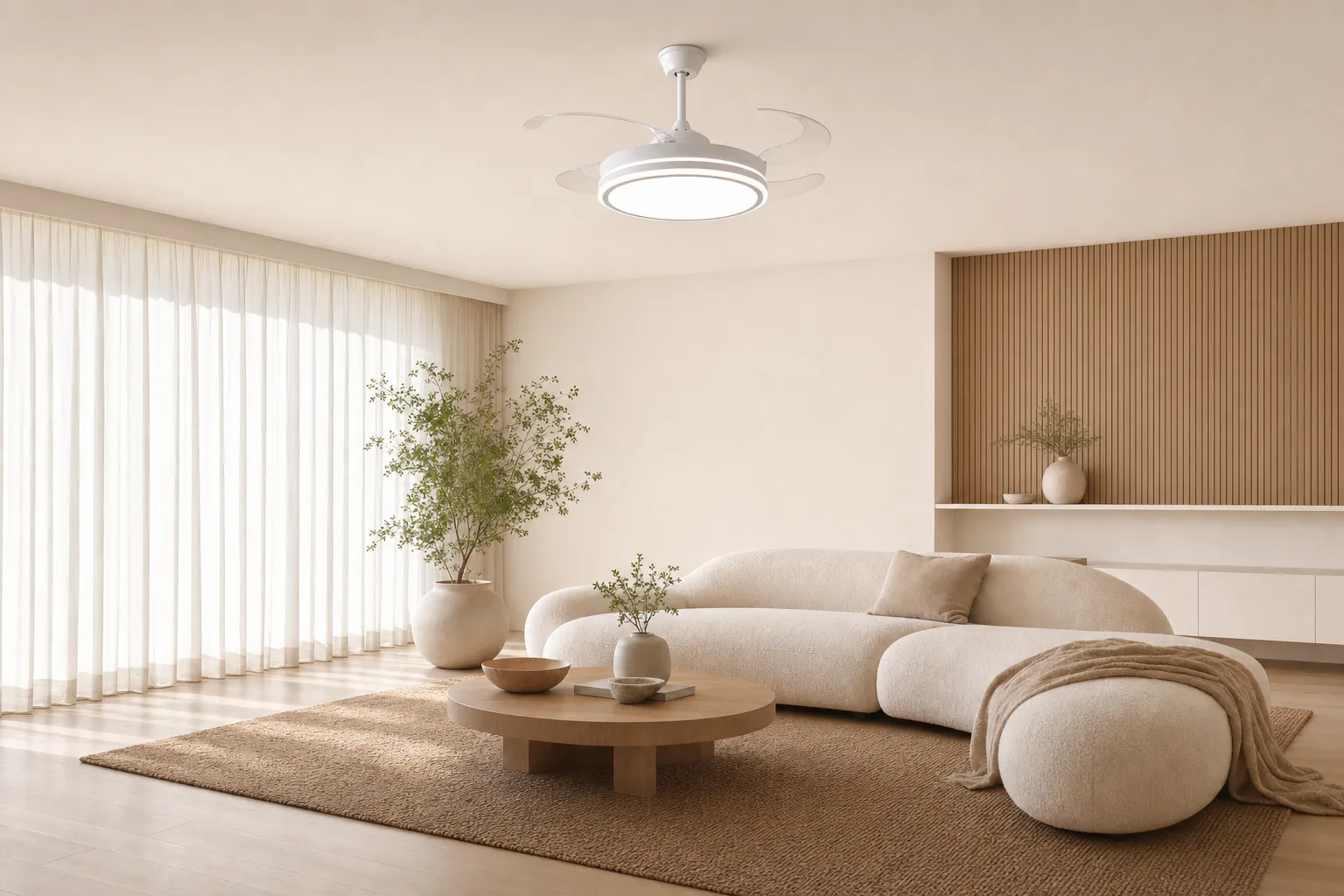
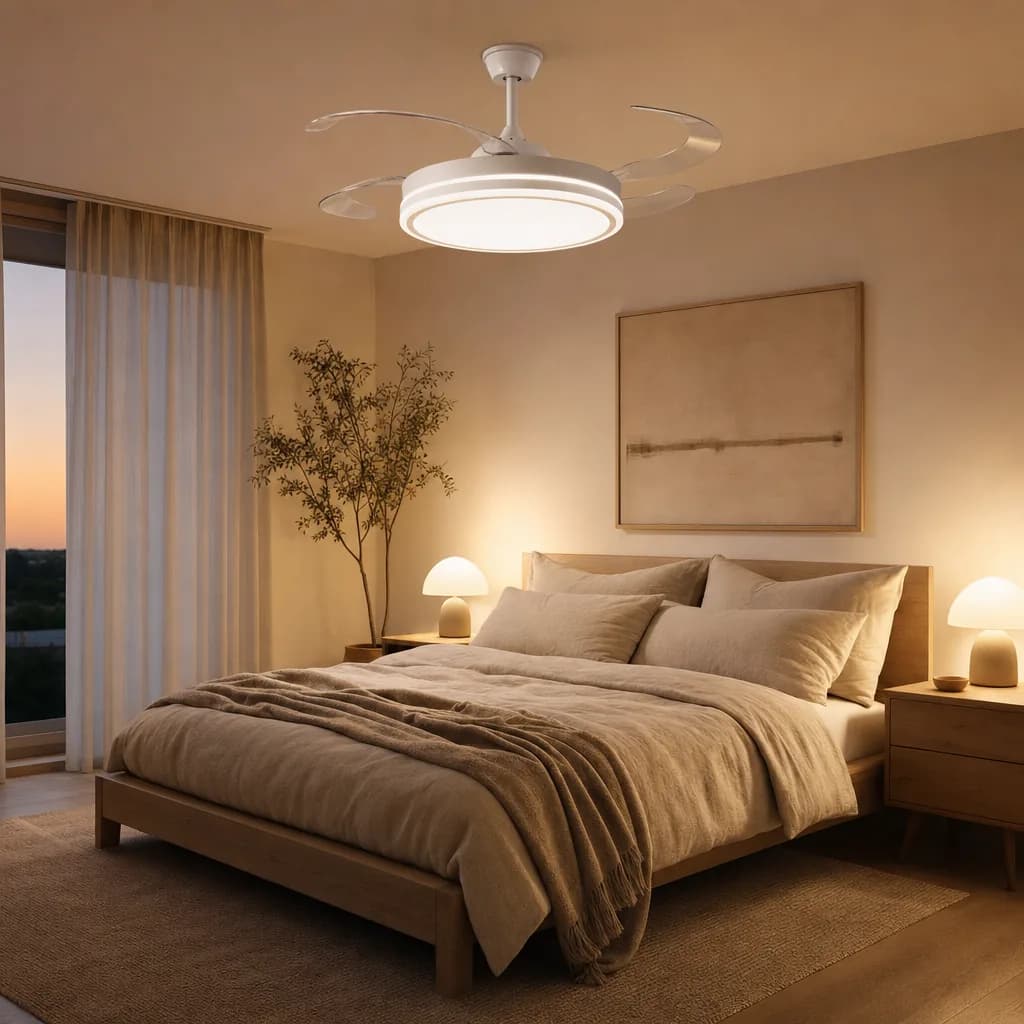
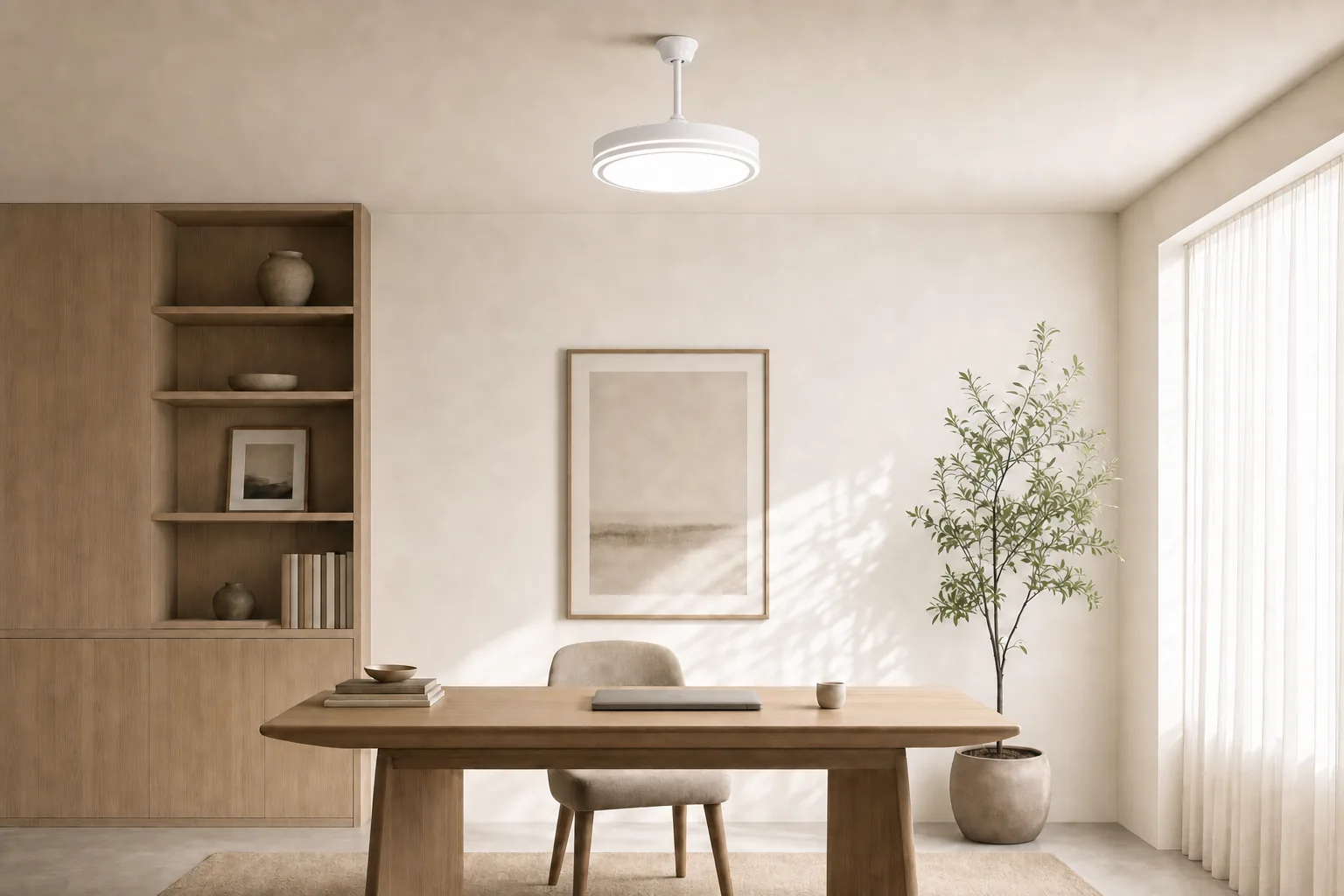
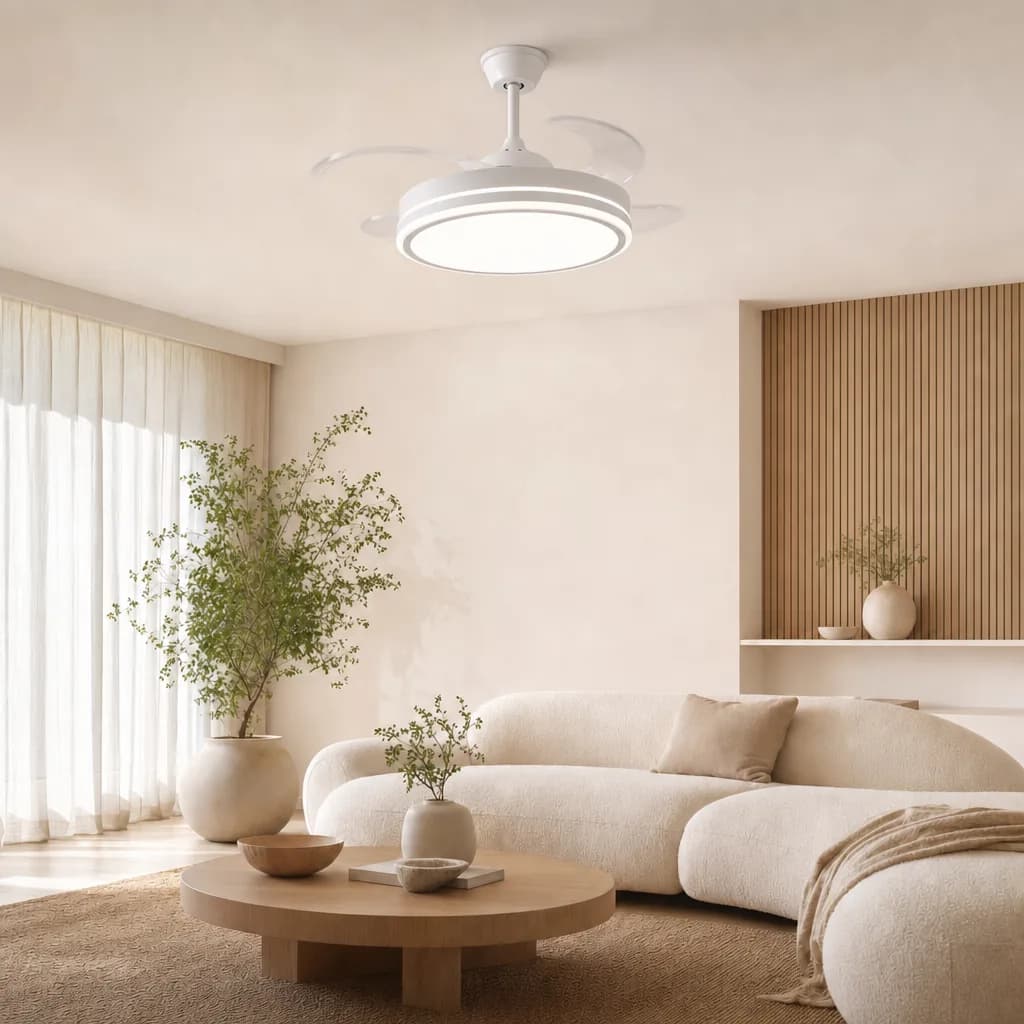
The Boréal 107
Retractable blades · Ø 107 cm · LED ceiling light & silent fan
- ✓Retractable blades: invisible when off, nobody guesses it's a fan
- ✓Sleep with windows closed, 30 dB, quieter than a whisper
- ✓Integrated LED 2700K → 6000K, dimmable: replaces your ceiling light
Humidity matters as much as the thermometer
Evaporative cooling assumes sweat can actually evaporate. In dry air, at 30 % relative humidity, it leaves quickly and the gain is at its maximum. In air at 80 % humidity, the air is already close to saturated: evaporation slows, and the 3 to 4°C gain shrinks noticeably.
This is why a night at 28°C in a dry interior is easier than a night at 26°C in a damp room, a ground-floor flat or a bedroom where laundry is drying. Before blaming a fan, it is worth looking at the humidity: a small dehumidifier sometimes does more good than a more powerful appliance.
How to push the threshold back without air conditioning
The most powerful lever is not in the appliance, it is in how the home is managed. An interior whose shutters stay closed from 10 am to 8 pm easily gains 4 to 6°C over an exposed one: twice the effect of a fan, at no cost. The fan then takes over once that heat has been kept out.
Next comes night-time ventilation: as soon as outside air falls below the indoor temperature, open everything wide and let the fan circulate. Reverse mode helps here too, pulling air upward to create a draw rather than a direct blast.
A word on sizing: a fan too small for the room does not make up for it by spinning faster, it only makes more noise. A Boréal 107 covers a bedroom or study up to 20 m²; beyond that, it is the diameter that must grow, not the speed.
- ·Shutters closed from 10 am to 8 pm: 4 to 6°C gained on the ambient
- ·Night ventilation as soon as outside drops below inside
- ·Fan off in empty rooms: it cools nobody
- ·Diameter matched to the floor area rather than permanent top speed
A ceiling fan is plenty up to 32°C of ambient air, which covers the overwhelming majority of a European summer with the shutters managed. Between 32 and 35°C it remains an ally but needs support, and above 35°C you should no longer rely on it alone, because the air becomes warmer than the skin. That is a physical limit, not a manufacturing flaw, and knowing it before buying beats discovering it in the middle of a heatwave.
Frequently asked questions
Does a ceiling fan actually cool a room?+
No. It does not change the air temperature: it accelerates it over the skin, which increases sweat evaporation and gains 3 to 4°C in felt temperature. A thermometer left in the room records no drop at all.
At what temperature does a fan become useless?+
Above roughly 35°C, which is the temperature of the skin. Moving air warmer than the body no longer cools it and speeds up dehydration. Health authorities advise against relying on a fan alone past that threshold.
Should it run during the day when nobody is home?+
No, that is consumption with no effect. The gain only exists on skin exposed to the flow: in an empty room, the fan merely moves air. Switch it on when you come in, off when you leave.
Why do I feel less effect when it is humid?+
Because the cooling works through sweat evaporation. In air already loaded with moisture, sweat evaporates poorly and the 3 to 4°C gain shrinks. In that case, lowering the humidity helps more than raising the speed.
Is it enough to sleep through a tropical night?+
Yes in most cases, a tropical night being defined by a minimum that does not drop below 20°C, far from the 35°C threshold. Shutters closed by day, windows open at night and slow circulation, the appliance does the job at 28-34 dB.
The SEY Maison Circle
Every month, an exceptional piece. Never reissued.
The Drops principle: one high-end furniture piece per month, in a numbered edition. Once it's gone, it never comes back. Circle members are notified 48 h early, access each drop 24 h before everyone else, and receive our guides before publication.
Discover the Drops →