
The art of the home
When to replace your pillow: five signs and the fold test
Published on ·5 min read
A pillow never breaks, it wears out slowly. That is what makes the replacement moment hard to spot: the decline is too gradual to notice from one day to the next, and you get used to a height that has quietly lost several centimetres.
There are clear signs though, all checkable in a minute, with no tool and no outside opinion. This article goes through them, gives lifespan orders of magnitude by type of filling, and explains what changing actually gains you.
The fold test, in ten seconds
Fold the pillow in half lengthwise, hold for a second, then let go. A pillow in good condition springs back on its own, in one clean movement. A finished pillow stays folded, or rises back limply and keeps the crease. The test says the essential in ten seconds: the filling no longer returns the pressure it receives. On memory foam the return is slow by design, so look instead at whether the wave keeps its shape at rest, a few minutes after being laid flat.
Second check, simpler still: look at the pillow in profile, at eye level. The curve should stay even from end to end. If it dips in the middle and swells at the ends, the zone carrying the head has given way. It is the most common and the most discreet fault. It settles in over months, you compensate without thinking by punching the pillow at bedtime, and the neck spends the night lower than the rest of the body.
How long a pillow lasts, by type of filling
No expiry date is printed on a pillow. You work with orders of magnitude, which depend mostly on the filling, the weight of the head and the protection used. A pillow works around two thousand five hundred hours a year, under load, in a humid atmosphere. That is more than most objects in the house, and it explains why a soft filling collapses faster than you would think. The markers below are commonly accepted averages, not rules.
Memory foam ages in its own way. It does not compact like fibres, it loses rebound: the core takes longer and longer to come back, then stops rising fully. Care weighs heavily on that lifespan. On Le Nuage 50 the textured cover comes off and washes, while the foam core is never washed, only aired. Foam aired regularly and protected by a washed cover holds up better than foam left bare under a plain sheet.
- ·Entry-level synthetic fibres: generally one to two years.
- ·Feather and down: generally two to three years, with regular plumping.
- ·Latex: generally three to four years.
- ·Memory foam: generally two to four years, depending on use and airing.
Stains and smell, and what they really mean
Yellow marks are not a manufacturing fault. They are months of sweat and sebum that have crossed the pillowcase. They do not make the pillow unusable overnight, but they measure an accumulation. The same deposit holds moisture, and moisture holds dust. A pillow never protected by a washable cover reaches that stage far faster than one whose cover goes into the machine every week.
Smell remains the most honest sign. Take the pillow out of its case, leave it an hour in open air, then bring your nose close. If it still smells, the filling is saturated deep down, and washing will settle nothing lasting, especially on a core that cannot be washed. A useful comparison: many people replace a mattress every ten years and keep the same pillow for eight. Real wear demands exactly the opposite.
What you gain by changing
A new pillow works no miracle, it simply puts the head back at the right height. When the neck stays in line with the spine, you turn over less, and you spend less of the night hunting for a position by folding the pillow or sliding an arm underneath. What most people describe is a less stiff morning. This advice is about comfort and posture, it does not replace medical advice: pain that lasts, or that wakes you at night, calls for a health professional.
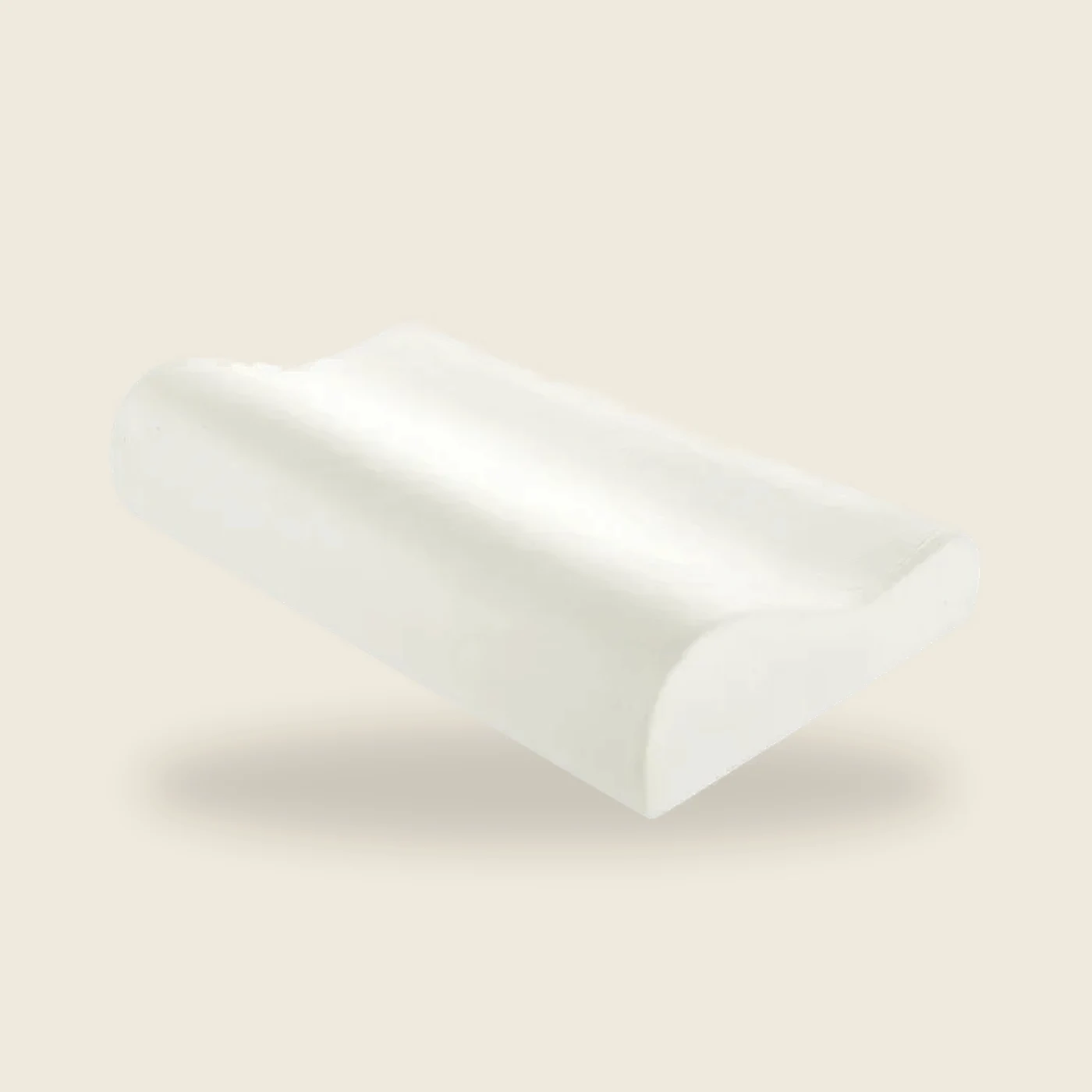
When replacing, height matters as much as filling. Le Nuage 50 is a memory foam pillow in 50 × 30 cm format, with two wave heights on the same product, 10 cm and 7 cm: you switch height by turning it over, the high wave for side sleeping, the low wave for the back. It comes alone at 55 € or with its textured cover at 65 €, and the second pillow is 20 % off in the cart. The cotton Nuage covers, cut to the wave shape, change like ordinary pillowcases.
A finished pillow shows itself without any tool: it stays folded after the test, it dips in the middle, it keeps its smell after an hour in the air. By filling, count on one to four years in general. Measured against the hours spent on it, it is one of the cheapest replacements in the house.
Frequently asked questions
How often should you replace a pillow?+
Generally every one to four years, depending on the filling: one to two years for synthetic fibres, two to three for feathers, two to four for memory foam. Those figures are orders of magnitude. The fold test decides better than any date.
How do you know if a pillow is dead?+
Fold it in half and let go: if it stays folded, it is finished. Then look at it in profile, a hollow in the middle means the zone carrying the head has given way. A smell that survives an hour in open air confirms it.
Can you wash a memory foam pillow?+
No, the foam core is not washable. On Le Nuage 50 the textured cover comes off and goes into the wash, while the core is simply aired. A machine cycle soaks the foam and damages its structure for good.
The SEY Maison Circle
Every month, an exceptional piece. Never reissued.
The Drops principle: one high-end furniture piece per month, in a numbered edition. Once it's gone, it never comes back. Circle members are notified 48 h early, access each drop 24 h before everyone else, and receive our guides before publication.
Discover the Drops →