Comparisons & guides
How much does a good ceiling fan cost? The budget guide
Published on ·4 min read
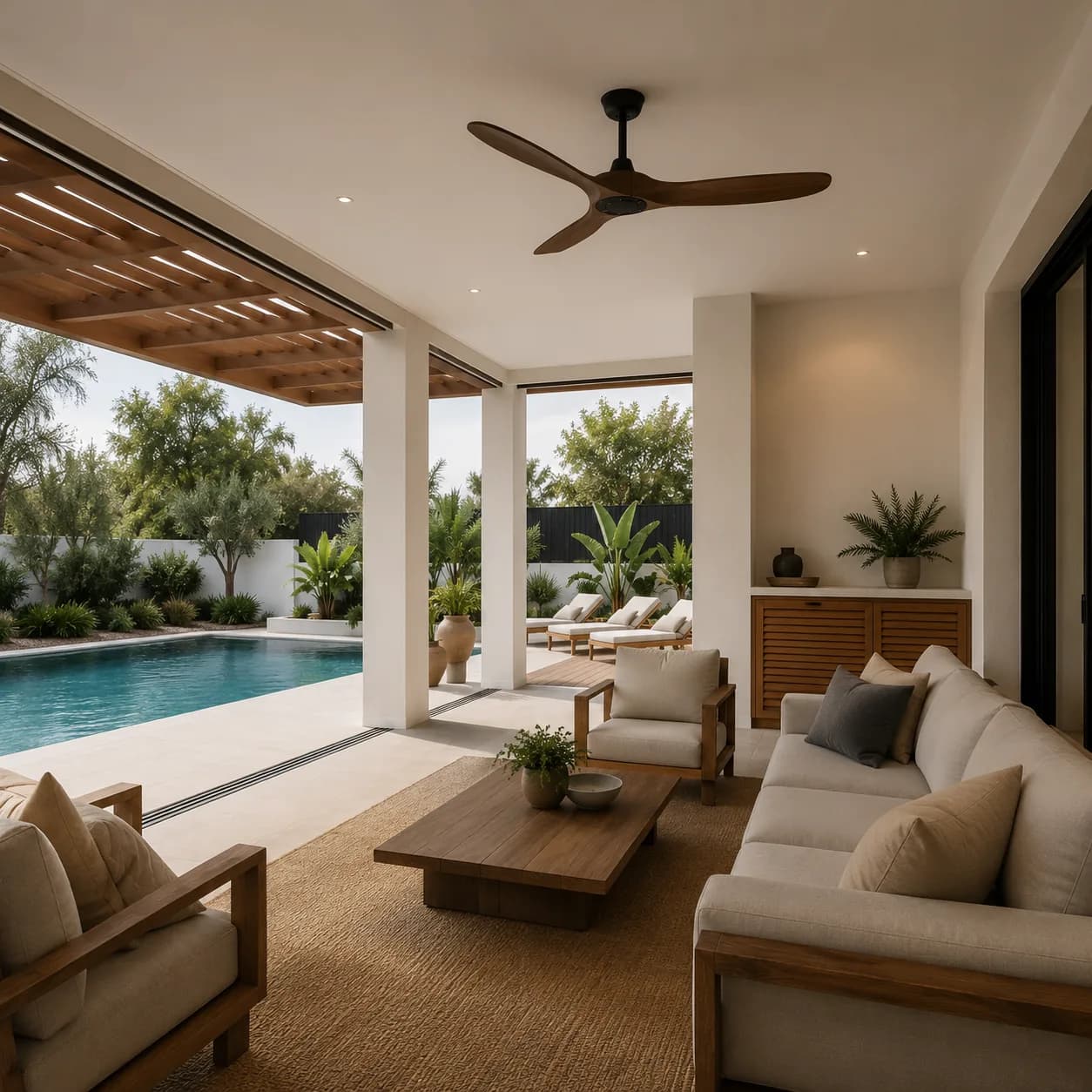
Between the ceiling fan priced like a pedestal fan and the model approaching €700, the gap raises a fair question: can the same object justify a tenfold price factor? The answer lies in what the photo does not show: motor type, blade balancing, acoustics, materials, and what happens after purchase.
This guide breaks down real market price ranges, what each tier concretely buys, then computes the 10-year total cost of ownership, the only honest metric for a device meant to stay on your ceiling for fifteen years.
What are the market price ranges?
The market organises into three clear tiers. Entry-level, under €150: AC motor, thin plastic or MDF blades, often three pull-chain speeds. Mid-range, €150-350: DC motor, remote control, six speeds, careful finishes and real acoustic work. Premium, €350-700 and beyond: noble materials, solid wood, large spans, complex mechanisms such as retractable blades, signature designs.
These ranges apply to new products from established brands, warranty and support included. Ultra-low marketplace prices usually mean unverified compliance and no recourse, a saving that costs dearly at the first fault.
- ·Under €150: AC motor, 3 speeds, pull chain, noticeable noise
- ·€150-350: silent DC motor, 6 speeds, remote, reverse winter mode, solid warranty
- ·€350-700+: solid wood, large spans, signature mechanisms, designer pieces
What does each tier actually change: motor, silence, materials?
The decisive frontier is the motor. An entry-level AC motor draws 50-70 W at full speed and produces 45-55 dB, conversation level: fine in a garage, unacceptable in a bedroom. A mid-range DC motor draws two to three times less and runs at 28-34 dB, quieter than a whisper, with six speeds and soft start.
The second step concerns balancing and materials: factory-paired blades, quality bearings, damped mounts, convincing finishes, optional dimmable LED. The third tier buys design and engineering: 25 cm ultra-flat profiles for low ceilings, retractable blades, 178 cm spans for lofts. At that level you pay for the disappearance of every compromise.
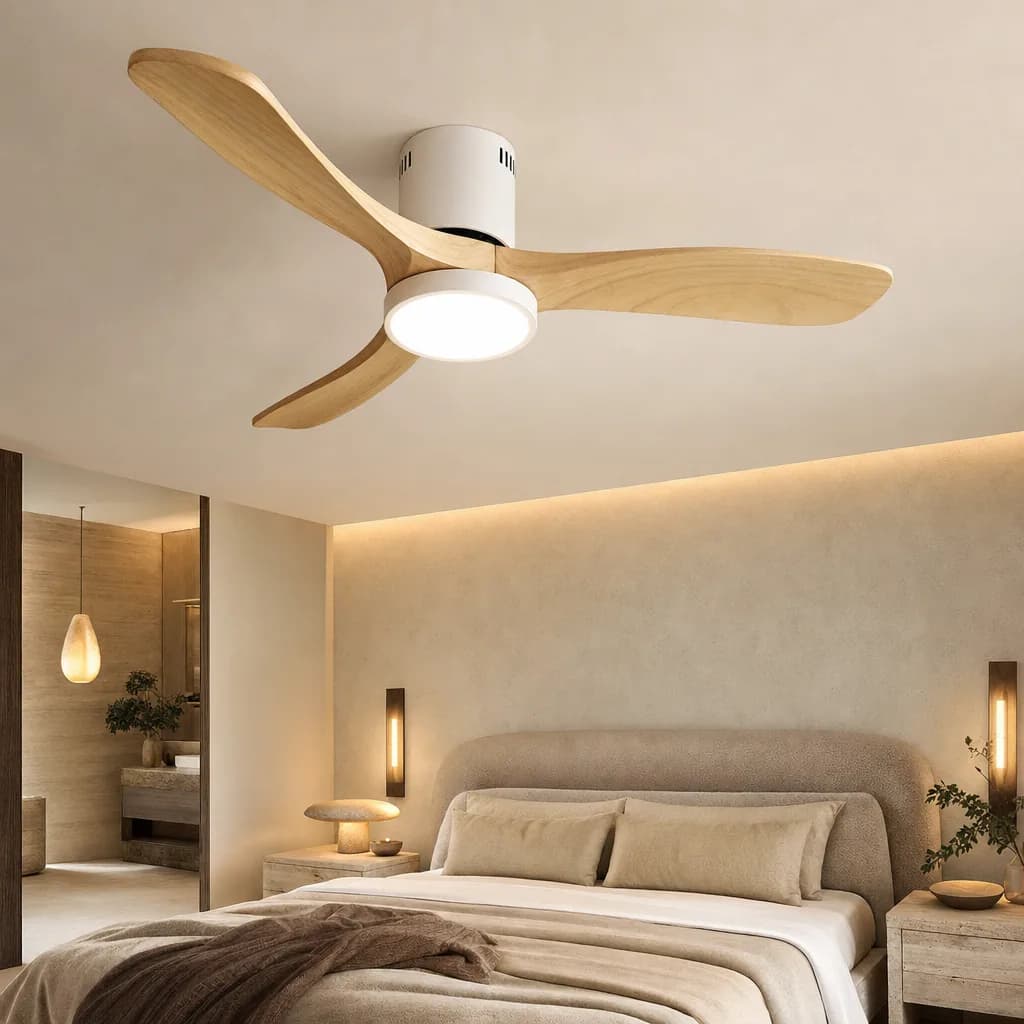
The Horizon 132
Ultra-flat · Ø 132 cm · Made for low ceilings
- ✓Flush-mount profile: ideal under 2.40 m ceilings
- ✓Large 132 cm diameter, covers up to 30 m²
- ✓Reversible blades, light or dark wood finish
€309€389
The 10-year total cost: the maths nobody does
Take a realistic profile: 8 h a day over 4 summer months plus light winter use in reverse mode, about 1,200 hours a year. A DC motor averaging 15-25 W costs €6-12 of electricity per year, so €60-120 over 10 years. An AC motor at 55-70 W costs €250-400 on the same profile. The electricity gap alone repays much of the purchase price difference.
Then comes lifespan: a budget unit with cheap bearings typically shows fatigue, growing noise, wobble, within 3 to 5 years, meaning two or three purchases over a decade. A properly installed mid-range DC model crosses the decade needing nothing but dusting.
Warranty, support, parts: the hidden after-purchase price
A ceiling fan is fixed to the ceiling: when something fails, logistics matter as much as refunds. A 2-year warranty with European support, available spare parts and a clear manual make a concrete difference. This is where entry-level disappoints: theoretical warranties, unobtainable spare remotes. Good after-sales is easily worth €30-50 of initial price difference.
Which budget for which need? The verdict
For a living room or bedroom used daily, mid-range DC is the equilibrium point: 28-34 dB, remote, reverse winter mode, 2-year warranty, negligible running cost. The Horizon 132 sits exactly there: a 25 cm ultra-flat profile designed for 2.40 m ceilings, a 132 cm span covering up to 30 m², 33 dB maximum and reversible light or dark wood blades.
Premium is justified when requirements exceed function: solid wood, very large volumes, signature mechanics. Entry-level only defends itself for occasional use in a secondary room, never a bedroom.
A good ceiling fan costs €150-350 upfront, and that is the only misleading number in the equation: over 10 years, electricity and durability included, it is the cheapest choice by far. If your room has a standard or low ceiling, the Horizon 132 shows exactly what the right budget buys: DC-motor silence, 30 m² covered, and not one centimetre of headroom sacrificed. Buying once, properly, remains the best deal on the shelf.
Frequently asked questions
Why does a ceiling fan cost more than a pedestal fan?+
Because it does a different job: circulating a whole room's air volume silently, continuously, for fifteen years, fixed to the ceiling. DC motor, blade balancing and acoustics explain the gap. Per year of use, it is usually the cheaper device.
Is a budget ceiling fan good enough?+
For occasional use in a secondary room, possibly. For a bedroom or living room, no: a 45-55 dB AC motor, three speeds and a 3-to-5-year lifespan make it a false economy. Mid-range DC delivers the best 10-year total cost.
How much electricity does a ceiling fan use?+
A DC motor draws from a few watts at night speed to about 30 W at full speed, roughly €6-12 a year for 1,200 hours of use. That is 20 to 50 times less than air conditioning for the same perceived comfort gain of 3 to 4°C.
The SEY Maison Circle
Every month, an exceptional piece. Never reissued.
The Drops principle: one high-end furniture piece per month, in a numbered edition. Once it's gone, it never comes back. Circle members are notified 48 h early, access each drop 24 h before everyone else, and receive our guides before publication.
Discover the Drops →