
Interior design
How many pillows on a bed? The practical and stylish answer
Published on ·5 min read
Interior photographs show beds covered in eight cushions, and real life shows the same bed with a pile of cushions on the floor at ten in the evening. Between the two sits a simple question nobody asks plainly: how many pillows does a bed really need, and which ones do what?
The answer rests on one distinction. There are sleeping pillows, chosen for the neck and the sleeping position, and there are decorative cushions, chosen for the eye. They do not replace one another, they are not counted the same way, and a successful bed respects the difference.
Two families of objects that get confused
A sleeping pillow is judged on one thing: what it does to the neck when the head rests on it all night. Its height, firmness and shape are chosen according to the sleeping position, side or back. It gets used, washed, and it ages. It has no obligation to be beautiful, though it gains from not being ugly, since it stays visible part of the day.
A decorative cushion carries nothing. It brings colour, a material, a visual height at the head of the bed. It sits in front of the pillows and comes off at bedtime. That confusion is exactly what spoils many bedrooms: piling decorative cushions behind the head hoping to sleep better, or sleeping on a sofa cushion that supports nothing. The two families coexist very well, provided you do not ask them for the same work.
How many pillows for sleeping
One per person. That is the base rule and it covers the great majority of cases. What counts is not the number but the match between pillow height and position: on the side, the gap between shoulder and head is larger and asks for more height; on the back, that gap shrinks and too much height tips the head forward. Stacking two flat pillows stays an unstable solution, because the stack slides during the night.
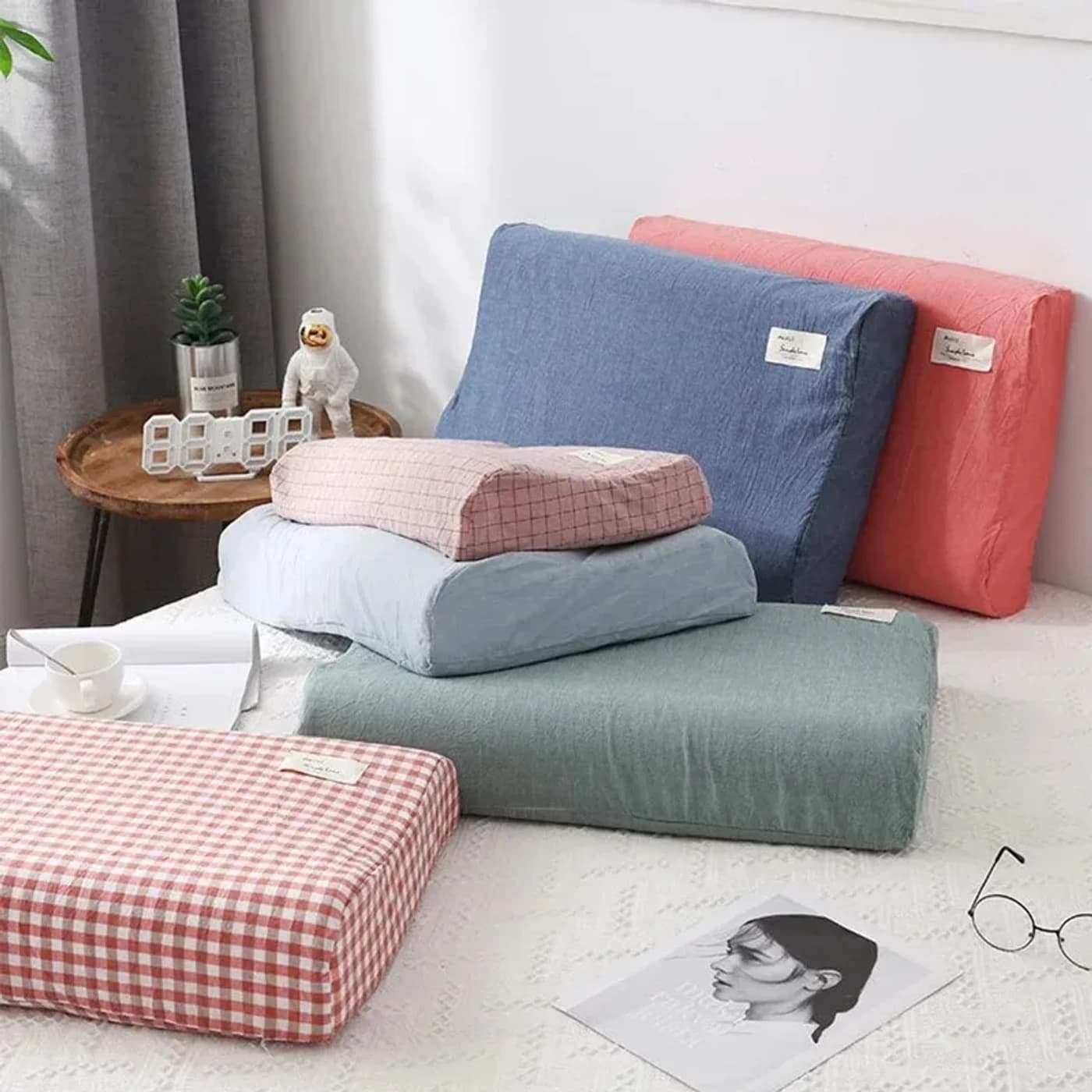
This is where the Nuage 50 offers a simple answer: two wave heights on the same pillow, 10 cm and 7 cm, switched by turning it over. The high wave suits side sleeping, the low wave back sleeping. Format 50 × 30 cm, two versions, on its own at 55 € or with its textured cover at 65 €, with the second pillow at 20 % off in the basket to equip both sides of the bed.
Building a bed that stays beautiful and practical
A readable arrangement is built in three planes. At the back, against the headboard, the sleeping pillows, laid flat or slightly propped. In front, one or two decorative cushions only, smaller, carrying the colour. At the foot, a folded throw breaking the plain surface of the duvet. Three planes are enough to give depth, and above all they come apart in five seconds at night, which is the real condition for the arrangement to last.
The count then follows the width of the bed. On a 90 cm bed, one sleeping pillow and one cushion in front, an odd number, look livelier than perfect symmetry. On 140 or 160 cm, symmetry works better: two sleeping pillows side by side, two cushions in front, possibly a fifth in the middle. Beyond that you enter the zone where the bed takes longer to undo than to make.
- ·90 cm bed: one sleeping pillow, one cushion in front.
- ·140 or 160 cm bed: two sleeping pillows, two cushions in front, a third in the middle if you like.
- ·Keep one colour family and one dominant material to avoid the catalogue effect.
- ·Take the decorative cushions off at night: what is not easy to undo is never redone.
Matching colours without changing the bedding
The cheapest way to move a bedroom forward is not to buy new bed linen, it is to change what shows most: the surface of the pillows. Two rules are enough. First, keep a neutral base on the duvet and sheet, and put the colour at the head of the bed. Second, pick two tones from the same family rather than two opposing colours: a plain and a discreet pattern talk to each other better than two patterns fighting.
The Housse Nuage comes in six colours: denim blue, sage green, anthracite, sky blue, red gingham and blue gingham. Anthracite and denim blue play the dark base, sage green and sky blue the soft tone, the two ginghams bring pattern when everything else is plain. At 22 € each with the buy three get two free offer, you get enough to cover a double bed and keep a clean rotation, changing the mood without touching the rest of the room.
One sleeping pillow per person, one or two cushions in front, a throw at the foot: the arrangement holds in three planes and comes apart in five seconds. The rest is a question of colour, and six cover shades are enough to change a bedroom's mood without buying new bedding.
Frequently asked questions
How many pillows should a double bed have?+
Two sleeping pillows, one per person, chosen for the sleeping position. Everything else is decoration: two cushions in front are plenty on a 140 or 160 cm bed, and they come off at bedtime.
Should you sleep with two pillows stacked?+
It is not the best solution, because the stack slides during the night and the height changes without warning. One pillow at the right height is better. The Nuage 50 offers two wave heights on the same pillow, 10 cm and 7 cm, chosen by turning it over.
How do you match cushions and pillows on a bed?+
Keep a neutral base on the duvet and put the colour at the head of the bed, using two tones from the same family rather than two opposing colours. A plain and a discreet pattern work better than two patterns. The Housse Nuage comes in six colours, two of them gingham for pattern.
The SEY Maison Circle
Every month, an exceptional piece. Never reissued.
The Drops principle: one high-end furniture piece per month, in a numbered edition. Once it's gone, it never comes back. Circle members are notified 48 h early, access each drop 24 h before everyone else, and receive our guides before publication.
Discover the Drops →Also worth reading

Lighting a painting at home: colour temperature, angle and intensity that respect the canvas
Read the article →
Ceiling fan and television: avoiding LED glare on the screen and blade flicker
Read the article →

Gallery wall or a single canvas: which to choose for your living room, and why empty space matters
Read the article →