Cooling without AC
Buying a ceiling fan off-season: why September is the smartest month
Published on ·4 min read
Every year, the same script: the first heatwave hits mid-June, searches explode, the most wanted models sell out in days and electricians quote three-week lead times. You end up sleeping in an oven waiting for a delivery, or panic-buying a noisy fan you will regret for ten summers.
The smart purchase runs against the current, in September. The heat is still fresh in memory, you know exactly which room suffered and by how much, but the urgency has passed. And thanks to the winter mode, the fan starts working the week it goes up.
Why June-July is the worst time to buy
Ceiling fan demand is among the most seasonal in the home market, concentrated almost entirely on heatwave weeks. The quiet models, the lit models, the 107-132 cm diameters go first; what remains in mid-July is precisely what nobody wanted.
Urgency also degrades the decision: buying at 11 pm in a 29°C bedroom, without checking real noise levels or the right diameter, for an appliance you will keep ten to fifteen years. Add the installation bottleneck, electricians all get the same calls the same week.
What a September purchase actually changes
In September you hold a precise memory of the summer: which room overheated, at what time, how many nights were rough. That is the best possible decision basis, far better than a theoretical winter choice or a heatwave panic buy.
You also have time to do things in order: measure, check ceiling height, choose the diameter, mount the fan on a calm Saturday morning in about 30 minutes, then test all six speeds and the remote before it ever truly matters.
- ·Measure the room: around 107 cm diameter up to 15 m², 132 cm beyond
- ·Check height: flush profile under 2.50 m, downrod possible above 2.60 m
- ·Install on the existing light point, 30 minutes, no construction work
- ·Test night-time silence before the first real heat
- ·Free delivery from €150, without high-season delays
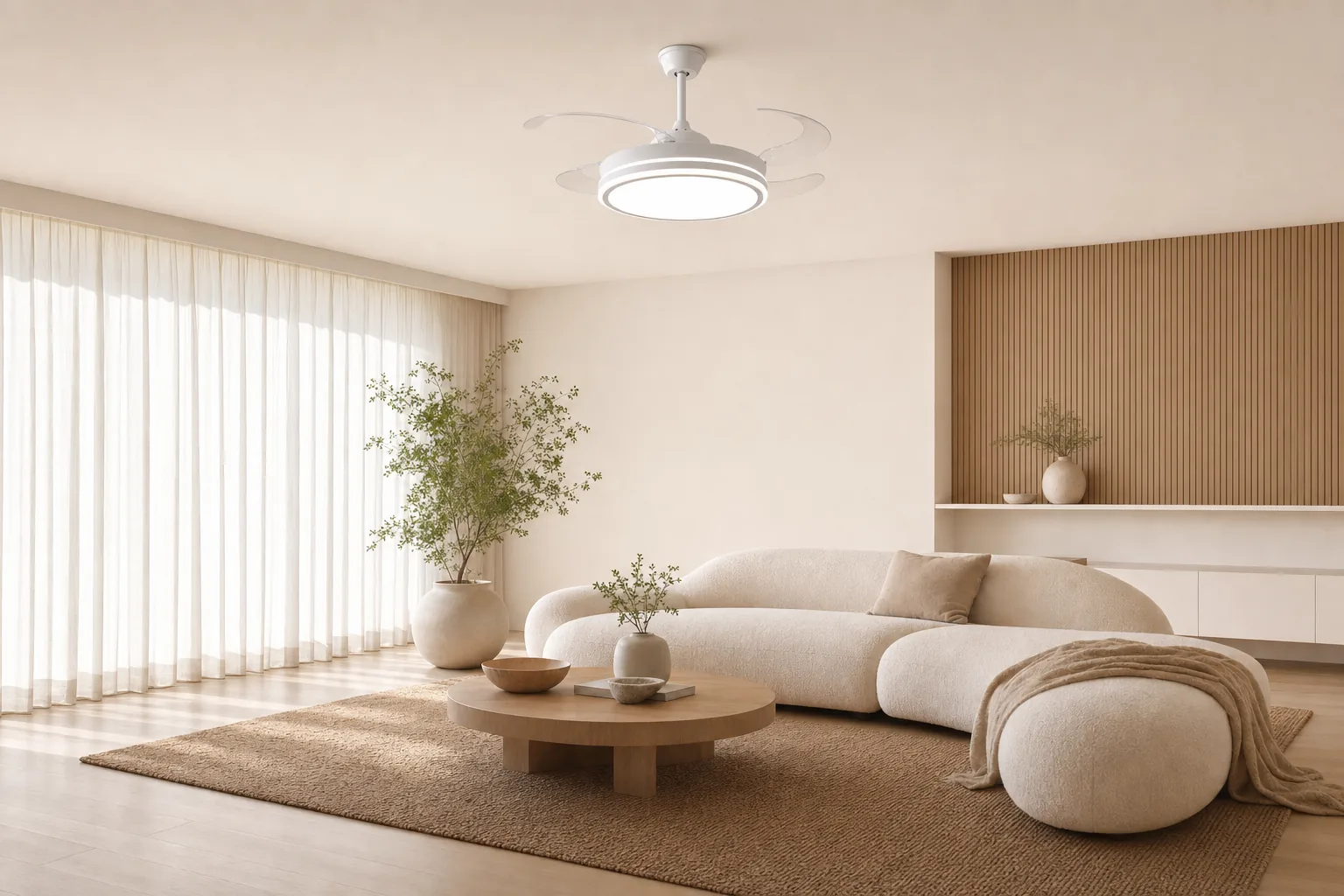
The Boréal 107
Retractable blades · Ø 107 cm · LED ceiling light & silent fan
- ✓Retractable blades: invisible when off, nobody guesses it's a fan
- ✓Sleep with windows closed, 30 dB, quieter than a whisper
- ✓Integrated LED 2700K → 6000K, dimmable: replaces your ceiling light
The winter mode: the argument almost everyone misses
A fan bought in September does not sleep in its box for eight months: it works from October. Warm air stratifies at the ceiling, often 3 to 5°C above floor level, more under attic roofs. The reversible winter mode inverts rotation and pushes that layer back down along the walls, with no perceptible draught.
The room becomes homogeneous and the thermostat stops compensating for cold feet. With a DC motor drawing a few dozen watts on low speed, a full winter of destratification costs a few euros. The purchase changes status: not a three-week summer gadget, but a twelve-month comfort appliance.
Which model to choose when you have time to choose well
Off-season, you can be demanding on the three criteria that matter in daily use: real silence (28 to 34 dB, the only level compatible with sleep), winter reversibility, and how the object lives on your ceiling all year.
This is where a retractable-blade model such as the Boréal 107 makes complete sense: switched off, it is a round ceiling light with a dimmable three-temperature LED; switched on, four blades deploy and move the room's air at 30 dB. Installed in September, it serves immediately as the main light and destratification tool, then reveals its summer role at the first heat. Six speeds, remote included, 2-year warranty.
Buying a ceiling fan in September turns a panic purchase into an equipment decision: chosen on criteria, installed without urgency, and earning its keep through winter before the first heatwave arrives. The Boréal 107 is the ideal candidate for this four-season logic: dimmable LED ceiling light from autumn, silent 30 dB air mover from the first warm days, fitted in 30 minutes on a quiet Saturday. Next summer is already handled.
Frequently asked questions
When is the best time of year to buy a ceiling fan?+
Late summer and autumn, ideally September-October: the need is still precise in memory, stock and installation availability are back to normal, and the reversible winter mode makes the fan useful immediately instead of waiting for June.
What does a ceiling fan do in winter?+
In reverse rotation at low speed it pushes down the warm air stratified at the ceiling, often 3 to 5°C warmer than floor level, and homogenises the room without a draught. Floor-level comfort improves and the heating stops overcompensating.
Does installation require construction work?+
No: a ceiling fan mounts on an existing light point, like a ceiling light, in about 30 minutes with an illustrated manual. Off-season, an electrician is also available within days if you prefer to delegate, versus several weeks in July.
The SEY Maison Circle
Every month, an exceptional piece. Never reissued.
The Drops principle: one high-end furniture piece per month, in a numbered edition. Once it's gone, it never comes back. Circle members are notified 48 h early, access each drop 24 h before everyone else, and receive our guides before publication.
Discover the Drops →