
The art of the home
Ceiling fan on a sloped ceiling: the attic conversion guide
Published on ·5 min read
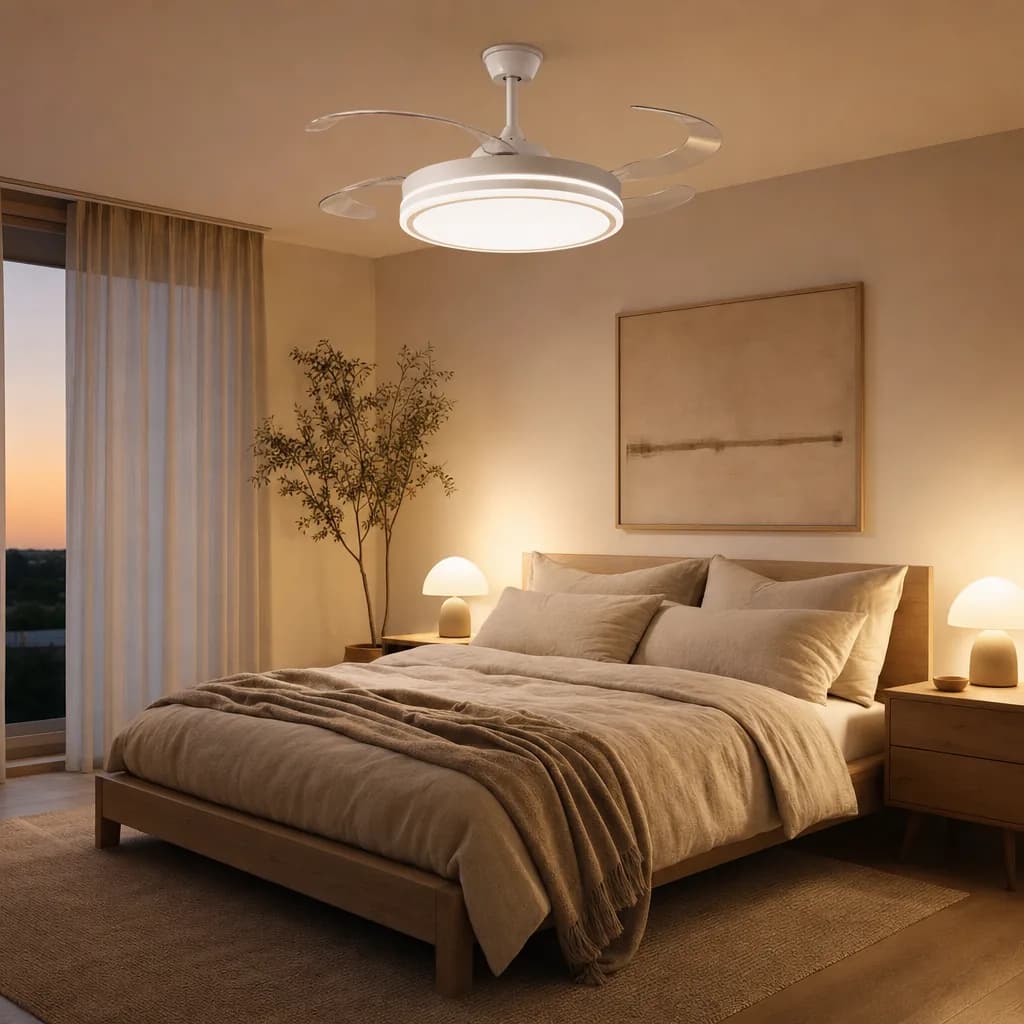
Converted attics are the most charming rooms in a house, and the harshest in summer. Hot air rises, piles up under the ridge, and the room becomes unliveable by June. The ceiling fan is the exact tool for this problem, on one condition: knowing how to install it under a slope.
Good news: it is possible in the vast majority of cases, without heavy work. This guide covers maximum angle, downrod choice, safety clearances and the right strategy for summer and winter.
Can you install a ceiling fan on a sloped ceiling?
Yes, and it is one of the places where it earns its keep most. Nearly all downrod ceiling fans accept an incline up to about 30°, which covers a common roof pitch of 45 to 58 %: the ball joint at the top of the rod compensates the angle and keeps the blades perfectly horizontal.
Beyond 30°, dedicated adapters exist for steep slopes. What to avoid at all costs: flush-mount models, designed for horizontal surfaces, and improvised fixings. The anchor point must be a purlin or a rafter able to carry the weight of a rotating appliance, never the plasterboard lining alone.
Stratified heat under the roof: why attics overheat
Two effects combine under a roof: stratification, lighter hot air stacks up under the ridge, and the thermal mass of the roofing, which absorbs solar radiation all day and releases it late into the night. Attic temperatures can exceed the rest of the home by 8 to 12°C.
The ceiling fan acts on exactly those two fronts: it draws the stratified hot air down from under the ridge, mixes it into the volume of the room and creates a wind-chill that lowers perceived temperature by 3 to 4°C. It does not cool the air, it breaks the stratification and makes the remaining heat bearable, windows closed, at 28 to 34 dB.
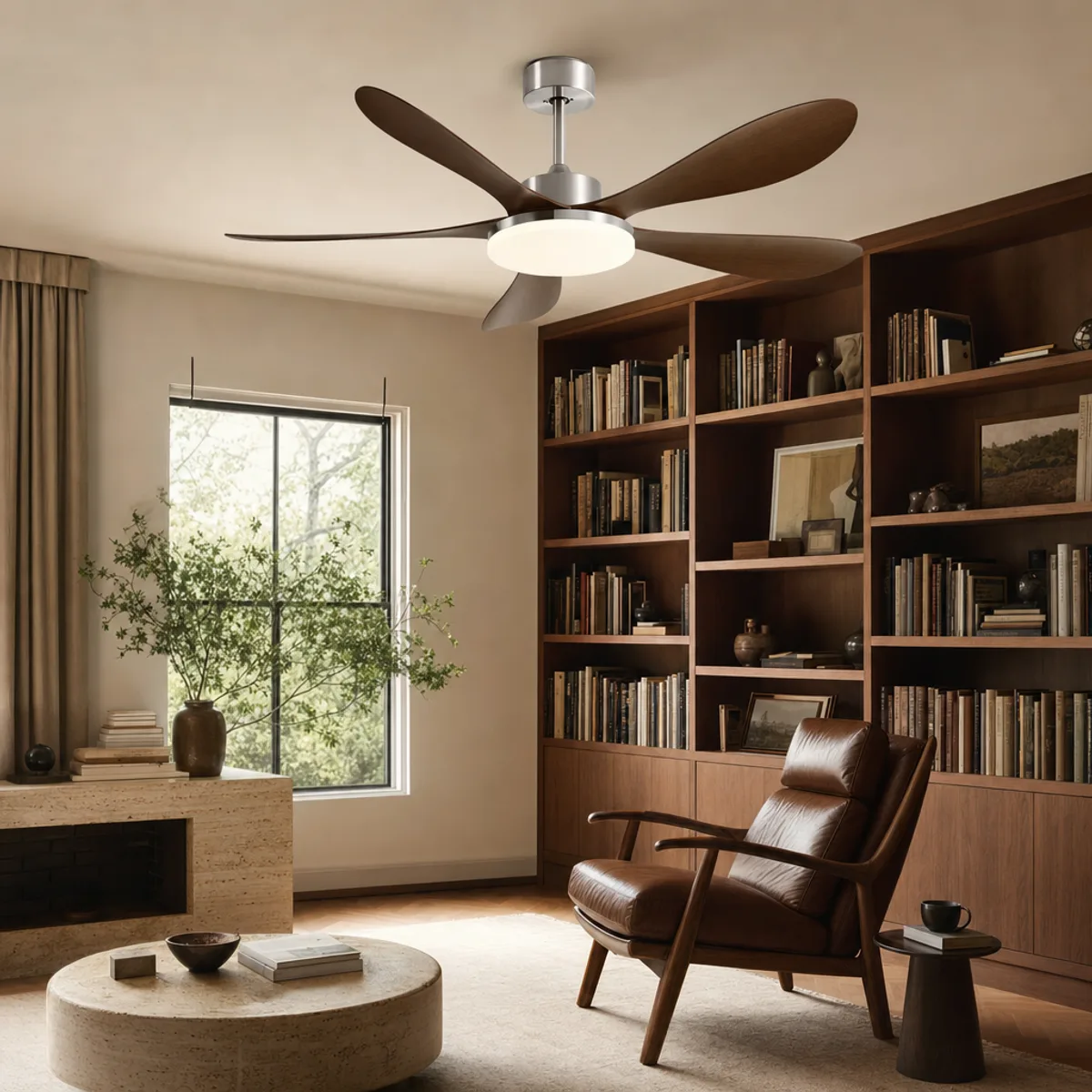
The Zénith 142
Five walnut blades · Brushed nickel · Integrated LED
- ✓Silent DC motor, 6 reversible speeds
- ✓Integrated dimmable LED + remote control
- ✓30-minute installation, illustrated manual
€379€479
Which downrod and which clearances under a slope?
Under a sloped ceiling the downrod is not an accessory: it is what lowers the rotation point far enough for the blades to turn horizontally without ever approaching the rafters. The steeper the pitch, the longer the rod has to be, which is why adjustable-rod models are the natural attic solution.
The ideal fixing point sits in the upper third of the slope or on the ridge purlin, where height is greatest: the fan works in the heart of the hot-air pocket while keeping its safety distances.
- ·Floor clearance: minimum 2.10 m between floor and blades
- ·Slope clearance: at least 40 cm between blade tips and the nearest rafter
- ·Pitch up to 30°: standard downrod + ball joint, the most common case
- ·Pitch above 30°: steep-slope adapter
- ·Anchor: always into a purlin or rafter, never plaster alone
Large diameter, slow rotation: the right attic formula
The classic attic mistake is choosing small 'because the room is low'. When floor area allows it, do the opposite: a large diameter turning slowly moves more volume than a small one at full speed, silently, without aggressive draughts.
The Zénith 142 is built for this exercise: five slender walnut blades across a 142 cm span, a silent DC motor and six speeds by remote. Its five blades cut the flow into closely spaced pulses, a wide and steady breeze that suits a bed under the rafters. For narrower attics it also comes in 102 and 117 cm.
Its integrated dimmable LED settles, along the way, a problem typical of converted attics: central lighting that cannot be fixed anywhere but on the slope. One anchor point, light and air together.
And in winter? Reverse mode under the rafters
Stratification works against you all year: in winter, radiator heat lodges under the ridge while the bed sits in cool air. Reverse mode inverts the rotation and sends the warm layer back down along the slopes, without any perceptible draught.
In a converted attic with 3 m at the ridge, recycling heat you have already paid for noticeably improves comfort at bed height. An attic ceiling fan is not summer equipment: it is a stratification regulator that works twelve months a year.
A sloped ceiling is not an obstacle, it is where a ceiling fan justifies itself best, working exactly where heat accumulates. Check three figures: 30° maximum angle, 2.10 m floor clearance, 40 cm to the rafter; choose the largest diameter the room accepts. With three spans (102, 117 and 142 cm), an integrated LED, a reversible DC motor and a 2-year warranty, the Zénith 142 ticks every box of the converted attic.
Frequently asked questions
What is the maximum angle for installing a ceiling fan on a slope?+
Most downrod fans accept up to about 30° of incline thanks to the ball-joint mount. Beyond that, a dedicated steep-slope adapter is needed. Flush-mount models are for horizontal ceilings only.
What minimum height do you need under the rafters?+
Allow 2.10 m between the floor and the bottom of the blades, plus the height of the fan and rod. In practice, a fixing point at 2.60-2.70 m on the slope is enough, fix in the upper third of the slope, where height is greatest.
Is a ceiling fan useful in an attic in winter?+
Yes, that is where it helps most: reverse mode sends the heat stratified under the ridge back to floor level. In a heated attic room, you recover heat already produced instead of raising the thermostat.
The SEY Maison Circle
Every month, an exceptional piece. Never reissued.
The Drops principle: one high-end furniture piece per month, in a numbered edition. Once it's gone, it never comes back. Circle members are notified 48 h early, access each drop 24 h before everyone else, and receive our guides before publication.
Discover the Drops →Also worth reading
Ceiling fan in a child's bedroom: safety, height, noise and loft beds
Read the article →
Paying for a ceiling fan in three interest-free instalments: how it works, what it costs, what to know
Read the article →
Inside a ceiling fan box: what is supplied, what is missing, what to prepare
Read the article →