Interior design
Ceiling fans in a country house: the charm of the classics
Published on ·4 min read
Some objects seem to have always belonged to old houses: the workshop pendant, the stone fireplace, the farm table. The ceiling fan is one of them, provided you choose the right one. Three wooden blades turning slowly under an oak beam evoke colonial verandas and family houses, not an anachronism.
Breton longère, Provençal mas, renovated farmhouse: these homes have exactly what modern housing lost, ceiling height and thermal mass. This guide shows how to use both, where to fix the fan in an old structure, and which style honours the materials.
Why does a ceiling fan belong in an old house?
The ceiling fan was born in tall rooms: colonial verandas, Parisian brasseries, southern townhouses. Its formal language, exposed downrod, wooden blades, metal hub, belongs to the same era as French country houses. Installing one is not a modern graft; it is a restoration.
Technically, old houses offer ideal conditions: with 2.80 to 3.50 m ceilings, the 2.10 m clearance is guaranteed, and a generous downrod places the blades at their most effective height, around 2.40 to 2.60 m from the floor.
Exposed beams: where and how to fix the fan?
Old beams and joists are the best possible anchor: two-hundred-year-old dry oak carries tonnes, so a rotating fan of a few kilos barely registers. Fixing goes directly into the solid wood with proper lag screws, no plugs, no reinforcement plate.
Beam choice defines the look: on the central joist, the fan becomes the room's focal point, aligned with the structure. Between two close joists, a matching wooden crosspiece bridges the gap, invisible joinery once the fan is up.
- ·Main beam or joist: direct lag-screw fixing into solid wood
- ·Between joists: wooden crosspiece screwed into the sides, stained to match
- ·Lath-and-plaster ceilings: locate the load-bearing joist, never fix into plaster alone
- ·Ideal blade height: 2.40 to 2.60 m from the floor, set by downrod length
- ·Wiring: reuse the old central pendant's supply, the remote control avoids new cabling
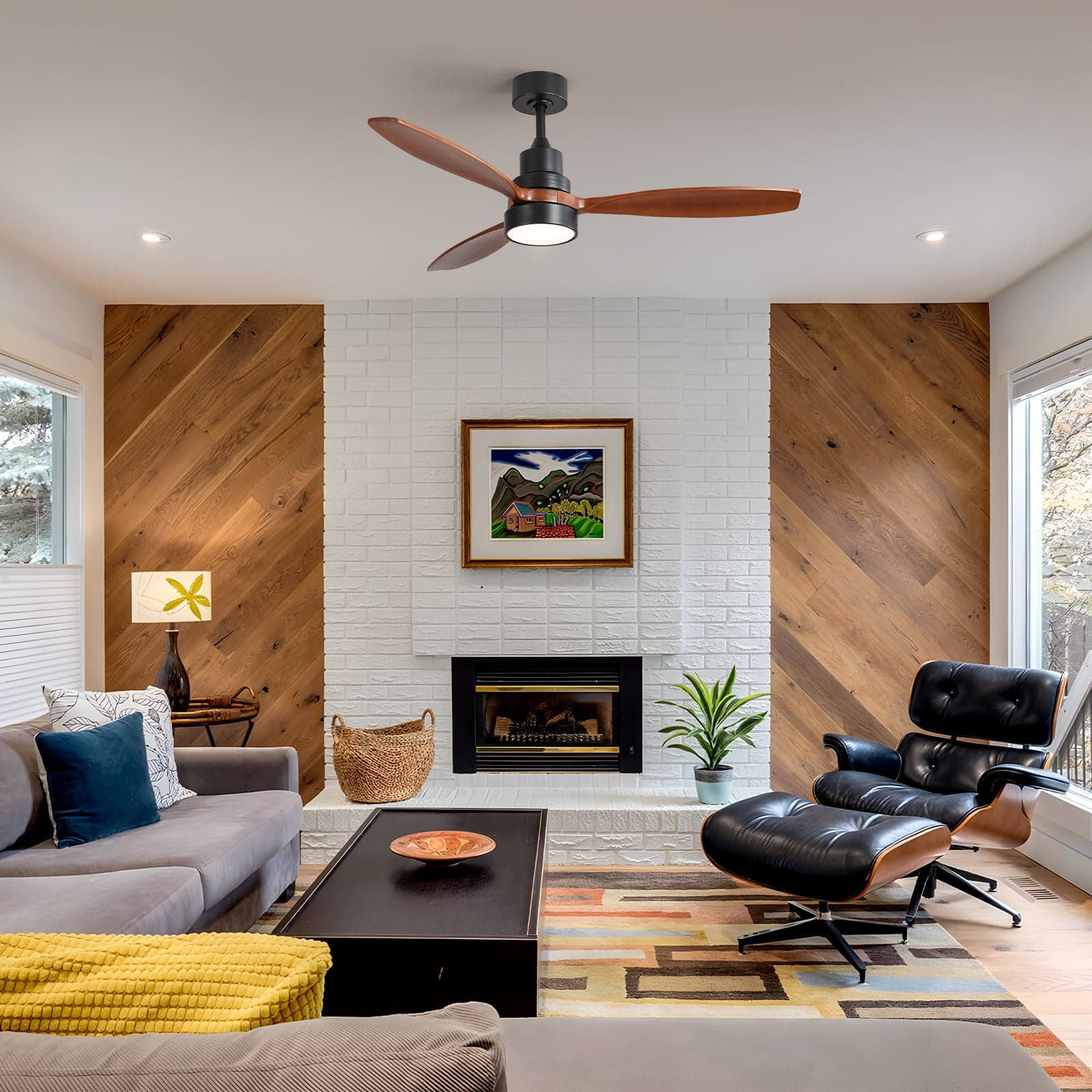
The Héritage 132
Solid walnut · Ø 132 cm · LED & reversible DC motor
- ✓Three carved solid-walnut blades: the warmth of wood on your ceiling
- ✓Low-consumption DC motor, 70% more efficient than AC
- ✓Reversible: cools in summer, spreads heating in winter
€399€419
Which style honours old materials?
The rule of good renovations applies to the ceiling: true materials that age with the house. Against oak beams and lime-washed walls, glossy plastic blades clash; solid wood converses. A matt black body recalls old ironmongery.
That is exactly the register of the Héritage 132: three solid-walnut blades shaped and sanded by hand like furniture, a black body recalling workshop pendants. Living wood grain on the ceiling, 132 cm across, standing up to the generous volumes of a farmhouse living room, with a dimmable LED replacing the central pendant.
Summer in a longère: thick walls + moving air
Old houses hold a thermal treasure: 50 to 80 cm of stone that buffers heat peaks. Shutters half-closed, a longère naturally stays 5 to 8°C below outdoor temperature in a heatwave. What walls cannot do is move air, in deep rooms, stillness turns relative coolness into stuffiness.
That is the fan's job: slow circulation lowering perceived temperature by 3 to 4°C at 35 dB maximum with a DC motor. Old walls plus moving air covers the vast majority of French summers, no ducts, no outdoor unit bolted to a stone façade.
Winter under 3-metre ceilings: reverse mode changes everything
The height that gives old rooms their charm costs you in winter: stove heat lodges at 3 m while life happens at 1.50 m. Reverse mode inverts the rotation and gently returns the warm layer along the walls to living height, without draughts.
With its reversible DC motor, 70 % more efficient than an AC motor, the Héritage 132 recycles that heat twelve months a year for a night-light's consumption. In a wood-heated country house, it is the most profitable accessory in the living room.
A country house does not need one more appliance; it needs objects at its own scale: true materials, generous proportions, quiet mechanics. A solid-wood ceiling fan ticks all three and works all year. With three hand-finished solid-walnut blades, a workshop-black body, a reversible DC motor at 35 dB and a 2-year warranty, the Héritage 132 was drawn for exactly these houses, the ones that have time.
Frequently asked questions
Can you fix a ceiling fan to an old beam?+
Yes, it is the best anchor there is: old solid oak carries a few rotating kilos effortlessly. Fix directly into the wood with proper lag screws. Never fix into a plaster ceiling alone; always reach the load-bearing structure.
What diameter for a 30-40 m² farmhouse living room?+
Aim for at least 132 cm, the right span for 25 to 35 m²; beyond 35 m², move to 152 cm or install two fans at either end of the room. Old houses' generous heights accommodate every format.
Do you need to rewire an old house to install a ceiling fan?+
Usually not: the supply of an old central pendant is enough, and the included remote control avoids pulling new switches or cable runs through old walls. The only requirement is a compliant, earthed circuit.
The SEY Maison Circle
Every month, an exceptional piece. Never reissued.
The Drops principle: one high-end furniture piece per month, in a numbered edition. Once it's gone, it never comes back. Circle members are notified 48 h early, access each drop 24 h before everyone else, and receive our guides before publication.
Discover the Drops →