Interior design
Replacing a ceiling light: the question nobody asks before buying
Published on ·5 min read
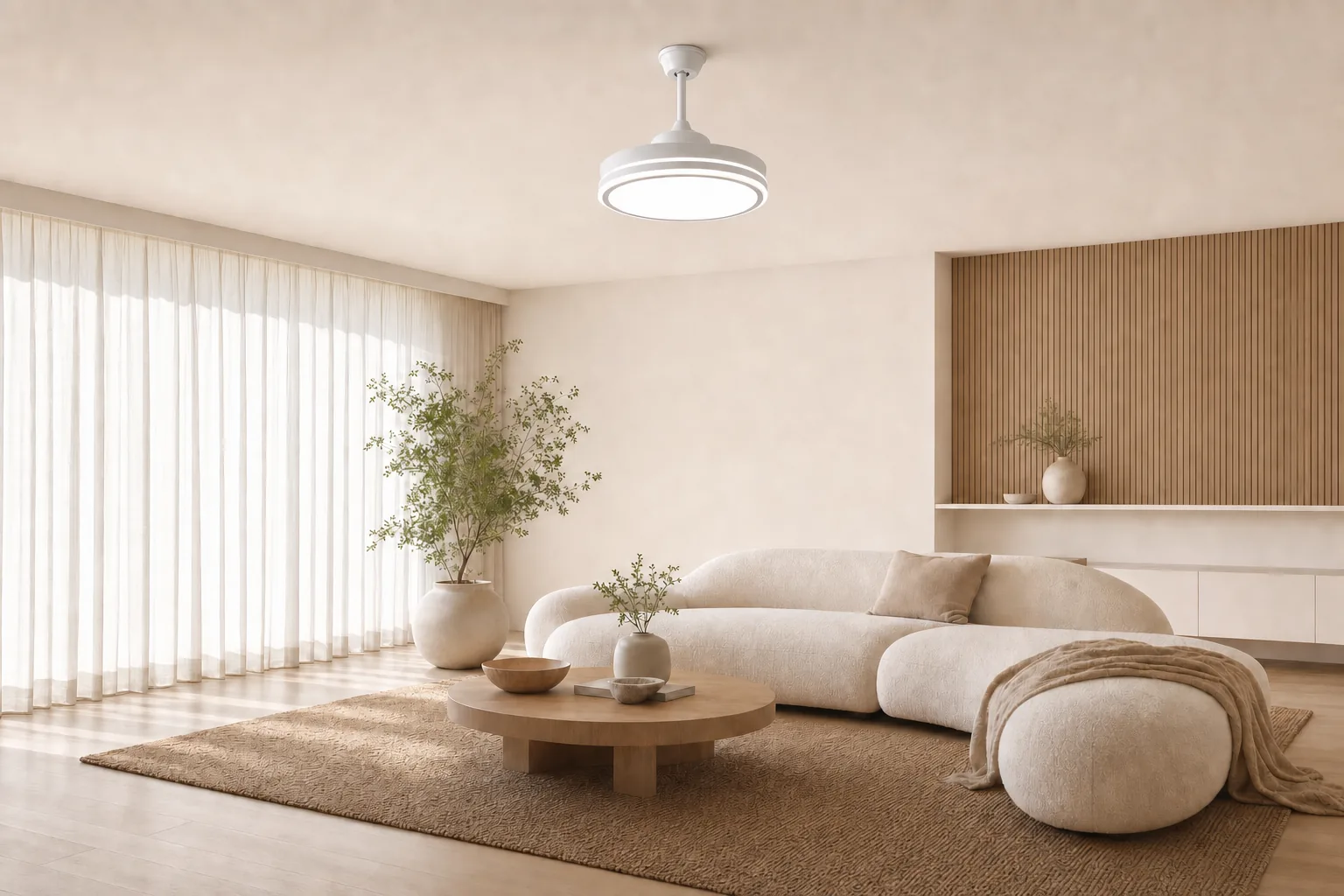
You change a ceiling light for a simple reason: the one up there no longer pleases, or it has died. The search then runs on shape, finish and the diameter of the disc, and the decision is settled in an evening. That is precisely where something bigger than lighting is decided, without anyone noticing.
A ceiling has one light point per room. Opening it happens once every ten or fifteen years, and what you fix there that day will decide the look of the room, but also how it feels in August and in January. It is worth knowing what can occupy that place.
What the light point can carry
The box in the ceiling delivers three conductors: live, neutral and earth. Anything that connects to them and that the mounting can hold has a right to be there. A flat luminaire, a pendant, a chandelier, and also a ceiling fan, which connects in exactly the same way.
That last family was long kept out of carefully composed interiors for an aesthetic reason, not a technical one: the blades, visible twelve months a year, imposed their presence on a room that only wanted them for three. That is the trade-off retractable-blade models remove.
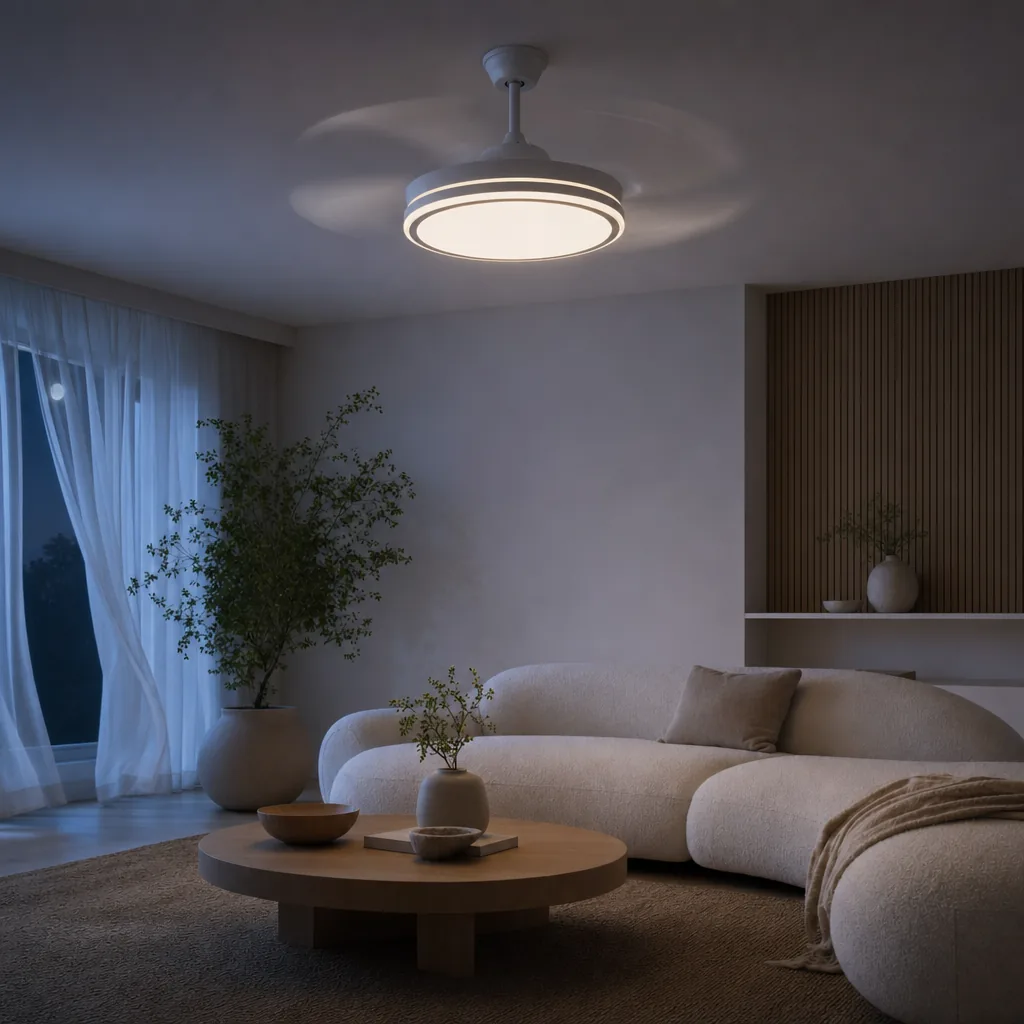
At rest, the four blades sit inside the body of the appliance and all that remains is a round disc on the ceiling, with the look of a ceiling light. They deploy only when it starts, by centrifugal force, and fold back on their own when it stops. Nine months a year, the object is a luminaire.
Light first: what to look at
If the appliance replaces a ceiling light, it must first be a good ceiling light. Three figures are enough to check that, and they are the ones most product sheets leave out.
Colour temperature, in kelvins, decides the mood: 2700K is the warm light of late afternoon, 4000K a neutral working light, 6000K a cold one. A model offering a single value locks you in; an adjustable one follows the hour and the use of the room.
The colour rendering index, the CRI, says how faithful colours are under that light. Below 80, textiles and woodwork shift. Above 90, real tones come back. It is the least-quoted figure on the market, and the one that changes the perception of a room the most: the Boréal 107 is at 97.
- ·Temperature: adjustable from 2700K to 6000K rather than a fixed value
- ·CRI: aim for 90 and above, most ceiling lights never state it
- ·Dimming: a real dimmer, not three positions
- ·Control: a remote, so you do not depend on the wall switch
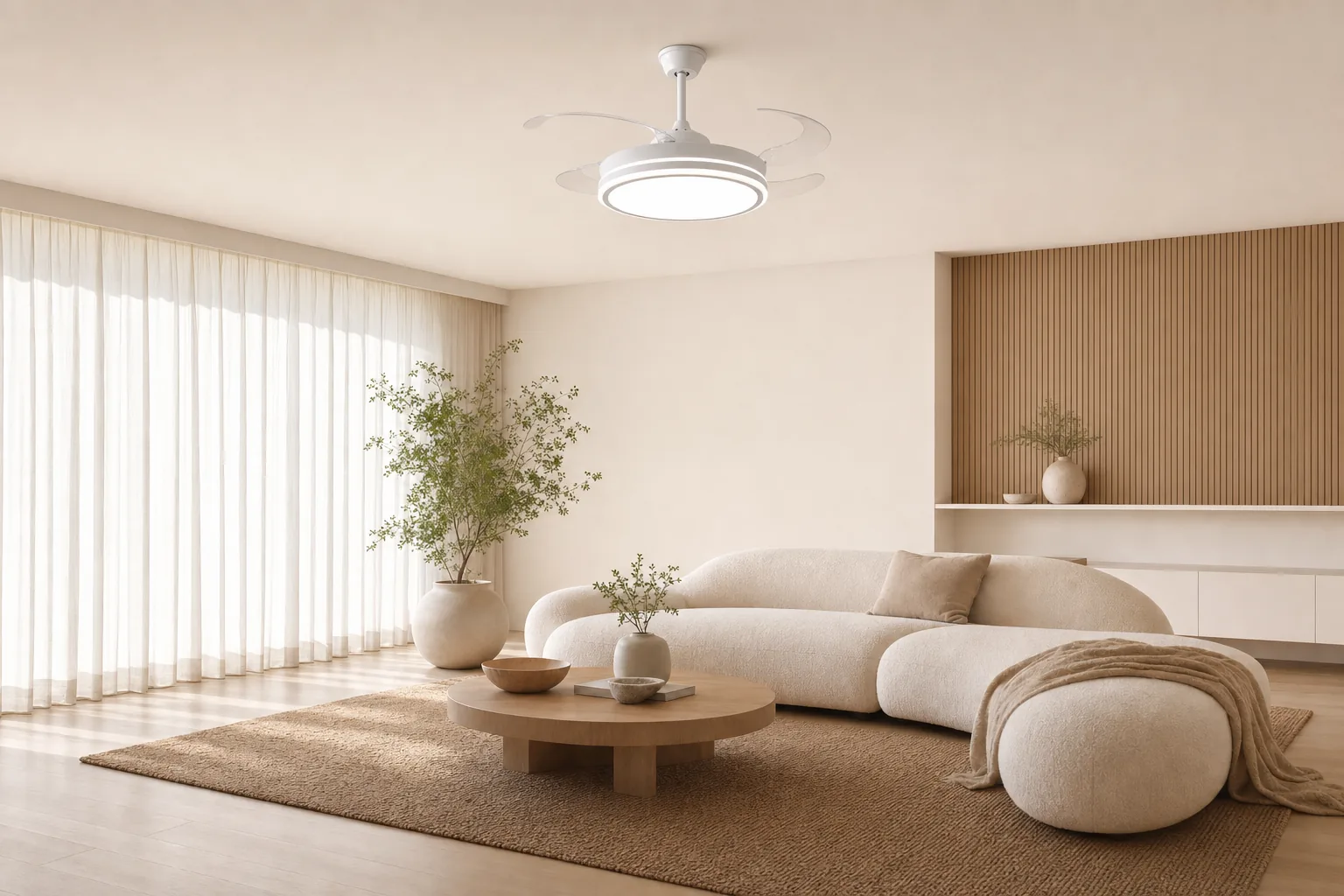
The Boréal 107
Retractable blades · Ø 107 cm · LED ceiling light & silent fan
- ✓Retractable blades: invisible when off, nobody guesses it's a fan
- ✓Sleep with windows closed, 30 dB, quieter than a whisper
- ✓Integrated LED 2700K → 6000K, dimmable: replaces your ceiling light
What a plain ceiling light will never do
In summer, a ceiling light lights. That is all it is asked for, and all it gives. An appliance that moves air takes 3 to 4 °C off the felt temperature for anyone beneath it, at 28-34 dB, without cooling the air or drawing more than 30 W. A bedroom at 29 °C feels like a bedroom at 25 or 26 °C.
In winter, the opposite is useful. Radiator heat rises and gathers at the ceiling, above people's heads. A reversible motor inverts the rotation and gently pushes that warm layer back towards the floor, with no perceptible draught. Upstairs, that often allows the heating to come down by a degree.
Neither use requires building work, a second fixing point or an extra socket. Both fit into the same gesture: the day you change your ceiling light.
Three checks before ordering
Height first. You must keep 2.10 m between floor and blades. With a ceiling at 2.50 m or above, every format fits. At 2.40 m, you need a profile specifically designed to mount flush, and certainly not a shortened downrod.
The mounting next, and it is the check most often skipped. A ceiling light weighs little and does not move; a rotating appliance works on its fixing for years. The anchor must reach a purlin, a rafter or a concrete slab. Plasterboard alone will not hold.
Diameter last, chosen on the floor area rather than on taste: 107 cm covers a bedroom or study up to 20 m², 132 cm a living room up to 30 m². Between two diameters, take the larger one: it will turn more slowly, so more quietly.
- ·2.10 m minimum between floor and blades, no exceptions
- ·Anchor into a purlin, a rafter or a slab, never into plasterboard
- ·Diameter chosen on floor area: 107 cm up to 20 m², 132 cm up to 30 m²
- ·Under a 2.50 m ceiling: a flush profile is mandatory
Changing a ceiling light is decided in an evening and lived with for ten years. If all you expect is light, a luminaire will do and will sometimes cost less. If you would rather that fixing point also earned its keep in August and January, a retractable-blade model takes the same place, fits in the same quarter of an hour, and shows no more than a luminaire during the nine months you ask nothing of it.
Frequently asked questions
Does a ceiling fan wire up like a ceiling light?+
Yes, to the same box and the same three conductors: live, neutral and earth. In France the standardised DCL socket makes it simpler still. Allow half an hour, as for a luminaire.
Can you tell when it is not running?+
On a retractable-blade model, no: the four blades fold into the body at rest and all that remains is a round disc, like a ceiling light. They deploy by centrifugal force when it starts.
Is the light enough to light a room on its own?+
On the Boréal 107, the LED is dimmable from 2700K to 6000K with a CRI of 97: it replaces the ceiling light whose place it takes, including in a living room or bedroom. Always check those two figures, adjustable temperature and CRI, before comparing two appliances.
What is the minimum ceiling height?+
You need 2.10 m between floor and blades. Under a ceiling of 2.50 m or more, every format fits. At 2.40 m you need a flush-mounted model, never a downrod cut short.
Can I fix it to plasterboard?+
Not to the board alone. A rotating appliance must be anchored to a purlin, a rafter or a concrete slab, through a spanning support if needed. It is the most important rule of the installation, and the one most often skipped.
The SEY Maison Circle
Every month, an exceptional piece. Never reissued.
The Drops principle: one high-end furniture piece per month, in a numbered edition. Once it's gone, it never comes back. Circle members are notified 48 h early, access each drop 24 h before everyone else, and receive our guides before publication.
Discover the Drops →