Interior design
The luminaire that disappears: why the best ceilings are the ones nobody looks at
Published on ·3 min read
There are two schools for the ceiling. The first treats it as a stand for an object: a sculptural pendant, a chandelier, a piece to be looked at. The second leaves it alone and puts the care into the light rather than the shape.
The second is less spectacular in photographs and far more comfortable to live with, for a reason rooted in how we look at a room.
Why a ceiling is not a wall
A wall takes pictures, shelves, a colour. The ceiling takes nothing: it is the largest plain surface in the room, and the only plane nothing interrupts. An object placed there therefore stands out far more than the same object on a wall.
That is why an imposing pendant, magnificent in a catalogue photograph, often ends up weighing on a room once lived in. It pulls the gaze upward, in a direction where there is nothing to do, and it does so all day.
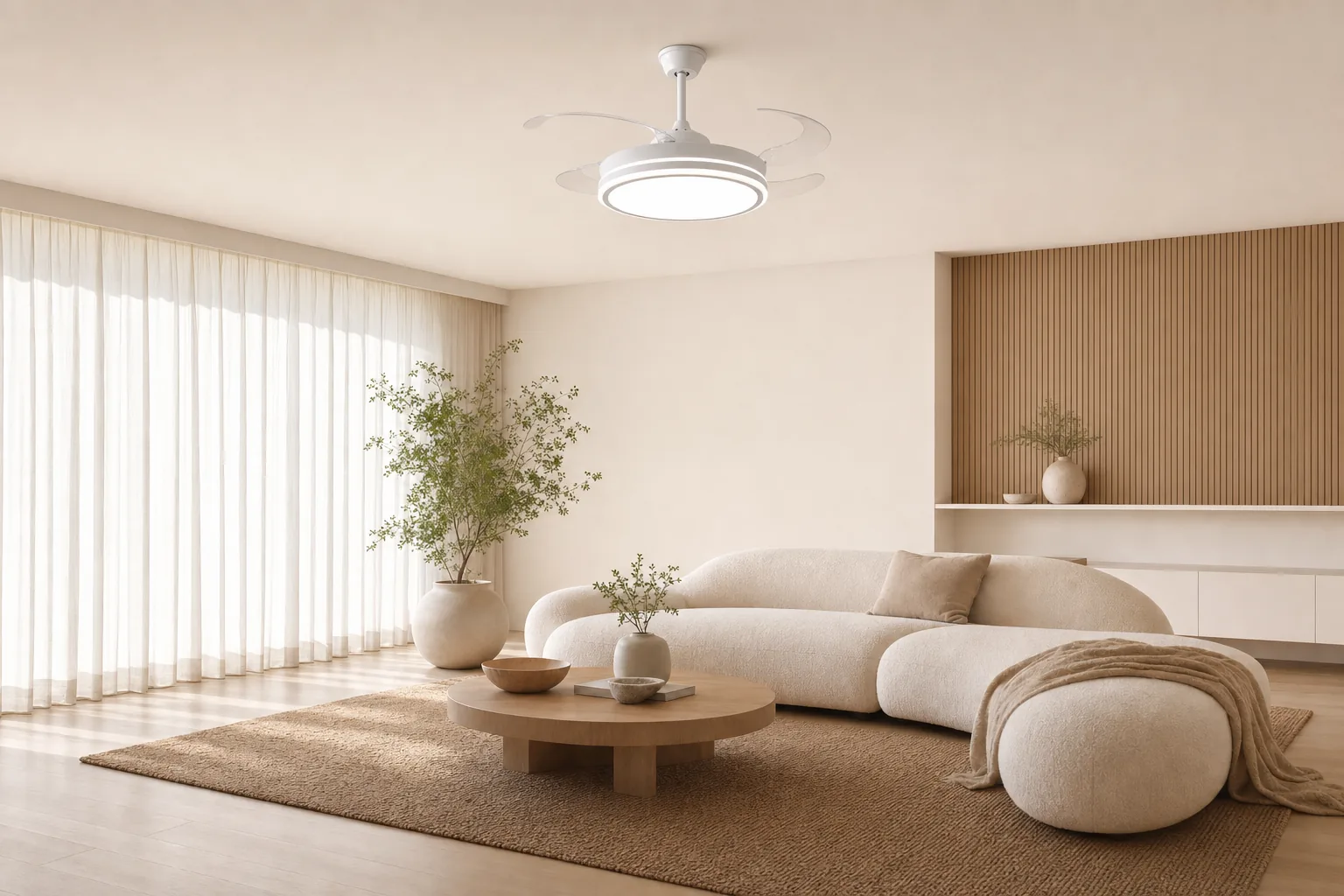
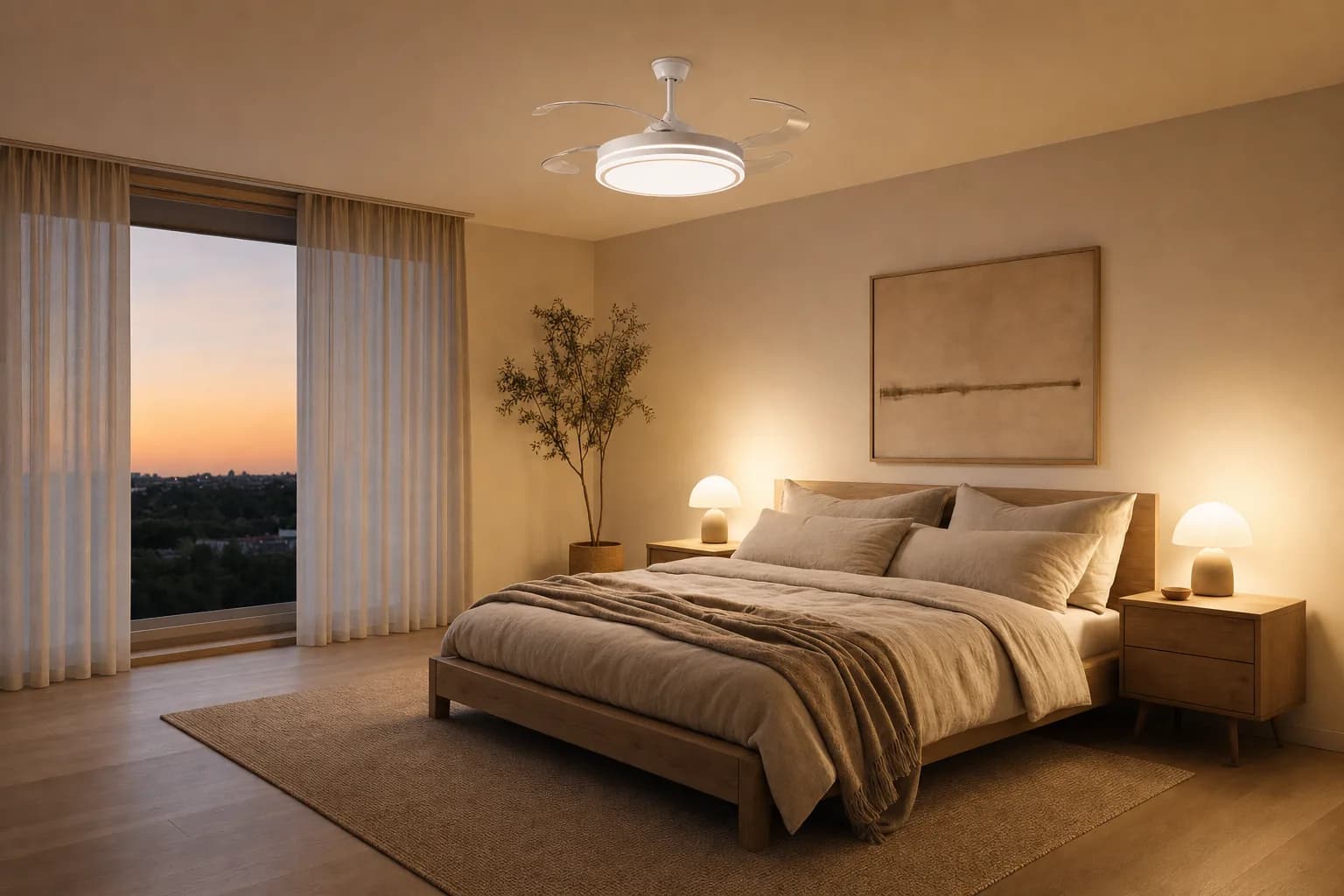
The Boréal 107
Retractable blades · Ø 107 cm · LED ceiling light & silent fan
- ✓Retractable blades: invisible when off, nobody guesses it's a fan
- ✓Sleep with windows closed, 30 dB, quieter than a whisper
- ✓Integrated LED 2700K → 6000K, dimmable: replaces your ceiling light
The three levers of discretion
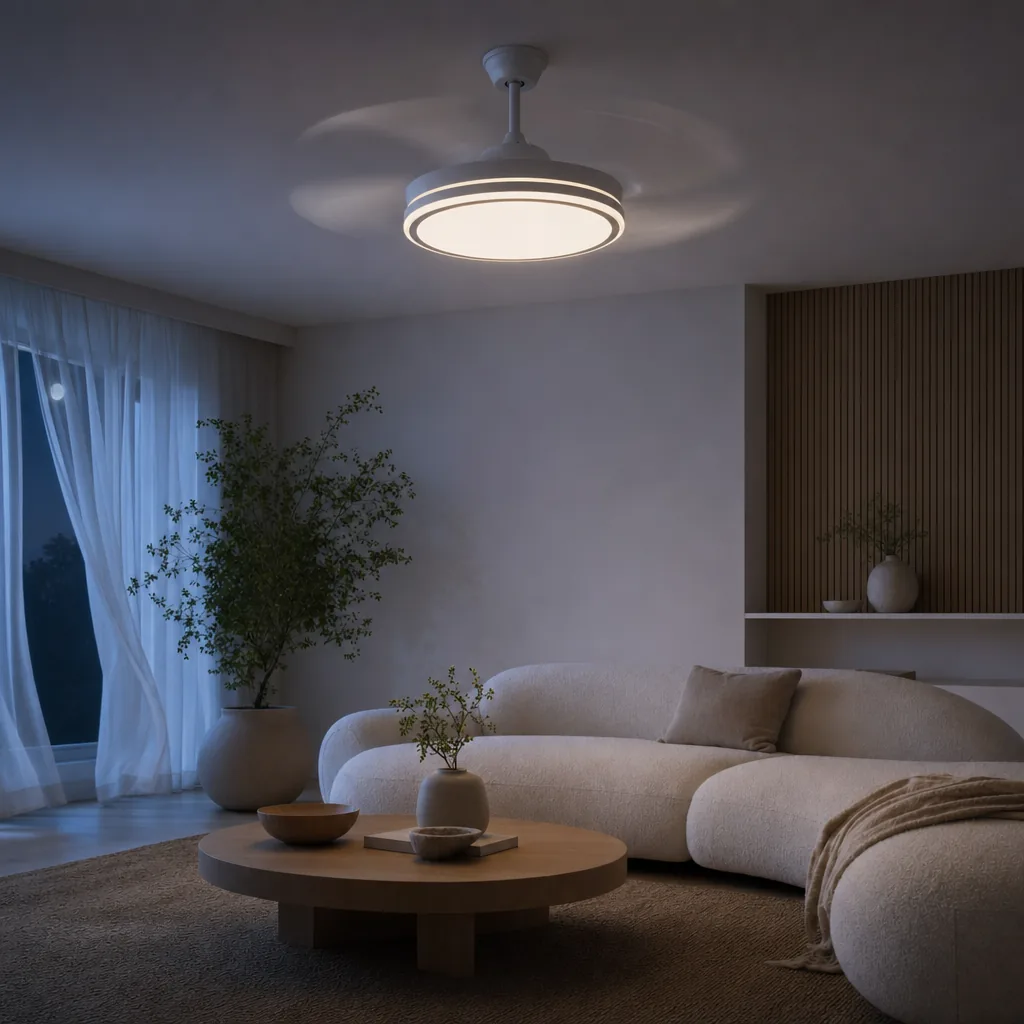
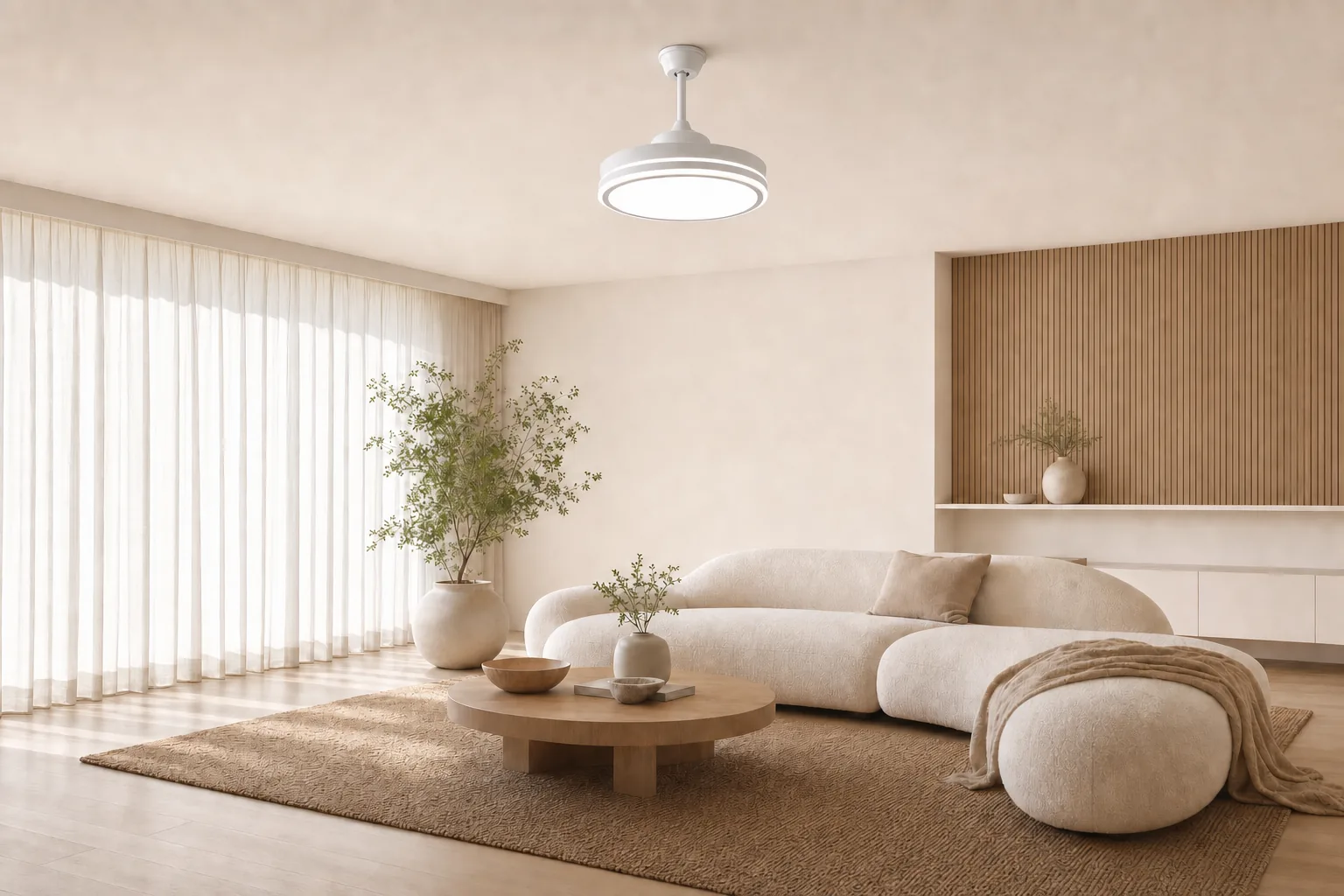
The first is colour. A white luminaire on a white ceiling blends in; the same one in black becomes a point. That does not forbid contrast, but it must be a deliberate choice, not an oversight.
The second is depth. The flatter the object, the less shadow it casts on the ceiling, and the less it announces itself. It is also what makes it possible under a low ceiling.
The third is shape. A disc has no orientation, so no good or bad angle from the sofa. Shapes with edges need to be aligned with something, and a ceiling usually offers nothing to align with.
- ·A colour close to the ceiling, unless contrast is intended
- ·Low depth, less shadow cast on the surface
- ·A round shape, imposing no orientation
- ·An opal diffuser, so the source is never visible
What discretion demands in return
A luminaire that cannot rely on its shape can only rely on its light. That is demanding: it needs a high CRI so the colours of the room stay true, dimming so it can fade in the evening, and preferably an adjustable temperature.
That is why a well-made discreet ceiling light often costs more than a striking cheap one. You pay for what cannot be seen, and that is precisely what is lived with.
A beautiful ceiling is one nobody talks about. If you want a room where attention goes to materials, colours and people, choose a luminaire that blends in and put the budget into the quality of its light. The spectacular overhead is justified mainly where there is nothing else to look at.
Frequently asked questions
Is a discreet ceiling light inferior?+
On the contrary, that is where the quality of the light becomes the only criterion. Unable to rely on its shape, a discreet luminaire must offer a high CRI, real dimming and an adjustable temperature.
Should a ceiling light match the ceiling colour?+
It is the surest way to make it disappear. Contrast remains possible, but it must be intended: on the only large plain surface in the room, a dark object becomes a permanent point of fixation.
Which shape shows least?+
The disc, because it has no orientation and therefore needs to be aligned with nothing. Shapes with edges require an axis, and a ceiling generally offers none.
The SEY Maison Circle
Every month, an exceptional piece. Never reissued.
The Drops principle: one high-end furniture piece per month, in a numbered edition. Once it's gone, it never comes back. Circle members are notified 48 h early, access each drop 24 h before everyone else, and receive our guides before publication.
Discover the Drops →