Comparisons & guides
Ceiling fan vs ducted air conditioning: the duel of the 'invisible' solutions
Published on ·4 min read
Those who refuse the wall-mounted split unit face two so-called invisible solutions: ducted air conditioning, hidden in false ceilings, and the ceiling fan, which accepts being seen but makes itself forgotten. Both promise a comfortable summer without disfiguring the room. Everything else sets them apart.
On one side, weeks of construction and a budget in the tens of thousands. On the other, a 30-minute installation on an existing light point and a budget in the hundreds. A one-to-hundred ratio, to weigh against the real need: how many days per year is your home actually uncomfortable?
Installation: the building site versus the screwdriver
Ducted AC is the heaviest residential option: false ceilings or accessible attics for the ducts, drilled walls for refrigerant lines, an outdoor unit, supply and return grilles in every room, and a certified technician for commissioning. In a renovation, count several weeks of work and tens of thousands of euros for a full home.
A ceiling fan mounts on the existing light point like a ceiling light: about 30 minutes per room, an illustrated manual, no façade impact, no co-ownership approval for an outdoor unit. The room is usable the same evening.
Real cost over ten years: purchase, energy, maintenance
Purchase price is only the first line. A ducted system draws several kilowatts in operation; a DC ceiling fan draws a few dozen watts, a consumption gap of a factor 20 to 50 depending on usage.
Then comes maintenance: regulations impose refrigerant leak checks and regular professional servicing on ducted systems, filters, ducts and condensates included, a recurring annual cost for the life of the installation. A ceiling fan has no refrigerant, no filters, no condensates: a wipe of the blades twice a year, and a 2-year warranty with EU support.
- ·Purchase + installation: tens of thousands of euros versus hundreds
- ·Work: several weeks with false ceilings versus 30 minutes on an existing light point
- ·Consumption: several kilowatts versus a few dozen watts
- ·Maintenance: mandatory annual servicing versus none
- ·Winter: auxiliary heating for ducted AC, warm-air destratification for the fan's reverse mode
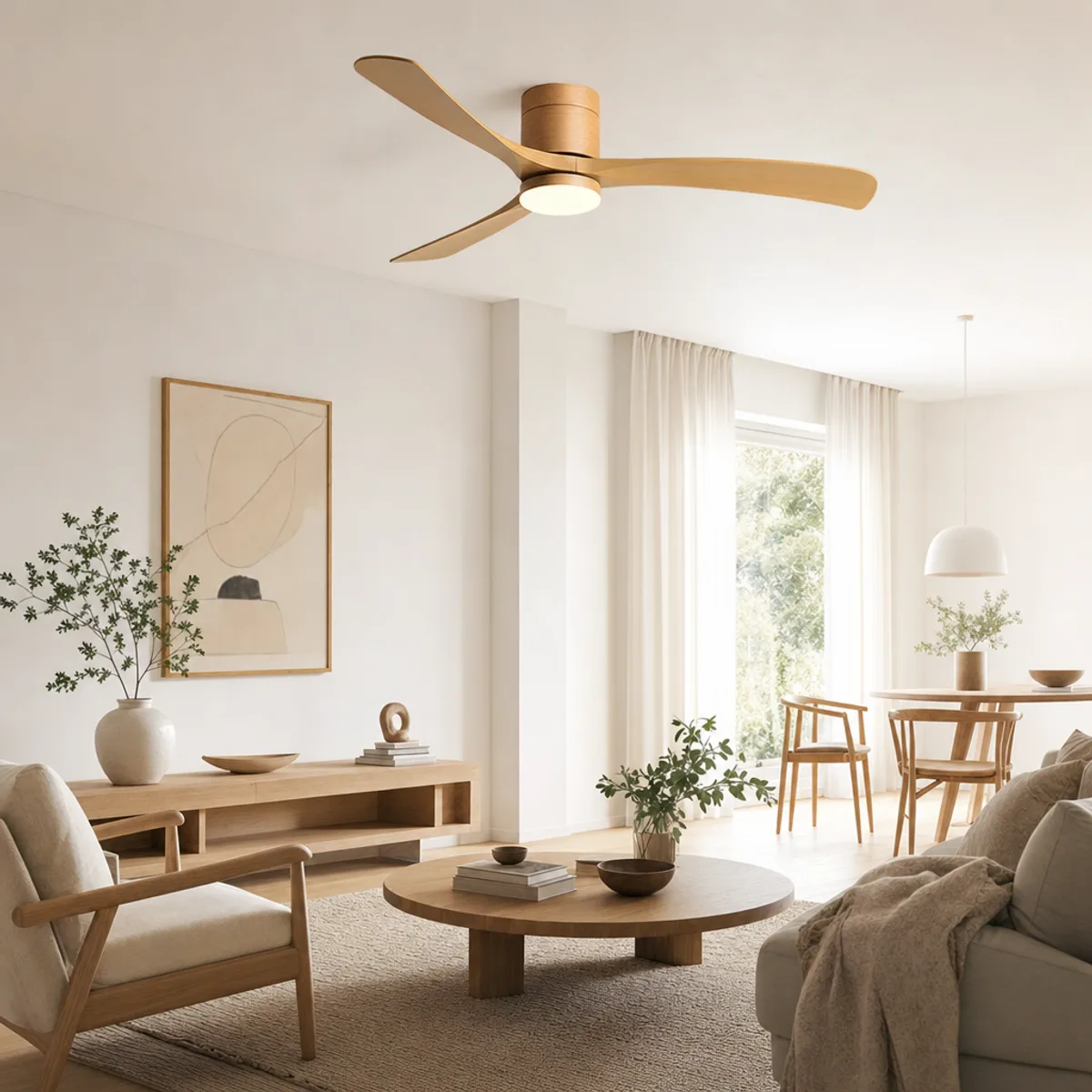
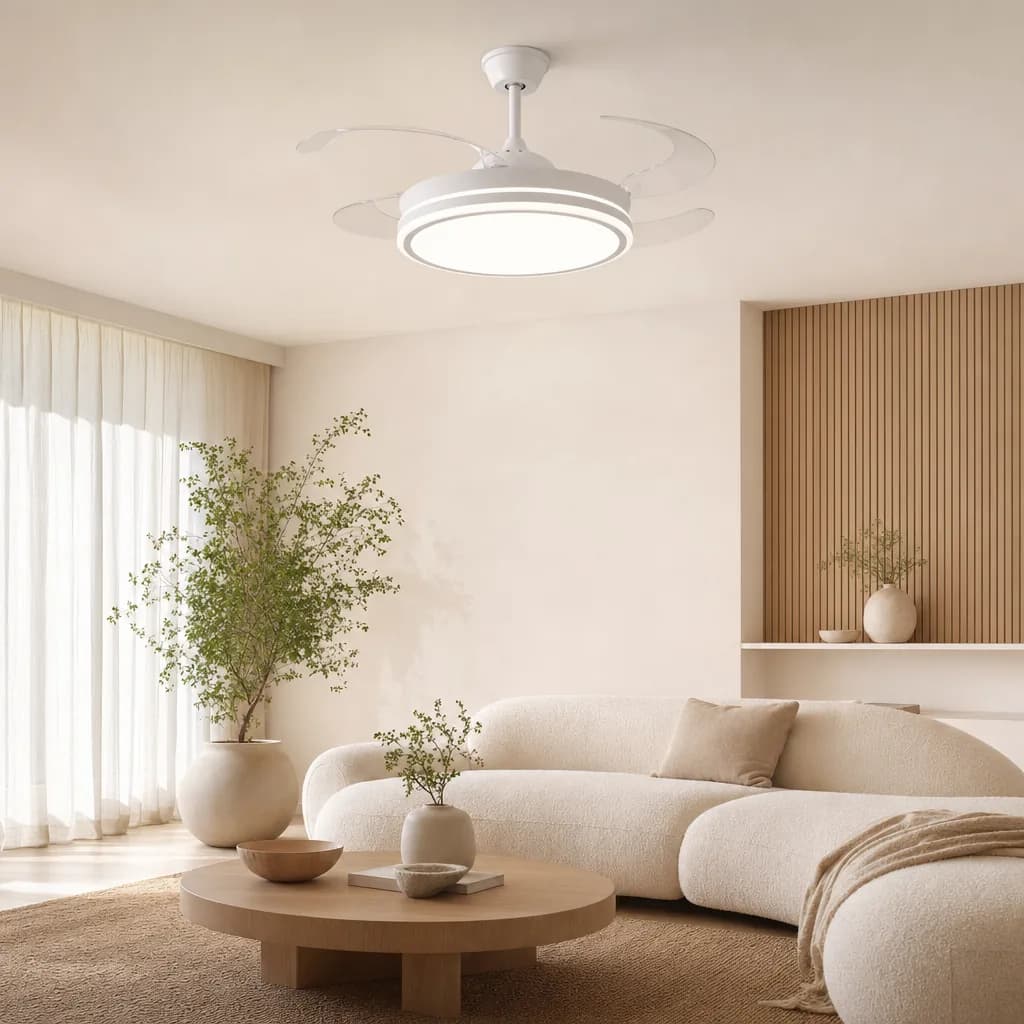
The Épicéa 142
Wood body & wood blades · Scandinavian · Integrated LED
- ✓Silent DC motor, 6 reversible speeds
- ✓Integrated dimmable LED + remote control
- ✓30-minute installation, illustrated manual
€299€419
Real usage: how many days a year do you actually need it?
The question the ducted quote never asks: in most regions, indoor temperatures durably exceed 28°C for only two to four weeks a year. The rest of the time, the installation sleeps in the ceiling.
The ceiling fan answers differently: it lowers perceived temperature by 3 to 4°C, so a room at an actual 27-28°C is lived in at a felt 23-24°C, exactly covering those critical weeks. It also serves the other forty-eight: gentle circulation in shoulder season, reversible winter mode pushing stratified warm air back down. Where AC is truly justified, very hot regions, vulnerable people, the two combine: air movement lets you set the AC 3 to 4°C higher for identical comfort.
Verdict: the right profile for each
Ducted AC holds its ground in one scenario: new build or heavy renovation already underway, very hot region, generous budget, and the will to lower the actual temperature of the whole home, accepting annual maintenance and compressor consumption.
For everyone else, an existing home, a budget in hundreds rather than tens of thousands, and a need concentrated on a few weeks a year, the ceiling fan delivers most of the comfort at roughly one hundredth of the full cost. An all-wood model such as the Épicéa 142, light-wood clad motor, matching blades, integrated dimmable LED, reads as Scandinavian design rather than equipment, runs at 28-34 dB on low speed with six reversible speeds and an included remote.
For an exceptional need, an exceptional solution; for a real need, a proportionate one. Committing tens of thousands of euros and weeks of construction against two to four weeks of discomfort is rarely rational when a ceiling fan fitted in 30 minutes brings perceived temperature down 3 to 4°C on a few dozen watts. The Épicéa 142 embodies that choice without aesthetic compromise: wood all the way to the motor housing, dimmable LED, six reversible speeds, remote included, 2-year warranty. The truly invisible solution is the one you forget.
Frequently asked questions
Can a ceiling fan really replace ducted air conditioning?+
In most homes, yes: moving air lowers perceived temperature by 3 to 4°C, covering the two to four critical weeks of summer. It does not replace AC in very hot regions or for vulnerable people, where the two solutions complement each other.
What is the cost gap between ducted AC and a ceiling fan?+
Roughly one to a hundred on installation: tens of thousands of euros with construction work versus hundreds of euros fitted in 30 minutes. The gap widens with mandatory annual servicing and compressor consumption, a factor of 20 to 50 on electricity.
Does ducted air conditioning require much maintenance?+
Yes: refrigerant leak checks, filter cleaning, duct and condensate inspection, with an annual professional visit for the life of the system. A ceiling fan requires no regulated maintenance; dusting the blades twice a year is enough.
The SEY Maison Circle
Every month, an exceptional piece. Never reissued.
The Drops principle: one high-end furniture piece per month, in a numbered edition. Once it's gone, it never comes back. Circle members are notified 48 h early, access each drop 24 h before everyone else, and receive our guides before publication.
Discover the Drops →