Cooling without AC
Cooling an old stone house without AC: making the most of thermal inertia
Published on ·3 min read
Old houses, limestone, granite, rammed earth or timber frame, were designed to survive summer heat without a single watt of air conditioning. They do it through principles that medieval masons knew empirically: thermal mass, phase shift, natural stack ventilation.
But these same buildings have specific traps that make AC ineffective or damaging. This guide explains how to get the best out of old construction during a heatwave without compromising its durability or character.
Thermal inertia: your free air conditioning at 40 cm thick
A 40 cm stone wall has a heat capacity of 800-1,000 J/(kg·K) and density of 2,000-2,700 kg/m³. It absorbs huge amounts of heat without rising in temperature, and releases it slowly. The thermal phase shift of a 40 cm wall is 8 to 12 hours: afternoon sun heat reaches the interior only at 2-3 am, when outside air has already cooled.
The golden rule: never let heat in during the day (shutters closed, cellar door cracked open for cool draught), and purge stored heat at night (maximum cross-ventilation as soon as outside drops below indoor temperature).
Traps specific to old buildings
First mistake: internal insulation. Fitting polystyrene or mineral wool inside destroys the thermal mass advantage accumulated over 200 years of construction in a single day's work. Old stone walls need no summer insulation, their thickness is the insulation.
Second trap: AC and moisture. Old walls breathe, they absorb and release moisture by capillarity. AC dehumidification creates a vapour gradient that accelerates rising damp and can damage lime plaster. If you install AC in an old house, keep indoor humidity above 45% and use it as a supplement, not continuously.
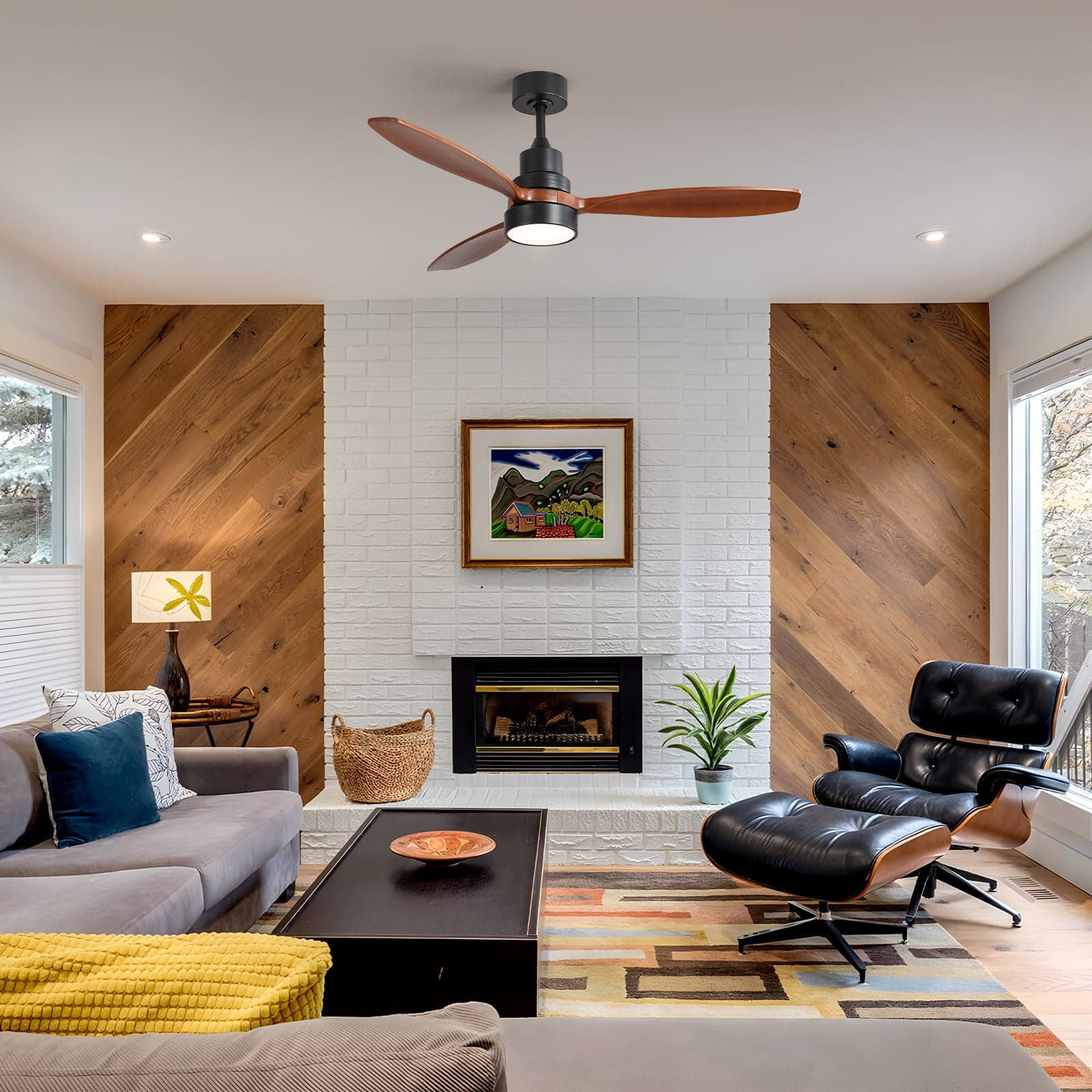
The Héritage 132
Solid walnut · Ø 132 cm · LED & reversible DC motor
- ✓Three carved solid-walnut blades: the warmth of wood on your ceiling
- ✓Low-consumption DC motor, 70% more efficient than AC
- ✓Reversible: cools in summer, spreads heating in winter
€399€419
Ceiling fans in old houses: a natural match
Old houses often have high ceilings (3-5 m in main rooms, higher in converted barns). This creates significant air stratification: temperature differences of 5-8°C between floor and ceiling level.
A large-diameter ceiling fan (132 cm or more) gently mixes the entire air volume, redistributing low cool air without aggressive draughts. In winter, reverse mode recovers stratified warm air: a double benefit especially valuable in large wood-heated rooms.
What an old house does naturally better than any technology
A well-managed stone house holds 24°C interior at 38°C outside with no active equipment, just shutters, a cellar and method. Old buildings are the best architectural response to climate warming. The problem is that forty years of renovation, internal insulation, airtight sealing, waterproofing, have destroyed exactly what made them work.
Cooling an old house without AC is first about not destroying what the building already does. Thermal mass, stack ventilation, managed humidity: three assets that heatwaves cannot defeat if respected. For circulating air in high-ceilinged characterful rooms, our large-diameter fans are designed to integrate as naturally as they perform.
Frequently asked questions
Can air conditioning be installed in an old house?+
Yes, but carefully. AC dehumidification can weaken lime plaster and accelerate rising damp. Keep indoor humidity above 45% and use AC as a supplement rather than in continuous operation.
Why do stone houses stay cool without air conditioning?+
Thermal inertia: a 40 cm stone wall takes 8-12 hours to transmit solar heat from outside to inside. With shutters closed by day and night ventilation, the house never reaches peak outdoor temperature.
Which ceiling fan for an old house with high ceilings?+
Choose a large diameter (120-140 cm or more) to circulate large volumes effectively. An adjustable downrod positions blades at optimal height (2.40-3 m above floor). Brushed metal or matt brass finishes integrate naturally into characterful interiors.
The SEY Maison Circle
Every month, an exceptional piece. Never reissued.
The Drops principle: one high-end furniture piece per month, in a numbered edition. Once it's gone, it never comes back. Circle members are notified 48 h early, access each drop 24 h before everyone else, and receive our guides before publication.
Discover the Drops →