Comparisons & guides
What size ceiling fan? The complete guide by room size
Published on ·4 min read
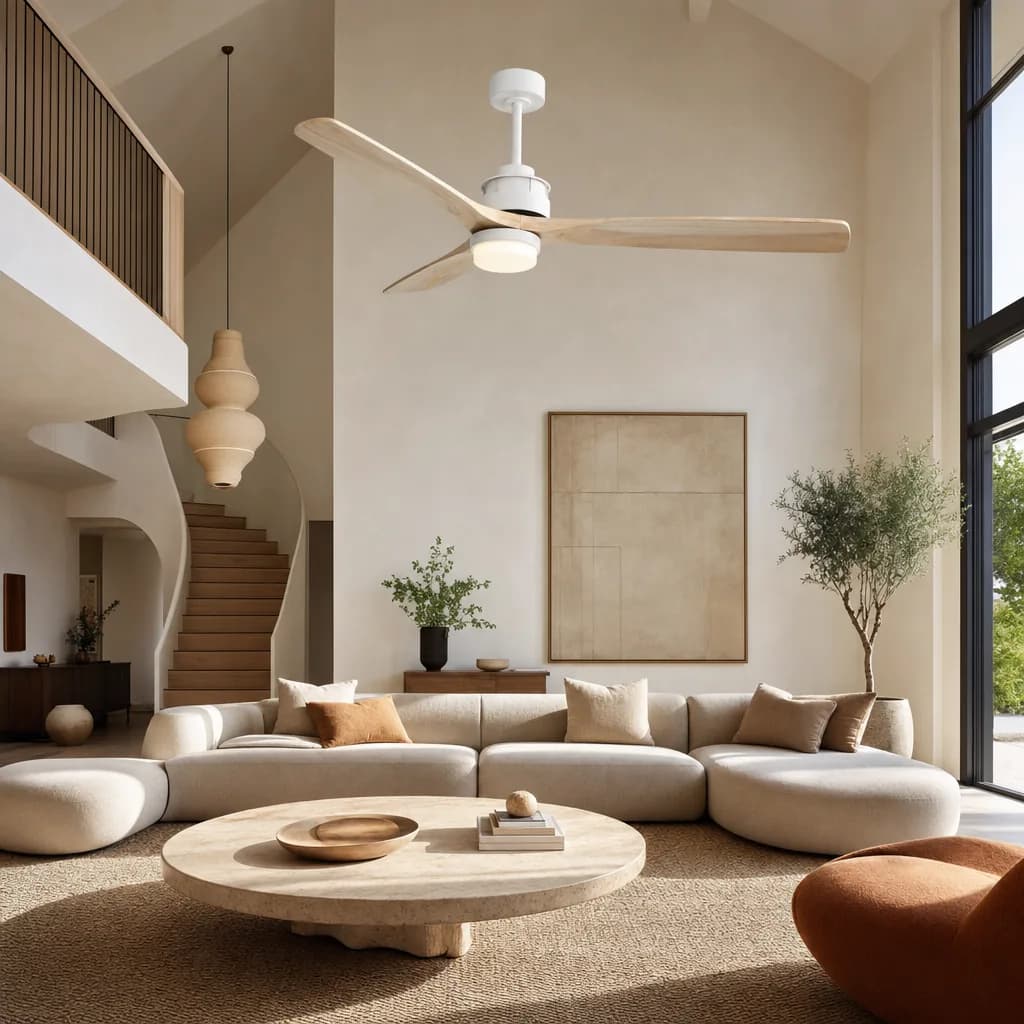
Blade span is the most decisive criterion when choosing a ceiling fan, and the most common source of mistakes. An undersized fan runs at full speed constantly: loud, wasteful and disappointing. An oversized fan in a small space creates uncomfortable draughts at the lowest setting.
This guide provides the reference pairings between blade diameter, room surface and ceiling height, along with the most common sizing errors and mounting rules.
The fundamental rule: diameter and room size
A ceiling fan's diameter is the circle described by the blade tips in rotation. It directly determines the volume of air moved per revolution, and therefore the area the fan can cover efficiently at a reasonable speed. Below the optimal size, the motor must spin faster to compensate, increasing noise and consumption.
The standard accepted by reputable manufacturers: diameter in centimetres divided by 3 gives the maximum recommended area in m². A 132 cm fan covers about 44 m² at maximum, but in practice 25 to 30 m² is the optimal range for comfortable circulation without excessive draught.
- ·107 cm (42 in) → 15-20 m², main bedroom, compact living room
- ·122 cm (48 in) → 20-25 m², standard living room, master bedroom
- ·132 cm (52 in) → 25-30 m², large living room, open dining area
- ·152 cm (60 in) → 30-40 m², open-plan space, loft, veranda
Ceiling height: the forgotten dimension
Ceiling height affects sizing as much as floor area. A fan too close to the floor blows directly onto people, uncomfortable and unsafe. Regulations recommend at least 2.1 m between floor and the underside of rotating blades.
Below 2.5 m ceiling height, only a flush-mount model is acceptable: the motor fixes directly to the ceiling bracket with no downrod. Between 2.5 m and 3 m, a 15-20 cm downrod optimises airflow. Above 3 m, a 30-45 cm rod ensures circulated air reaches the living zone effectively.
- ·< 2.5 m: flush mount required
- ·2.5 m - 3.0 m: 15-20 cm downrod
- ·3.0 m - 3.6 m: 30-45 cm downrod
- ·> 3.6 m: 60-90 cm downrod or extension rod
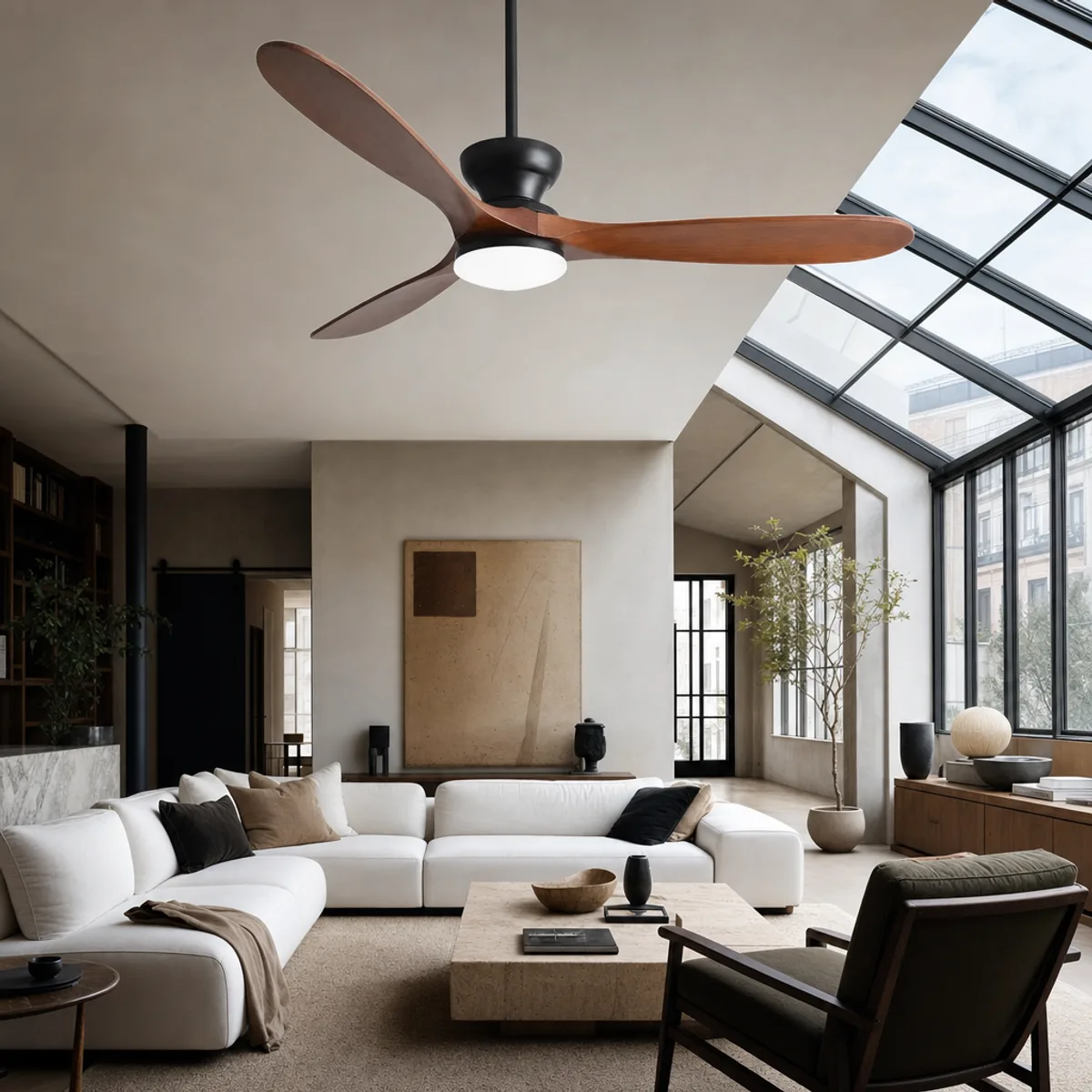
The Panorama 178
Giant Ø 178 cm · Walnut & black · Integrated LED
- ✓Silent DC motor, 6 reversible speeds
- ✓Integrated dimmable LED + remote control
- ✓30-minute installation, illustrated manual
€449€569
Common sizing mistakes
Mistake 1: trusting product photos. Staging photographs use generous spaces or angles that make the fan appear smaller than it is. Measure the room before opening any configurator. Mistake 2: counting only the main area. If the room is L-shaped or opens onto a hallway, the total surface to be circulated may exceed one fan's coverage, two smaller fans are often more effective than one large model.
Mistake 3: forgetting the room centre. For optimal circulation the fan should be centred above the living zone, not above the bed or a desk corner. Mistake 4: choosing by aesthetics alone. A beautiful 107 cm fan in a 45 m² loft will always underperform, regardless of motor quality.
Open-plan and atypical spaces
Open kitchen-living spaces or L-shaped rooms present a geometric-centre problem: the ideal fan position is often not above the most-used zone. In that case, install the fan above the sofa or dining table, where people spend the most time, rather than the absolute room centre.
For very large surfaces above 40 m², two fans in line are preferable to a single XXL model. The recommended spacing is 2 to 3 times the blade diameter between the two fan centres, ensuring even circulation without dead zones.
Choosing the right ceiling fan size means refusing the trade-off between comfort and silence. The reference table is simple: 107 cm up to 20 m², 122 cm up to 25 m², 132 cm up to 30 m², 152 cm up to 40 m². The SEY Maison range runs from 51 cm to 178 cm, with DC motors precisely engineered for each diameter.
Frequently asked questions
Is an oversized ceiling fan a problem?+
Yes. Too large for the space, it creates uncomfortable draughts from speed 1 and its downward airflow is too concentrated. Perceived comfort is worse than with a correctly sized model.
Can two fans be installed in the same room?+
Yes, and it is recommended for rooms above 40 m² or L-shaped spaces. The optimal spacing is 2 to 3 times the blade diameter between the two fan centres.
Does the stated diameter include the blades or just the motor?+
It always refers to the total rotation diameter, the circle described by the blade tips. This measurement determines the coverage area. The motor housing alone is much smaller.
The SEY Maison Circle
Every month, an exceptional piece. Never reissued.
The Drops principle: one high-end furniture piece per month, in a numbered edition. Once it's gone, it never comes back. Circle members are notified 48 h early, access each drop 24 h before everyone else, and receive our guides before publication.
Discover the Drops →